 Indietro
Chapter 5: The Working Cell – Membranes, Energy, and Enzymes (Campbell Biology, 10th Edition)
Guida di studio - Note intelligenti
 Appunti personalizzati basati sui tuoi materiali, ampliati con definizioni chiave, esempi e contesto.
Chapter 5: The Working Cell – Membranes, Energy, and Enzymes
Membrane Structure and Function
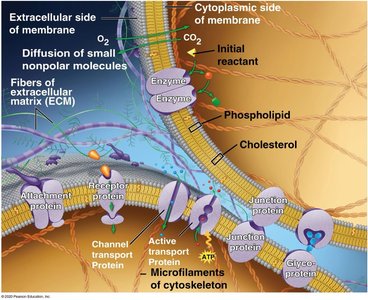
The plasma membrane is a dynamic structure that separates the cell from its environment and regulates the movement of substances in and out of the cell. It is composed primarily of a phospholipid bilayer with embedded proteins, forming a fluid mosaic model that allows for flexibility and diverse functions.
Phospholipid bilayer: Provides the basic structure, with hydrophobic tails facing inward and hydrophilic heads facing outward.
Membrane proteins: Serve as channels, transporters, receptors, enzymes, and anchors.
Selective permeability: The membrane allows some substances (e.g., small nonpolar molecules like O2 and CO2) to diffuse freely, while restricting others.
Transport Proteins
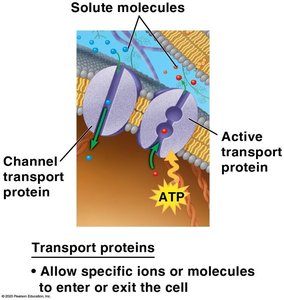
Transport proteins facilitate the movement of specific ions or molecules across the membrane. There are two main types:
Channel proteins: Provide hydrophilic pathways for ions and small molecules to diffuse through the membrane.
Active transport proteins: Use energy (usually from ATP) to move substances against their concentration gradient.
Enzymes and Receptor Proteins
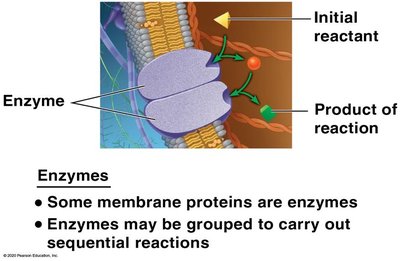
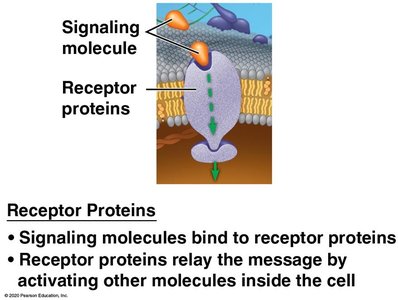
Some membrane proteins act as enzymes, catalyzing sequential reactions, while others serve as receptors for signaling molecules.
Enzymes: Speed up chemical reactions at the membrane surface.
Receptor proteins: Bind signaling molecules and initiate cellular responses by relaying messages inside the cell.
Passive Transport: Diffusion and Osmosis
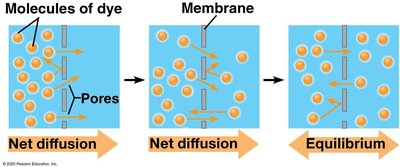
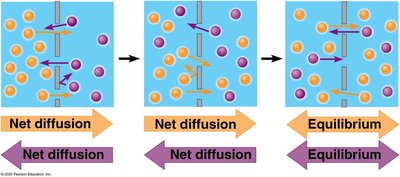
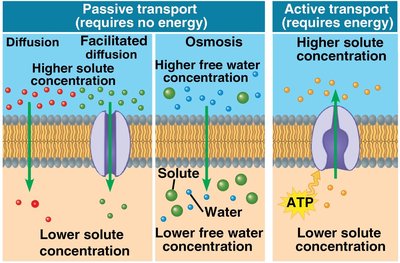
Diffusion is the movement of particles from an area of higher concentration to an area of lower concentration, driven by the concentration gradient. Passive transport does not require energy input from the cell.
Each type of molecule diffuses independently until equilibrium is reached.
Facilitated diffusion: Uses channel or carrier proteins to help polar or charged substances cross the membrane.
Osmosis
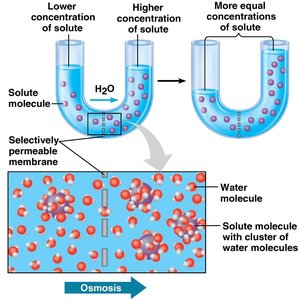
Osmosis is the diffusion of water across a selectively permeable membrane. Water moves from areas of higher free water concentration (lower solute concentration) to areas of lower free water concentration (higher solute concentration).
Solute molecules bind water, reducing the number of free water molecules on that side.
Net water flow is toward the side with higher solute concentration.
Water Balance and Tonicity
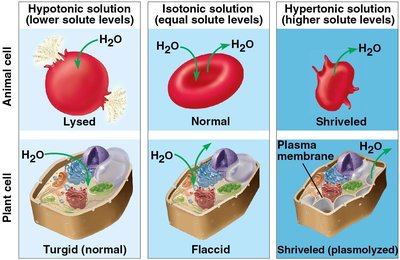
Tonicity describes the ability of a solution to cause a cell to gain or lose water:
Hypotonic solution: Lower solute concentration outside; water enters the cell. Animal cells may lyse, plant cells become turgid.
Isotonic solution: Equal solute concentration; no net water movement. Animal cells are normal, plant cells are flaccid.
Hypertonic solution: Higher solute concentration outside; water leaves the cell. Animal cells shrivel, plant cells undergo plasmolysis.
Bulk Transport: Exocytosis and Endocytosis
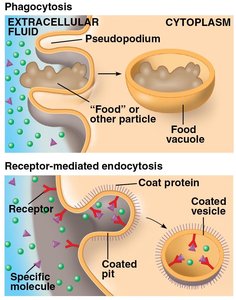
Large molecules or particles are transported across the membrane via vesicles in processes called exocytosis and endocytosis.
Exocytosis: Vesicles fuse with the plasma membrane, releasing contents outside the cell.
Phagocytosis: The cell engulfs large particles or cells, forming a food vacuole.
Receptor-mediated endocytosis: Specific molecules bind to receptors, triggering vesicle formation for selective uptake.
Passive vs. Active Transport
Passive transport moves substances down their concentration gradient without energy input. Active transport requires ATP to move substances against their gradient.
Diffusion, facilitated diffusion, and osmosis are passive processes.
Active transport uses membrane proteins and ATP to move solutes from low to high concentration.
ATP: The Energy Currency of the Cell
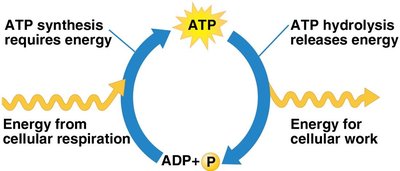
Adenosine triphosphate (ATP) stores and transfers energy within cells. The hydrolysis of ATP releases energy for cellular work.
ATP structure: Adenosine + three phosphate groups; the bonds between phosphates are high-energy and easily broken.
Hydrolysis: ATP + H2O → ADP + Pi + energy
ATP cycle: Energy from cellular respiration regenerates ATP from ADP and Pi.

Enzymes: Biological Catalysts
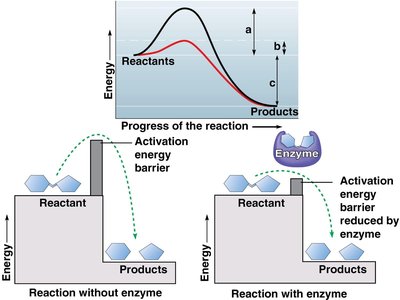
Enzymes are proteins that speed up chemical reactions by lowering the activation energy barrier. They are highly specific for their substrates and emerge unchanged after the reaction.
Activation energy (EA): The energy required to start a reaction.
Enzymes lower EA but do not change the net energy released or absorbed.
Enzyme Structure and Function
Each enzyme has an active site that binds a specific substrate. The induced fit model describes how the enzyme changes shape to better fit the substrate, facilitating the reaction.
Catalytic cycle: (1) Substrate binds to active site; (2) Enzyme-substrate complex forms; (3) Reaction occurs, converting substrate to product; (4) Product is released, and enzyme is free to catalyze another reaction.
Key Terms: Substrate (reactant), active site (enzyme pocket), induced fit (enzyme conformational change).
