 Indietro
DNA Replication, Transcription, and Translation: The Central Dogma of Molecular Biology
Guida di studio - Note intelligenti
 Appunti personalizzati basati sui tuoi materiali, ampliati con definizioni chiave, esempi e contesto.
DNA Replication, Transcription, and Translation
The Central Dogma of Molecular Biology
The central dogma describes the flow of genetic information in cells: DNA is transcribed into RNA, which is then translated into protein. This process is fundamental to all living organisms and underlies gene expression and inheritance.
DNA stores genetic information in its sequence of bases.
Transcription is the process by which DNA is copied into messenger RNA (mRNA).
Translation is the process by which mRNA is decoded to synthesize proteins.
Proteins are the functional molecules responsible for cellular structure and activity.
Key Terms: Codon, Anticodon, Ribosome, tRNA, mRNA, Polypeptide.
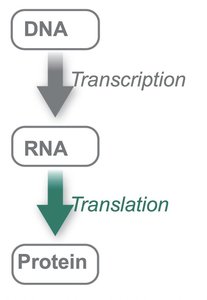
Overview of the Central Dogma
Genetic information flows from DNA to RNA to protein. Each step is catalyzed by specific enzymes and occurs in distinct cellular locations.
Replication: DNA is copied to produce identical DNA molecules.
Transcription: DNA is used as a template to synthesize RNA.
Translation: RNA is used as a template to synthesize proteins.
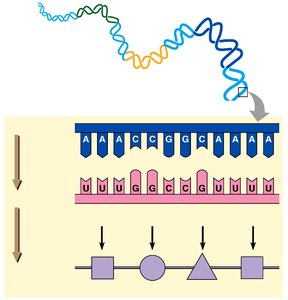
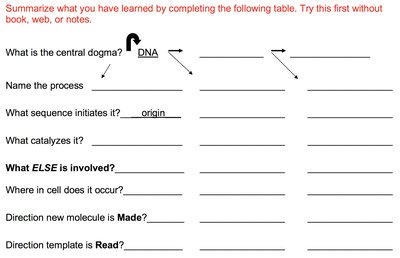
Summary Table: Central Dogma Processes
This table summarizes the key aspects of replication, transcription, and translation.
Process | Initiating Sequence | Catalyst | Cellular Location | Direction New Molecule is Made | Direction Template is Read |
|---|---|---|---|---|---|
Replication | Origin | DNA Polymerase | Nucleus | 5' → 3' | 3' → 5' |
Transcription | Promoter | RNA Polymerase | Nucleus | 5' → 3' | 3' → 5' |
Translation | Start Codon (AUG) | Ribosome | Cytoplasm | N → C (amino to carboxyl) | 5' → 3' (mRNA) |
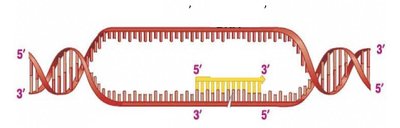
Replication: DNA Synthesis
DNA replication is the process by which a cell copies its DNA before cell division. It ensures genetic continuity between generations.
Initiation: Begins at specific sequences called origins.
Enzyme: DNA polymerase catalyzes the addition of nucleotides.
Directionality: New DNA is synthesized in the 5' to 3' direction; template is read 3' to 5'.
Antiparallel Strands: DNA strands run in opposite directions, affecting how replication occurs.
Transcription: RNA Synthesis
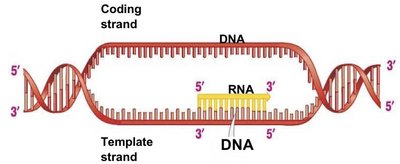
Transcription is the process by which a DNA template is used to synthesize RNA. The coding strand of DNA has the same sequence as the mRNA (except T is replaced by U).
Initiation: Occurs at promoter regions.
Enzyme: RNA polymerase synthesizes RNA.
Directionality: RNA is synthesized 5' to 3'; template DNA is read 3' to 5'.
Types of RNA: mRNA (messenger), tRNA (transfer), rRNA (ribosomal).

Translation: Protein Synthesis
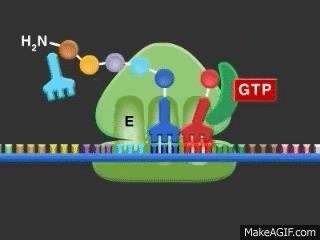
Translation is the process by which the sequence of an mRNA is decoded to produce a polypeptide (protein). This occurs in the cytoplasm at the ribosome.
Initiation: Begins at the start codon (AUG) on mRNA.
Elongation: tRNAs bring amino acids to the ribosome, matching their anticodon to the mRNA codon.
Termination: Occurs when a stop codon is reached (UAA, UAG, UGA).
Directionality: mRNA is read 5' to 3'; polypeptide is synthesized from N-terminus to C-terminus.
Codons and the Genetic Code
The genetic code is composed of triplet codons in mRNA, each specifying an amino acid or a stop signal. The start codon is AUG (methionine).
Codon: Three-nucleotide sequence in mRNA.
Anticodon: Three-nucleotide sequence in tRNA complementary to the codon.
Start Codon: AUG (methionine).
Stop Codons: UAA, UAG, UGA.
Peptide Bond Formation
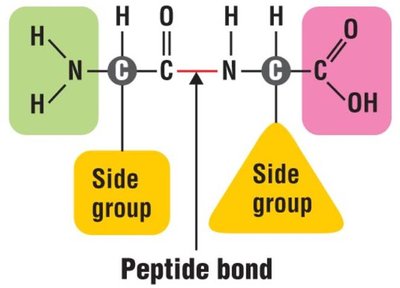
During translation, amino acids are joined by peptide bonds, forming a polypeptide chain. This process is catalyzed by the ribosome.
Peptide Bond: Covalent bond between the amino group of one amino acid and the carboxyl group of another.
Dehydration Synthesis: Water is released during bond formation.
Mutations and Their Effects
Mutations are changes in the DNA sequence. They can be harmless, harmful, or beneficial, and may affect protein function or gene expression.
Point Mutation: Change in a single nucleotide.
Missense Mutation: Changes one amino acid in the protein.
Nonsense Mutation: Introduces a premature stop codon.
Silent Mutation: Does not change the amino acid sequence.
Amino Acid Properties
Amino acids have side chains with distinct properties: acidic, basic, polar, or nonpolar. These properties influence protein structure and function.
Acidic: Negatively charged at physiological pH.
Basic: Positively charged at physiological pH.
Polar: Hydrophilic, can form hydrogen bonds.
Nonpolar: Hydrophobic, often found in protein interiors.
Summary Table: DNA, RNA, and Protein Synthesis
Process | Key Enzyme | Template | Product | Directionality |
|---|---|---|---|---|
Replication | DNA Polymerase | DNA | DNA | 5' → 3' |
Transcription | RNA Polymerase | DNA | RNA | 5' → 3' |
Translation | Ribosome | mRNA | Protein | N → C |
Additional info: The notes cover the molecular basis of inheritance, gene expression, and the regulation of genetic information, which are central to General Biology topics such as DNA replication, transcription, translation, mutations, and protein synthesis.
