 Indietro
Energy, Enzymes, and Metabolism: Study Notes for General Biology
Guida di studio - Note intelligenti
 Appunti personalizzati basati sui tuoi materiali, ampliati con definizioni chiave, esempi e contesto.
Energy, Enzymes, and Metabolism
Metabolism: Definition and Overview
Metabolism encompasses all the chemical reactions occurring within cells or organisms. These reactions include both the synthesis (anabolism) and breakdown (catabolism) of molecules, as well as intermediary processes.
Anabolism: Building larger molecules from smaller ones (e.g., protein synthesis).
Catabolism: Breaking down larger molecules into smaller ones (e.g., cellular respiration).
Energy Intermediates: ATP, NADH, FADH2 are used to transfer energy within metabolic pathways.
Types of Energy in Biological Systems
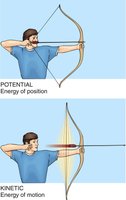
Energy is fundamental to all cellular processes and can be classified into two main types: potential and kinetic energy.
Potential Energy: Stored energy due to position or structure (e.g., energy in chemical bonds, concentration gradients).
Kinetic Energy: Energy of motion or active use (e.g., movement of ions, muscle contraction).
Physical Laws Governing Energy
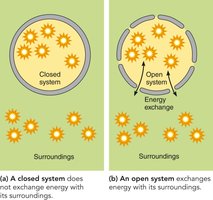
Biological systems obey the laws of physics and chemistry, especially the laws of thermodynamics.
First Law of Thermodynamics: Energy cannot be created or destroyed; it can only be transformed from one form to another.
Second Law of Thermodynamics: Systems tend toward disorder (entropy) unless energy is input. Life on Earth depends on the sun's energy to maintain order.
Exergonic and Endergonic Reactions
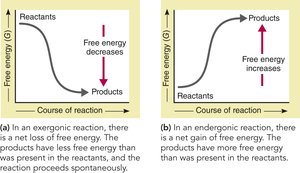
Chemical reactions in cells either release energy (exergonic) or absorb energy (endergonic).
Exergonic Reaction: Releases free energy; ΔG is negative.
Endergonic Reaction: Requires input of energy; ΔG is positive.
ATP: The Energy Currency of Cells
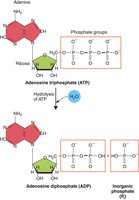
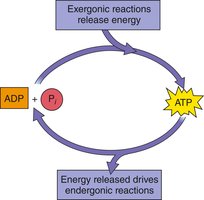
ATP (adenosine triphosphate) is a nucleic acid that stores and transfers energy within cells. Its structure includes a base (adenine), a ribose sugar, and three phosphate groups. The bonds between phosphate groups are high-energy bonds.
Hydrolysis of ATP: Releases energy by breaking the bond between phosphate groups, forming ADP and inorganic phosphate.
ATP Cycle: Energy from exergonic reactions is used to regenerate ATP from ADP.
Redox Reactions in Metabolism
Many energy conversions involve oxidation-reduction (redox) reactions, where electrons (and their energy) are transferred between molecules.
Oxidation: Loss of electrons (often involves removal of hydrogen atoms).
Reduction: Gain of electrons (often involves addition of hydrogen atoms).
Mnemonic: "LEO the lion says GER" (Loss of Electrons is Oxidation; Gain of Electrons is Reduction).
Agents: The oxidizing agent accepts electrons and is reduced; the reducing agent donates electrons and is oxidized.
Enzymes: Biological Catalysts
Enzymes are proteins (or rarely RNA, called ribozymes) that catalyze chemical reactions by lowering the activation energy required. They are highly specific and reusable until denatured.
Activation Energy: The energy needed to start a reaction.
Specificity: Each enzyme catalyzes a specific reaction.
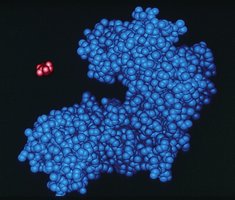
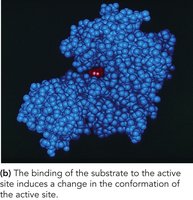
Enzyme Function: Enzymes hold reactants in optimal positions for reactions to occur.
Classes of Enzymes
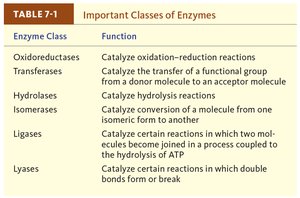
Enzymes are classified based on the type of reaction they catalyze.
Enzyme Class | Function |
|---|---|
Oxidoreductases | Catalyze oxidation-reduction reactions |
Transferases | Catalyze transfer of functional groups |
Hydrolases | Catalyze hydrolysis reactions |
Isomerases | Catalyze conversion between isomers |
Ligases | Catalyze joining of molecules, often coupled to ATP hydrolysis |
Lyases | Catalyze formation or breaking of double bonds |
Factors Affecting Enzyme Activity
Enzyme activity is influenced by physical and chemical factors.
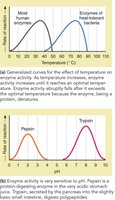
Temperature: Each enzyme has an optimum temperature; activity decreases outside this range.
pH: Each enzyme has an optimum pH; activity decreases outside this range.
Coenzymes: Organic molecules (often vitamins) required for enzyme function.
Cofactors: Inorganic ions (often minerals) required for enzyme function.
Enzyme Concentration and Substrate Limitation
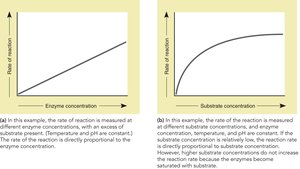
The rate of an enzyme-catalyzed reaction depends on enzyme and substrate concentrations.
Enzyme Limitation: Increasing enzyme concentration increases reaction rate (if substrate is abundant).
Substrate Limitation: At low substrate concentrations, increasing substrate increases reaction rate; at high concentrations, the rate plateaus.
Enzyme Inhibition
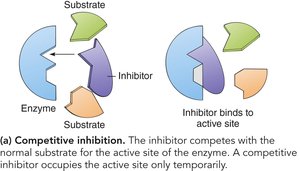
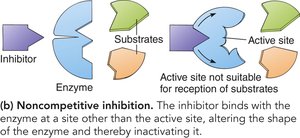
Enzyme activity can be regulated by inhibitors, which slow or stop reactions.
Competitive Inhibitors: Bind to the active site, competing with the substrate.
Noncompetitive Inhibitors: Bind elsewhere on the enzyme, changing its shape and reducing activity.
Metabolic Pathways
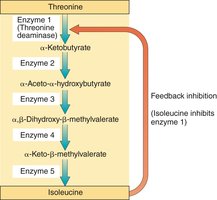
Metabolism is organized into pathways, where a series of enzyme-catalyzed reactions convert substrates into products.
Pathway Regulation: Enzymes control the flow of reactions; regulation can occur via genetic, physical, or biochemical means.
Feedback Inhibition: End products inhibit earlier steps, preventing overproduction.

Summary of Metabolic Regulation
Genetic Control: Expression of enzyme genes determines pathway activity.
Physical Control: Environmental factors (temperature, pH) affect enzyme function.
Biochemical Control: Coenzymes, cofactors, and inhibitors modulate enzyme activity.
Negative Feedback: Excess product shuts down the pathway to maintain balance.
Additional info:
Metabolic pathways are highly complex and interconnected; scientists often specialize in studying specific pathways.
ATP, NADH, and FADH2 are key energy carriers in cellular metabolism.
