 Indietro
Energy, Metabolism, and Cellular Respiration: Foundations of Bioenergetics
Guida di studio - Note intelligenti
 Appunti personalizzati basati sui tuoi materiali, ampliati con definizioni chiave, esempi e contesto.
Energy and Life
Introduction to Energy in Biological Systems
Energy is fundamental to all living organisms, enabling them to maintain homeostasis, grow, and reproduce. In biology, energy is defined as the ability to do work. Organisms require a constant supply of energy to maintain an internal environment distinct from the external surroundings.
Homeostasis: The maintenance of stable internal conditions, requiring energy at all levels of biological organization.
Source of Energy: Ultimately, all energy for life on Earth is derived from the sun, though it must be converted into usable forms by living organisms.
Evolution of Energy Extraction
Early life forms extracted energy anaerobically from simple molecules, while the evolution of photosynthesis introduced oxygen into the atmosphere, enabling more efficient aerobic metabolism.
Anaerobic Metabolism: Occurred in the absence of oxygen, producing minimal ATP.
Aerobic Metabolism: Enabled by the accumulation of oxygen, allowing organisms to generate more ATP and grow larger.


Photosynthesis and Cellular Respiration
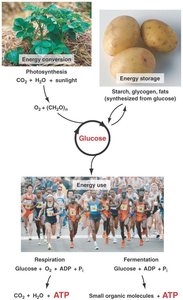
Photosynthesis and cellular respiration are interconnected metabolic processes. Photosynthetic organisms (producers) convert solar energy into glucose, which is then used by themselves and other organisms (consumers and decomposers) for energy through cellular respiration.
Photosynthesis: Converts CO2 and H2O into glucose and O2 using sunlight.
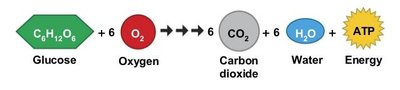
Cellular Respiration: Breaks down glucose with O2 to produce CO2, H2O, and ATP.
Fermentation: An alternative pathway when oxygen is not available, producing less ATP.
Bioenergetics and Metabolic Pathways
Energy Flow and the Laws of Thermodynamics
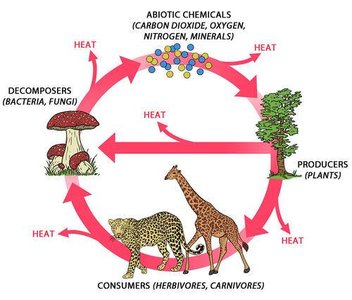
Bioenergetics studies how organisms manage energy resources. Energy flows through ecosystems, with some lost as heat at each transfer. The laws of thermodynamics govern these processes:
First Law: Energy cannot be created or destroyed, only transformed.
Second Law: Every energy transfer increases the entropy (disorder) of the universe; some energy is always lost as heat.
Metabolism: Anabolism and Catabolism
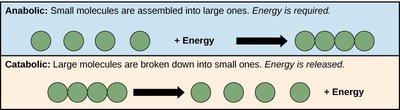
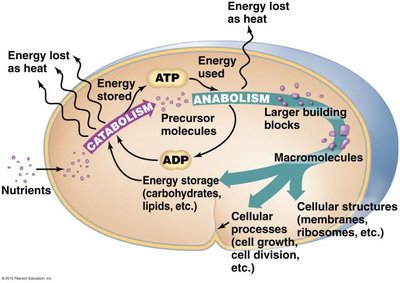
Metabolism encompasses all chemical reactions in a cell, divided into two main types:
Anabolic Pathways: Build complex molecules from simpler ones, requiring energy input.
Catabolic Pathways: Break down complex molecules into simpler ones, releasing energy.
Anabolic | Catabolic |
|---|---|
Small molecules assembled into large ones; energy required | Large molecules broken down into small ones; energy released |
Types of Energy in Biology
Kinetic and Potential Energy
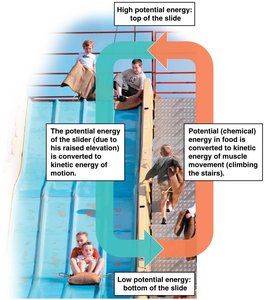
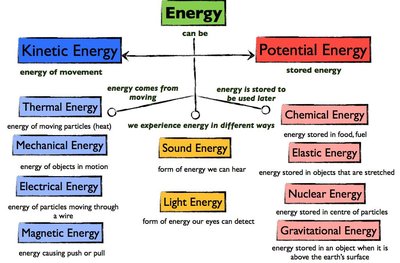
Energy exists in various forms, but in biological systems, kinetic and potential energy are most relevant:
Kinetic Energy: Energy of motion (e.g., movement of molecules, muscle contraction).
Potential Energy: Stored energy due to position or structure (e.g., chemical bonds in glucose).
Energy Conversions and Efficiency
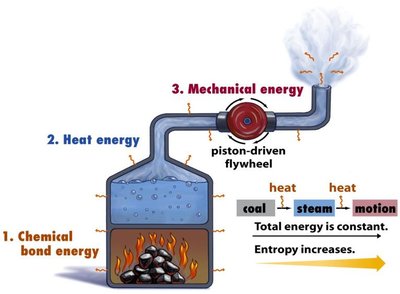
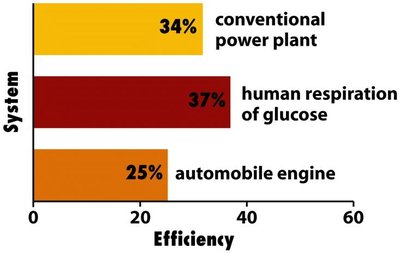
Energy can be converted from one form to another, but these conversions are never 100% efficient due to entropy (heat loss).
Example: Chemical energy in coal is converted to heat, then to mechanical energy in a steam engine, with some energy lost as heat at each step.
Free Energy and Activation Energy
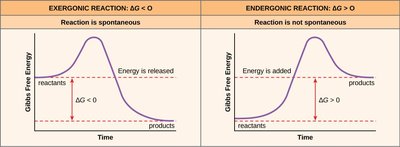
Free energy (Gibbs free energy) is the energy available to do work in a system. In chemical reactions, the change in free energy () determines whether a reaction is spontaneous (exergonic, ) or requires energy input (endergonic, ).
Activation Energy (Ea): The minimum energy required to initiate a chemical reaction.
ATP and Electron Carriers: The Energy Currency of the Cell
ATP: Adenosine Triphosphate
ATP is the primary energy currency in cells, storing energy in its high-energy phosphate bonds. Hydrolysis of ATP releases energy for cellular work, while phosphorylation of ADP regenerates ATP.
Short-term energy storage: ATP, NADH, FADH2, NADPH
Long-term energy storage: Glycogen and fats (triglycerides)


Energetic Coupling and Redox Reactions
Cells couple exergonic (energy-releasing) reactions with endergonic (energy-requiring) reactions to drive essential processes. Redox (reduction-oxidation) reactions involve the transfer of electrons and energy between molecules.
Oxidation: Loss of electrons
Reduction: Gain of electrons
Activated Carriers: Molecules like NADH, FADH2, and NADPH shuttle electrons and energy within cells.
Summary Table: Key Equations
Process | Equation (LaTeX) |
|---|---|
Photosynthesis | |
Cellular Respiration | |
ATP Hydrolysis |
Conclusion
Understanding energy flow, metabolic pathways, and the role of ATP and electron carriers is essential for grasping how life is powered at the cellular level. These concepts form the foundation for further study of cellular respiration, photosynthesis, and metabolism in biology.
