 Indietro
Exam 2 Study Guidance: Evolution, Genomics, and Speciation
Guida di studio - Note intelligenti
 Appunti personalizzati basati sui tuoi materiali, ampliati con definizioni chiave, esempi e contesto.
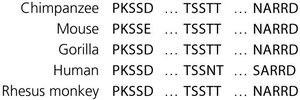
Q1. Compare the amino acid sequences of the FOXP2 protein from five species and answer parts (a)–(d).
Background
Topic: Molecular Evolution and Comparative Genomics
This question tests your understanding of how protein sequences can be compared across species to infer evolutionary relationships and rates of molecular change.
Key Terms and Concepts:
FOXP2 protein: A transcription factor important in speech and language development.
Amino acid sequence: The order of amino acids in a protein, which can vary between species due to mutations.
Evolutionary divergence: The process by which species accumulate differences over time.
Step-by-Step Guidance
Examine the sequences for each species and identify which ones are identical. Look for any differences in the amino acid letters.
For the mouse sequence, compare each amino acid to those in the chimpanzee, gorilla, and rhesus monkey. Mark any differences.
For the human sequence, compare each amino acid to those in the chimpanzee, gorilla, and rhesus monkey. Underline any differences.
Count the number of amino acid differences between mouse and the primates, and between human and the primates. Consider the time since divergence for each comparison.
Think about what the number of differences suggests about the rate of evolution of the FOXP2 gene in each lineage.
Try solving on your own before revealing the answer!
Final Answer:
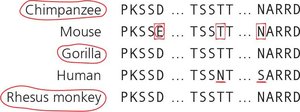
(a) Chimpanzee, gorilla, and rhesus monkey have identical FOXP2 sequences.
(b) Mouse differs from the primates at two positions: E instead of D, and T instead of N.
(c) Human differs from the primates at two positions: N instead of T, and S instead of N.
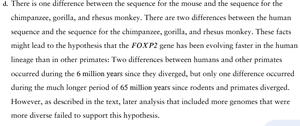
(d) There is one amino acid difference between mouse and the primates, and two between human and the primates. This might suggest a faster rate of evolution in the human lineage, but later studies showed this is not necessarily correct.
The FOXP2 gene has not evolved unusually fast in humans compared to other primates, based on broader genomic comparisons.
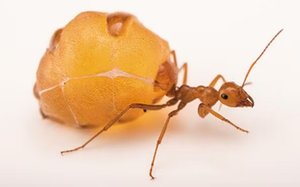
Q2. Synthesize your knowledge: How does the honeypot ant exemplify adaptation, unity, and diversity?
Background
Topic: Evolutionary Biology – Features of Life
This question asks you to connect three fundamental concepts: adaptation (specialized traits), unity (shared characteristics), and diversity (unique features) in the context of a specific organism.
Key Terms:
Adaptation: A trait that increases an organism's fitness in its environment.
Unity: Common features shared among organisms due to shared ancestry.
Diversity: Unique features that arise from evolutionary change.
Step-by-Step Guidance
Describe how the honeypot ant's expandable abdomen is an adaptation for food storage.
Identify features that honeypot ants share with other ants, illustrating unity (e.g., body structure, social behavior).
Explain how the unique abdomen demonstrates diversity among ants.
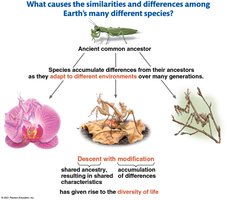
Relate these features to the concept of descent with modification.
Try solving on your own before revealing the answer!
Final Answer:
The honeypot ant's expandable abdomen is an adaptation for storing food. Honeypot ants share many features with other ants, showing unity from common ancestry. Their unique abdomen illustrates diversity, a result of evolutionary modification. Together, these features exemplify adaptation, unity, and diversity in life.
Q3. Calculate genotype and allele frequencies for a population with 85 AA, 320 Aa, and 295 aa individuals.
Background
Topic: Population Genetics – Hardy-Weinberg Principle
This question tests your ability to calculate genotype and allele frequencies in a population, a fundamental skill in population genetics.
Key Terms and Formulas:
Genotype frequency: Proportion of each genotype in the population.
Allele frequency: Proportion of each allele in the population.
Hardy-Weinberg equation:
Allele frequency formula:
Step-by-Step Guidance
Calculate the total number of individuals: .
Find genotype frequencies: for AA, for Aa, for aa.
Calculate the total number of alleles: .
Determine the number of A and a alleles: (AA) + $320 (aa) + $320$ (Aa) for a.
Calculate allele frequencies: , .
Try solving on your own before revealing the answer!
Final Answer:
Genotype frequencies: AA = 0.12, Aa = 0.46, aa = 0.42.
Allele frequencies: A = 0.35, a = 0.65.
These values show the distribution of genotypes and alleles in the population, calculated using the Hardy-Weinberg principle.
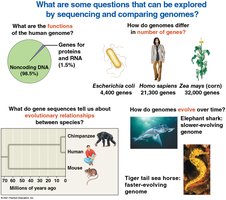
Q4. What are some questions that can be explored by sequencing and comparing genomes?
Background
Topic: Genomics – Comparative and Functional Genomics
This question explores the types of scientific questions that can be addressed using genome sequencing and comparison.
Key Concepts:
Genome sequencing: Determining the complete DNA sequence of an organism's genome.
Comparative genomics: Comparing genomes across species to understand evolutionary relationships and functional differences.
Step-by-Step Guidance
Identify questions about gene function, number of genes, and evolutionary relationships that can be answered by genome sequencing.
Consider how comparing genomes can reveal similarities and differences between species.
Think about how genome data can be used to study adaptation, disease, and development.
Try solving on your own before revealing the answer!
Final Answer:
Sequencing and comparing genomes can answer questions about gene functions, differences in gene numbers, evolutionary relationships, rates of genome evolution, and how genomes contribute to adaptation and diversity.
