 Indietro
Exam 3 Study Guide: Metabolism, Cellular Respiration, and Photosynthesis
Guida di studio - Note intelligenti
 Appunti personalizzati basati sui tuoi materiali, ampliati con definizioni chiave, esempi e contesto.
Metabolism
Introduction to Metabolism
Metabolism encompasses all chemical reactions occurring within a living organism, enabling it to maintain life, grow, and reproduce. These reactions are organized into metabolic pathways, which are either anabolic (building up) or catabolic (breaking down).
Metabolism: The sum of all chemical reactions in a cell.
Anabolic pathways: Consume energy to build complex molecules from simpler ones.
Catabolic pathways: Release energy by breaking down complex molecules into simpler compounds.
Energy: The capacity to do work; exists as kinetic, potential, heat, chemical, and thermal energy.
Laws of Thermodynamics
The laws of thermodynamics govern energy transformations in biological systems.
First Law: Energy cannot be created or destroyed, only transformed.
Second Law: Energy transformations increase entropy (randomness); some energy is lost as heat.
Entropy: A measure of disorder; spontaneous processes increase entropy.
Free Energy and Reaction Types
Free energy (ΔG) determines whether a reaction is spontaneous.
Exergonic reactions: Release free energy; ΔG is negative; spontaneous.
Endergonic reactions: Absorb free energy; ΔG is positive or zero; nonspontaneous.
ATP: The Energy Currency
ATP (adenosine triphosphate) is the principal energy carrier in cells.
Structure: Adenosine (base + ribose) and three phosphate groups.
Function: Releases energy when a phosphate group is removed (hydrolysis).
Coupled reactions: ATP hydrolysis drives endergonic reactions via phosphorylation.
Enzymes and Activation Energy
Enzymes are protein catalysts that speed up metabolic reactions by lowering activation energy barriers.
Enzyme: A protein that catalyzes specific reactions; not consumed in the reaction.
Substrate: The reactant an enzyme acts upon.
Active site: The region of the enzyme where the substrate binds.
Activation energy (EA): The initial energy required to start a reaction.
Environmental factors: Temperature, pH, and salt concentration affect enzyme activity.
Cellular Respiration
Overview and Equation
Cellular respiration is the process by which cells break down glucose to produce ATP, the energy currency of the cell.
Equation:
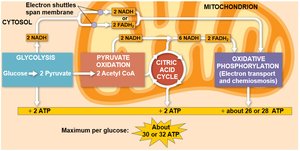
Location: Glycolysis occurs in the cytosol; subsequent steps occur in specific mitochondrial compartments.
Stages of Cellular Respiration
Glycolysis: Glucose (6C) is split into two pyruvate (3C each); produces 2 ATP and 2 NADH; occurs in cytosol; anaerobic.
Pyruvate Oxidation: Pyruvate is converted to acetyl CoA; produces 2 NADH and 2 CO2; occurs in mitochondrial matrix.
Citric Acid Cycle (Krebs Cycle): Acetyl CoA is oxidized; produces 2 ATP, 6 NADH, 2 FADH2, and 4 CO2; occurs in mitochondrial matrix.
Oxidative Phosphorylation: Electron transport chain and chemiosmosis; produces 26–28 ATP; occurs in inner mitochondrial membrane.
Reduction/Oxidation Reactions
Redox reactions: Transfer electrons between molecules; reduction (gain of electrons), oxidation (loss of electrons).
NAD+/NADH and FAD/FADH2: Electron carriers; NADH and FADH2 deliver electrons to the electron transport chain.
ATP Production
Substrate-level phosphorylation: Direct transfer of phosphate to ADP during glycolysis and citric acid cycle.
Oxidative phosphorylation: ATP synthesis powered by electron transport and chemiosmosis.
Fermentation
Fermentation allows ATP production without oxygen, using glycolysis.
Lactic acid fermentation: Pyruvate is converted to lactic acid; net 2 ATP per glucose; occurs in some bacteria and vertebrate muscle cells.
Alcoholic fermentation: Pyruvate is converted to ethanol and CO2; net 2 ATP per glucose; occurs in yeast.
Human benefits: Used in food production (cheese, bread, wine).
Photosynthesis
Overview and Equation
Photosynthesis is the process by which plants convert solar energy into chemical energy, producing glucose and oxygen.
Equation:
Location: Occurs in chloroplasts, specifically in thylakoids and stroma.
Leaf and Chloroplast Structure
The structure of leaves and chloroplasts supports photosynthesis and water conservation.
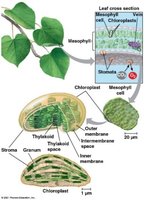
Leaf: Contains mesophyll cells rich in chloroplasts; stomata regulate gas exchange and water loss.
Chloroplast: Contains thylakoid membranes (site of light reactions) and stroma (site of Calvin cycle).
Electromagnetic Spectrum and Pigments
Electromagnetic spectrum: Range of wavelengths of light; visible light is absorbed by plant pigments.
Pigments: Chlorophyll a (primary pigment), chlorophyll b, and accessory pigments absorb specific wavelengths; green is reflected.
Absorption spectrum: Shows which wavelengths are absorbed by pigments.
Stages of Photosynthesis
Light Reactions
Light reactions capture solar energy and convert it to chemical energy (ATP and NADPH).
Location: Thylakoid membranes (grana).
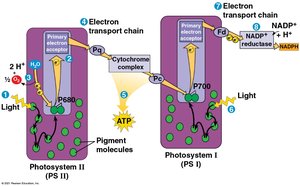
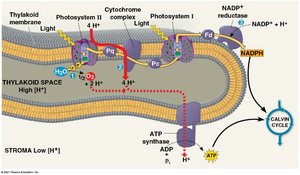
Process: Chlorophyll absorbs light, energizing electrons; electrons move through electron transport chains, producing ATP and NADPH; water is split (photolysis), generating O2.
Photosystems: PS II absorbs light first, followed by PS I; each has a reaction center and pigment molecules.
Electron transport chains: Pump protons to create a gradient; ATP synthase uses this gradient to make ATP (chemiosmosis).
Calvin Cycle (Light Independent Reactions)
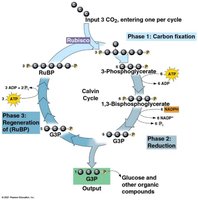
The Calvin cycle uses ATP and NADPH from light reactions to fix carbon dioxide and produce glucose.
Location: Stroma of chloroplast.
Inputs: CO2, ATP, NADPH.
Outputs: Glucose and other carbohydrates.
Phases: Carbon fixation, reduction, regeneration of RuBP.
Direct product: G3P (glyceraldehyde-3-phosphate); glucose is synthesized from G3P.
Summary Table: Cellular Respiration vs. Photosynthesis
Process | Location | Main Inputs | Main Outputs | Energy Conversion |
|---|---|---|---|---|
Cellular Respiration | Cytosol & Mitochondria | Glucose, O2 | CO2, H2O, ATP | Chemical to ATP |
Photosynthesis | Chloroplasts | CO2, H2O, Light | Glucose, O2 | Light to Chemical |
Key Equations
Cellular Respiration:
Photosynthesis:
Additional info:
ATP yield varies due to electron shuttle efficiency and cell type.
Glucose is not always the direct storage form; plants often store starch.
Enzyme function is highly sensitive to environmental conditions.
