 Indietro
Gene Expression: From Gene to Protein (Transcription & Translation)
Guida di studio - Note intelligenti
 Appunti personalizzati basati sui tuoi materiali, ampliati con definizioni chiave, esempi e contesto.
Gene Expression: From Gene to Protein
Central Dogma of Molecular Biology
The central dogma describes the directional flow of genetic information in cells, from DNA to RNA to protein. This process is fundamental to all living organisms and underlies the expression of genetic traits.
DNA serves as the genetic blueprint.
Transcription is the process by which RNA is synthesized from a DNA template.
Translation is the process by which proteins are synthesized from the information encoded in RNA.
Gene expression encompasses both transcription and translation.
Information transfer from nucleic acid to protein is irreversible.
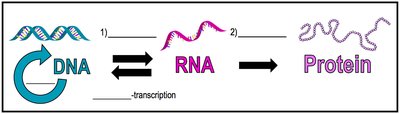
Transcription: From DNA to RNA
Structure of a Gene and Transcription Initiation
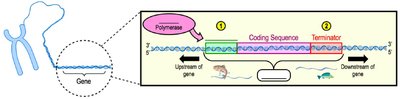
Transcription is the process of synthesizing RNA using DNA as a template. Genes are specific DNA sequences that encode products such as proteins or functional RNAs. Transcription begins and ends at specific DNA sequences.
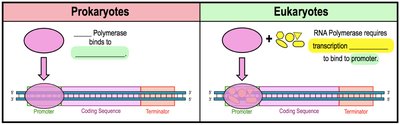
Promoter: DNA sequence where transcription starts; site of RNA polymerase attachment.
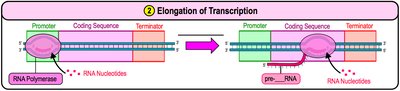
RNA Polymerase: Enzyme that synthesizes RNA from DNA without the need for a primer.
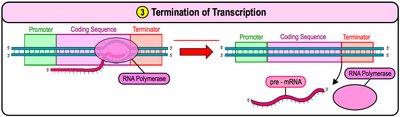
Terminator: DNA sequence where transcription ends.
Upstream: DNA sequences before the start site of transcription.
Downstream: DNA sequences after the start site of transcription.
Transcription Overview: Coding and Template Strands
DNA consists of two strands: the coding strand and the template strand. The RNA transcript has the same sequence as the coding strand (except T is replaced by U), and is synthesized by pairing free RNA nucleotides to the template strand.
Coding Strand: DNA strand with the same sequence as the RNA (except T/U).
Template Strand: DNA strand used as a template for RNA synthesis.
Base Pairing: A-U, T-A, C-G, G-C (Watson & Crick pairing).
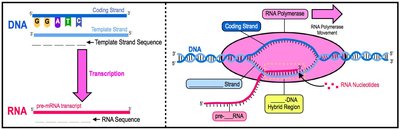
Steps of Transcription
Transcription occurs in three main steps: initiation, elongation, and termination. Each step is essential for accurate RNA synthesis.
Initiation: RNA polymerase binds to the promoter and unwinds DNA.
Elongation: RNA polymerase synthesizes RNA by adding nucleotides in the 5' to 3' direction.
Termination: RNA polymerase releases the completed RNA transcript.
Eukaryotic RNA Processing & Splicing
RNA Processing
In eukaryotes, the initial RNA transcript (pre-mRNA) undergoes modifications to become mature mRNA. These modifications are essential for stability, export, and translation.
5' Cap: Addition of a modified guanine nucleotide to the 5' end.
Poly-A Tail: Addition of a sequence of adenine nucleotides to the 3' end.
Functions: Facilitate export from nucleus, protect from degradation, assist ribosome binding.


RNA Splicing
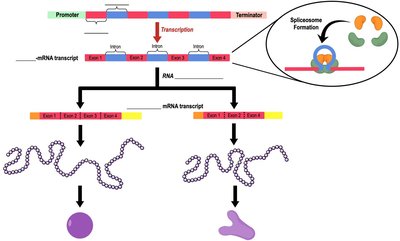
RNA splicing removes noncoding regions (introns) from pre-mRNA and joins coding regions (exons) to produce mature mRNA. The spliceosome is responsible for this process. Alternative splicing allows for multiple protein products from a single gene.
Introns: Noncoding regions removed during splicing.
Exons: Coding regions retained in mature mRNA.
Spliceosome: Complex responsible for intron removal.
Alternative Splicing: Generates diverse proteins from one gene.
Types of RNA
Major Types of RNA
Cells utilize several types of RNA, each with distinct functions in gene expression and protein synthesis.
Messenger RNA (mRNA): Carries genetic information from DNA to ribosomes; contains codons.
Ribosomal RNA (rRNA): Structural and functional component of ribosomes.
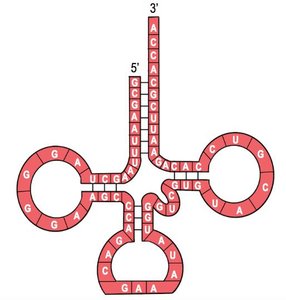
Transfer RNA (tRNA): Brings amino acids to ribosomes; contains anticodons complementary to mRNA codons.
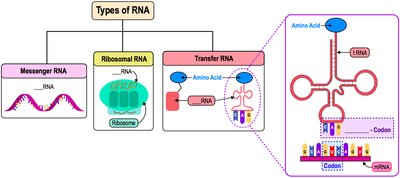
The Genetic Code
Structure and Use of the Genetic Code
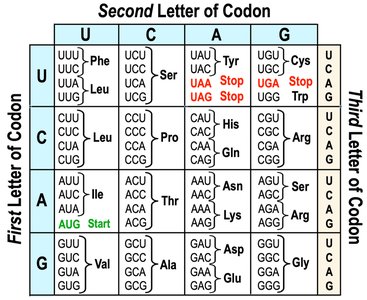
The genetic code is a set of rules by which nucleotide sequences in mRNA are translated into amino acid sequences in proteins. It is nearly universal and redundant, meaning multiple codons can code for the same amino acid.
Codon: Three-nucleotide sequence in mRNA specifying an amino acid.
Start Codon: AUG (Methionine) initiates translation.
Stop Codons: UAA, UAG, UGA signal termination.
Redundancy: More codons than amino acids; protects against mutations.
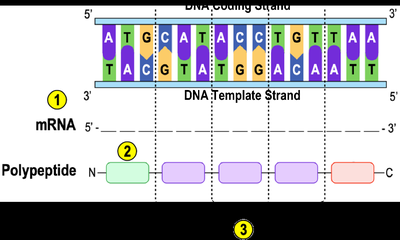
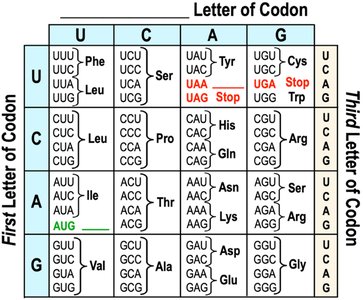
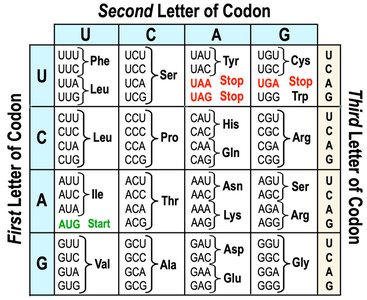
Translation: From RNA to Protein
Translation Process and Components
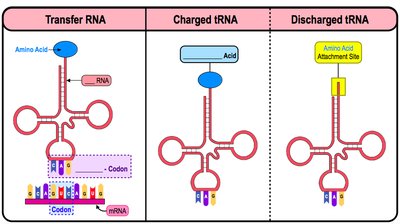
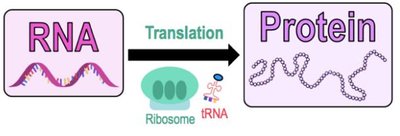
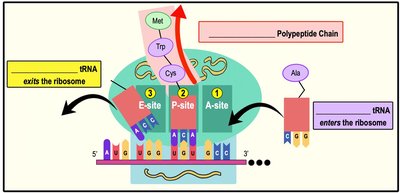
Translation is the process by which ribosomes synthesize proteins using the information in mRNA. tRNA molecules bring amino acids to the ribosome, matching their anticodons to mRNA codons.
Ribosome: Complex of rRNA and proteins; site of protein synthesis.
tRNA: Carries amino acids; charged tRNA has an amino acid attached, discharged tRNA does not.
Anticodon: Three-nucleotide sequence in tRNA complementary to mRNA codon.
Ribosome Structure and tRNA Binding Sites
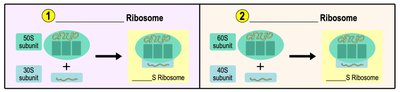
Ribosomes consist of two subunits and have three tRNA binding sites: A (aminoacyl), P (peptidyl), and E (exit). Prokaryotic and eukaryotic ribosomes differ in their subunit sizes.
A-site: Holds tRNA with the next amino acid.
P-site: Holds tRNA with the growing polypeptide chain.
E-site: Releases discharged tRNA.
Prokaryotic ribosome: 70S (50S + 30S).
Eukaryotic ribosome: 80S (60S + 40S).
Steps of Translation
Initiation, Elongation, and Termination
Translation occurs in three steps: initiation, elongation, and termination. Each step is essential for accurate protein synthesis.
Initiation: Small ribosomal subunit binds mRNA and tRNA; large subunit joins; start codon (AUG) specifies Methionine.
Elongation: Amino acids are added to the growing chain; ribosome moves 5' to 3' along mRNA.
Termination: Stop codon is reached; release factors bind; polypeptide is released.
Equations:
Post-Translational Modification
Types and Functions of PTM
After translation, proteins may undergo covalent modifications that regulate their activity, localization, and stability. Common types include methylation, acetylation, ubiquitination, phosphorylation, and glycosylation.
Methylation: Addition of methyl groups.
Acetylation: Addition of acetyl groups.
Ubiquitination: Addition of ubiquitin for protein degradation.
Phosphorylation: Addition of phosphate groups; reversible and regulates activity.
Glycosylation: Addition of carbohydrates.
Transcription vs. Translation: Comparison
Key Differences and Review
Transcription and translation are distinct processes in gene expression. Transcription synthesizes RNA from DNA, while translation synthesizes proteins from RNA. Both are essential for expressing genetic information.
Transcription: Occurs in the nucleus (eukaryotes); produces RNA.
Translation: Occurs in the cytoplasm; produces proteins.
Directionality: RNA and protein synthesis proceed 5' to 3'.
Mutations
Types and Effects of Mutations
Mutations are permanent changes in the DNA sequence. They can affect gene expression and protein function, and may be spontaneous or induced by environmental factors. Mutations contribute to genetic diversity.
Point Mutation: Single nucleotide change.
Frameshift Mutation: Insertion or deletion of nucleotides altering the reading frame.
Missense Mutation: Changes one amino acid.
Nonsense Mutation: Introduces a premature stop codon.
Silent Mutation: No effect on amino acid sequence.
Example: A single base substitution resulting in a redundant codon is least likely to be deleterious.
Additional info: Mutations are a primary source of genetic variation and evolution.
