 Indietro
Biology Unit 2: Cell Transport, Structure, Respiration, and Homeostasis
Guida di studio - Note intelligenti
 Appunti personalizzati basati sui tuoi materiali, ampliati con definizioni chiave, esempi e contesto.
Cell Membrane Transport
Phospholipid Bilayer and Selective Permeability
The cell membrane is a critical structure that separates the internal environment of the cell from the external environment. It is composed primarily of a phospholipid bilayer, which provides selective permeability, allowing only certain substances to cross.
Phospholipid bilayer: Consists of two layers of phospholipids with hydrophilic heads facing outward and hydrophobic tails facing inward.
Selective permeability: Small, nonpolar molecules (e.g., O2, CO2) can cross easily; large polar molecules and ions require transport proteins.
Membrane proteins: Facilitate the movement of specific molecules across the membrane.
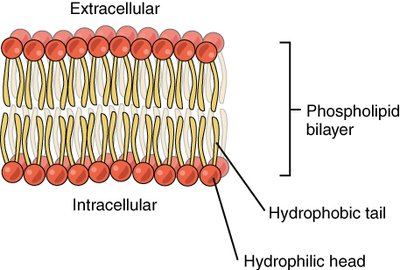
Example: Oxygen and carbon dioxide gases diffuse directly through the lipid bilayer due to their small size and nonpolar nature.
Diffusion and Osmosis
Diffusion and osmosis are passive transport mechanisms that move substances across cell membranes without energy expenditure.
Diffusion: Movement of particles from an area of high concentration to low concentration, down a concentration gradient.
Osmosis: Diffusion of water across a selectively permeable membrane toward the side with higher solute concentration.
Dynamic equilibrium: State where concentrations are equal but particles continue to move randomly.
Facilitated diffusion: Passive movement of large or charged molecules via transport proteins.
Active transport: Movement against a concentration gradient, requiring energy (often ATP).
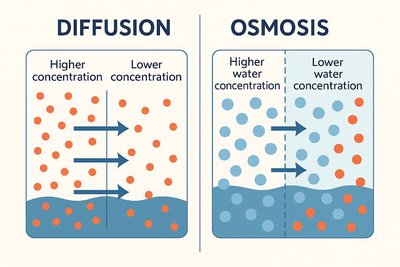
Example: Water entering an animal cell in a hypotonic solution by osmosis, causing the cell to swell.
Types of Solutions and Effects on Cells
Cells respond differently to their environment depending on the solute concentration outside relative to inside.
Hypertonic: Higher solute concentration outside; water moves out, cell shrinks.
Hypotonic: Lower solute concentration outside; water moves in, cell swells and may burst.
Isotonic: Equal solute concentration; no net water movement, cell remains stable.
Solution Type | Solute Concentration | Net Water Movement | Cell Effect |
|---|---|---|---|
Hypertonic | Higher outside | Out of cell | Cell shrinks |
Hypotonic | Lower outside | Into cell | Cell swells/bursts |
Isotonic | Equal | Both ways | Cell stable |
Example: Cells placed in a hypotonic solution will swell and may lyse.
Cell Walls and Membranes
Cell walls provide structural support in plants, fungi, and many prokaryotes. Animal cells lack cell walls but have flexible membranes.
Phospholipid bilayer: Creates a flexible, selectively permeable barrier.
Membrane proteins: Aid in transport and communication.
Cellular Respiration
Overview and Equation
Cellular respiration is the process by which cells convert glucose and oxygen into ATP, the energy currency of the cell.
Equation:
Reactants: Glucose and oxygen
Products: Carbon dioxide, water, ATP
ATP: Transfers usable energy for cell activities
Example: Muscle cells use ATP for contraction during exercise.
Respiratory System and Gas Exchange
Structure and Function
The respiratory system enables gas exchange, supplying oxygen and removing carbon dioxide.
Trachea: Connects mouth/nose to lungs
Lungs: Absorb oxygen
Alveoli: Tiny air sacs for rapid gas exchange
Diaphragm: Muscle controlling airflow
Heart: Circulates respiratory gases
Gas exchange: Oxygen diffuses into blood at alveoli; carbon dioxide diffuses out.
Breathing control: Brainstem senses CO2 and pH, adjusting breathing rate.
Cell Size and Surface Area-to-Volume Ratio
Importance of SA:V Ratio
Cell size affects efficiency of material exchange. Surface area-to-volume ratio (SA:V) decreases as cells grow, limiting transport.
High SA:V: More efficient exchange
Low SA:V: Less efficient; adaptations needed
Higher the surface area to volume ratio the quicker diffusion can occur
Rate of diffusion was about the same
Cube Side Length | Surface Area | Volume | SA:V Ratio |
|---|---|---|---|
1 unit | 6 units2 | 1 unit3 | 6:1 |
2 units | 24 units2 | 8 unit3 | 3:1 |
3 units | 54 units2 | 27 unit3 | 2:1 |
Example: Small cells exchange nutrients and wastes more efficiently than large cells.
Homeostasis and Feedback Loops
Homeostasis
Homeostasis maintains stable internal conditions despite external changes through ONLY negative feedback .
Negative feedback: Reverses a change (e.g., blood glucose regulation)
Positive feedback: Amplifies a change (e.g., oxytocin during childbirth)
Feedback Type | Action | Example |
|---|---|---|
Negative | Reverses change | Blood glucose regulation |
Positive | Amplifies change | Uterine contractions |
Blood Glucose Regulation
Insulin: Lowers blood glucose by promoting uptake and storage
Glucagon: Raises blood glucose by promoting release from storage
Diabetes: Type 1 (no insulin production), Type 2 (cells unresponsive to insulin)
Example: After eating, insulin helps cells absorb glucose; between meals, glucagon releases glucose.
Temperature and Hydration Regulation
Hypothalamus: Regulates temperature
Sweating: Cools body
Shivering: Produces heat
ADH: Conserves water in kidneys
Example: During exercise, sweating and increased skin blood flow help release heat.
Connecting Concepts: Ultra-Marathons
During prolonged exercise, cellular respiration increases, requiring more oxygen and producing more carbon dioxide and heat. The respiratory and circulatory systems deliver oxygen and remove wastes, while homeostasis maintains temperature, hydration, and glucose levels.
Quick Self-Test and Checklist
Explain diffusion, dynamic equilibrium, and osmosis
Identify hypertonic, hypotonic, and isotonic solutions
Compare passive, facilitated, and active transport
Describe phospholipid bilayer and selective permeability
Compare prokaryotic and eukaryotic cells
Write cellular respiration equation and explain ATP, ETC, oxygen, fermentation
Show directions of gas movement in lungs and tissues
Explain cell size and SA:V ratio
Explain lead toxicity
Explain feedback loops, glucose regulation, temperature, and hydration
