 Indietro
Genetic Technology and Genome Editing: Study Guide
Guida di studio - Note intelligenti
 Appunti personalizzati basati sui tuoi materiali, ampliati con definizioni chiave, esempi e contesto.
Genetic Technology
Recombinant DNA and Gene Cloning
Recombinant DNA technology enables scientists to manipulate genetic material for research, medical, and agricultural purposes. The process involves combining DNA from different sources to create new genetic combinations.
Recombinant DNA: DNA molecules formed by laboratory methods to bring together genetic material from multiple sources.
Vector: A DNA molecule used to transport foreign genetic material into another cell.
Plasmid: Small, circular DNA molecules found in bacteria, often used as vectors.
Restriction Enzyme: Enzymes that cut DNA at specific sequences called restriction sites, often palindromic.
Sticky Ends: Overhanging sequences created by restriction enzymes that facilitate the joining of DNA fragments.
Selectable Markers: Genes (e.g., antibiotic resistance) used to identify cells that have taken up recombinant DNA.
Origin of Replication: Sequence required for plasmid replication in host cells.
Example: Cloning a gene into a plasmid using restriction enzymes and ligase, then selecting transformed bacteria using antibiotic resistance.
Polymerase Chain Reaction (PCR)
PCR is a technique used to amplify specific DNA sequences, making millions of copies from a small initial sample.
DNA Polymerase: Enzyme that synthesizes new DNA strands.
Oligonucleotide Primer: Short DNA sequences that initiate DNA synthesis.
dNTPs: Deoxynucleotide triphosphates, the building blocks for DNA synthesis.
Steps of PCR:
Denaturation: DNA is heated to separate strands.
Annealing: Primers bind to target sequences.
Extension: DNA polymerase synthesizes new DNA.
Equation:
where n is the number of cycles.
Gel Electrophoresis
Gel electrophoresis separates DNA fragments by size using an electric field. Smaller fragments move faster through the gel matrix.
Application: Used to analyze PCR products, restriction digests, and DNA sequencing results.
Genetically Modified Organisms (GMOs) and Transgenic Organisms
GMOs are organisms whose genetic material has been altered using genetic engineering techniques. Transgenic organisms contain genes from other species.
Gene Knockout: Disabling a gene to study its function.
Transformation: Introduction of foreign DNA into a cell.
Agrobacterium-Mediated Plant Transformation
Agrobacterium tumefaciens is used to transfer genes into plants via T-DNA. Binary vectors are used to carry the gene of interest.
Ti Plasmid: Tumor-inducing plasmid used in plant genetic engineering.
Promoter: Sequence that initiates transcription; e.g., Cauliflower Mosaic Virus 35S promoter for constitutive expression.
CRISPR/Cas9 Genome Editing
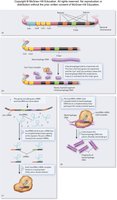
CRISPR/Cas9 is a revolutionary genome editing tool derived from bacterial defense systems. It allows precise modification of DNA sequences.
Guide RNA: Directs Cas9 to the target DNA sequence.
Donor DNA: Used for homology-directed repair to introduce new sequences.
Spacers: DNA segments in CRISPR arrays that correspond to viral sequences, providing immunity.
Example: Creating a gene knockout by designing guide RNA to target a specific gene, allowing Cas9 to introduce double-strand breaks.
Genomics, Proteomics, and DNA Sequencing
Genomics studies the entire genome, while proteomics focuses on the complete set of proteins. DNA sequencing determines the order of nucleotides in DNA.
NCBI BLAST: Tool for identifying homologs of genes and proteins.
Genetic Approaches and Methods
Classical Genetics
Classical genetics studies heredity based on observable traits, tracing back to Mendel's experiments.
Gene Co-Expression Networks (GCN)
GCNs identify genes with similar expression patterns, revealing functional relationships and regulatory mechanisms.
Comparative Genomics
Comparative genomics analyzes similarities and differences in genome structure and function across species.
Ecological Genetics
Ecological genetics examines genetic variation in natural populations, linking genome sequences to fitness-related phenotypes.
Evolutionary Genetics
Evolutionary genetics explores how genetic variation drives evolutionary change, including adaptation and speciation.
Forward and Reverse Genetics
Forward Genetics: Identifies genes responsible for phenotypes by screening mutants.
Reverse Genetics: Determines gene function by altering gene sequences and observing phenotypic effects.
Genome-Wide Association Studies (GWAS)
GWAS identify genetic variants (SNPs) associated with traits or diseases by scanning the genome.
Population Genetics
Population genetics studies genetic composition and changes in populations, including selection, drift, mutation, and gene flow.
Quantitative Genetics
Quantitative genetics uses statistical methods to analyze traits that vary continuously, such as height or mass.
Phenomics and Phenotype
Phenomics: Assays phenotypic variation on a genome-wide scale.
Phenotype: Observable characteristics resulting from genotype-environment interaction.
Transcriptomics and RNA-Seq
Transcriptomics studies the transcriptome using high-throughput methods like RNA-Seq, identifying differentially expressed genes.
Two-Hybrid Screening
Two-hybrid screening detects protein–protein and protein–DNA interactions, revealing molecular networks.
Practice Questions and Applications
Designing Plasmid Maps and Primers
Plasmid Map: Includes origin of replication, selectable marker, and cloning site.
Primer Design: Primers must be complementary to target sequences and labeled with 5' and 3' ends.
CRISPR/Cas System in Bacteria
Spacers: Provide immunity by storing viral DNA sequences; each spacer is unique to a specific virus.
Example: Using CRISPR/Cas9 to create a knockout in Arabidopsis for pest resistance.
Key Terms Table
Term | Definition |
|---|---|
Recombinant DNA | DNA formed by combining genetic material from different sources |
Vector | DNA molecule used to deliver genetic material |
Plasmid | Circular DNA in bacteria, used as a vector |
Restriction Enzyme | Enzyme that cuts DNA at specific sites |
Selectable Marker | Gene used to identify transformed cells |
Gel Electrophoresis | Technique to separate DNA fragments by size |
PCR | Technique to amplify DNA |
GMO | Organism with altered genetic material |
CRISPR/Cas9 | Genome editing tool |
Guide RNA | RNA that directs Cas9 to target DNA |
Donor DNA | DNA used for repair in genome editing |
Additional info: Academic context was added to expand brief points and clarify technical terms for exam preparation.
