 Indietro
Macromolecules of Biological Importance: Carbohydrates, Lipids, Proteins, and Nucleic Acids
Guida di studio - Note intelligenti
 Appunti personalizzati basati sui tuoi materiali, ampliati con definizioni chiave, esempi e contesto.
Macromolecules of Biological Importance
Introduction to Biological Macromolecules
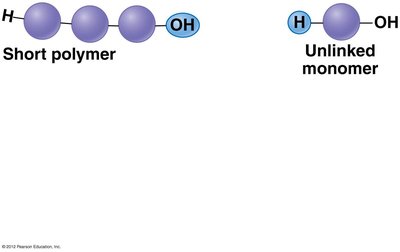
Biological macromolecules are large, complex molecules essential for life. They include carbohydrates, lipids, proteins, and nucleic acids. These macromolecules are polymers, built from smaller units called monomers, through specific chemical reactions.
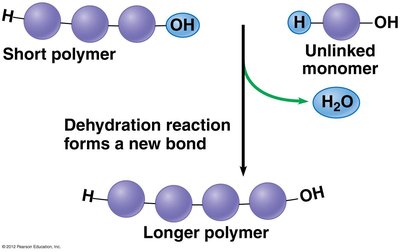
Polymer: A long molecule consisting of many similar or identical building blocks (monomers) linked by covalent bonds.
Monomer: The repeating unit that serves as the building block of a polymer.
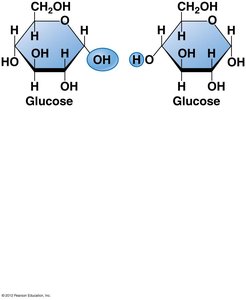
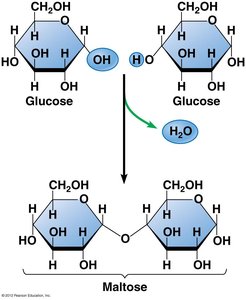
Dehydration Reaction: A chemical reaction in which two molecules are covalently bonded to each other with the removal of a water molecule.
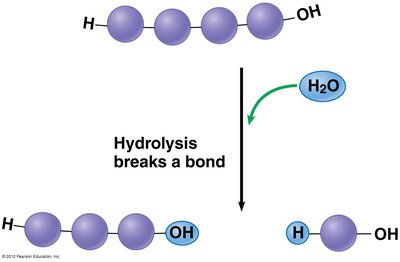
Hydrolysis: A process that breaks the bonds between monomers by adding water, essentially the reverse of a dehydration reaction.
Carbohydrates
Monosaccharides: Simple Sugars
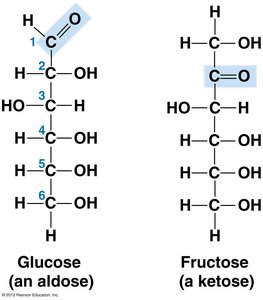
Monosaccharides are the simplest carbohydrates, serving as the monomers for more complex carbohydrates. They are classified by the number of carbons and the location of their carbonyl group.
Triose: 3-carbon sugar (e.g., glyceraldehyde)
Pentose: 5-carbon sugar (e.g., ribose)
Hexose: 6-carbon sugar (e.g., glucose, fructose)
Aldose: Sugar with an aldehyde group (e.g., glucose)
Ketose: Sugar with a ketone group (e.g., fructose)
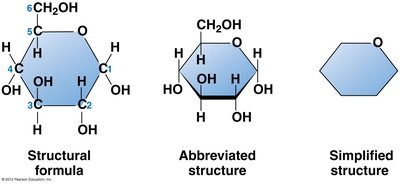
Disaccharides: Double Sugars
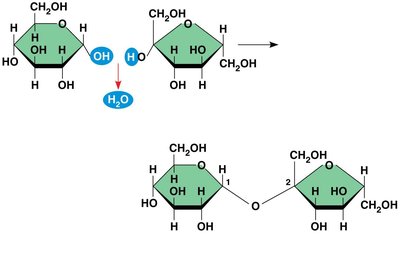
Disaccharides are formed when two monosaccharides are joined by a glycosidic linkage, a covalent bond formed by a dehydration reaction. Common examples include sucrose, lactose, and maltose.
Glycosidic Linkage: A covalent bond formed between two monosaccharides by a dehydration reaction.
Maltose: Formed from two glucose molecules.
Polysaccharides: Complex Carbohydrates
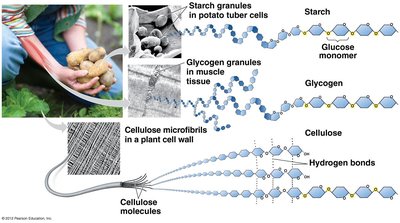
Polysaccharides are large polymers of monosaccharides. They serve as storage or structural molecules in cells.
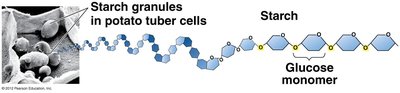
Starch: Storage polysaccharide in plants, composed of glucose monomers.
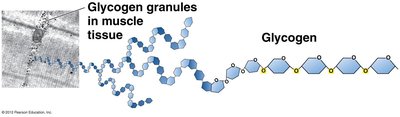
Glycogen: Storage polysaccharide in animals, highly branched and composed of glucose.
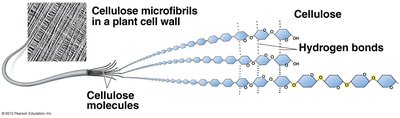
Cellulose: Structural polysaccharide in plant cell walls, composed of β-glucose monomers.
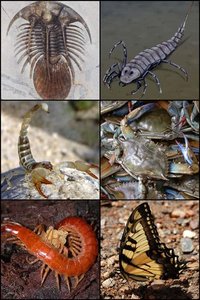
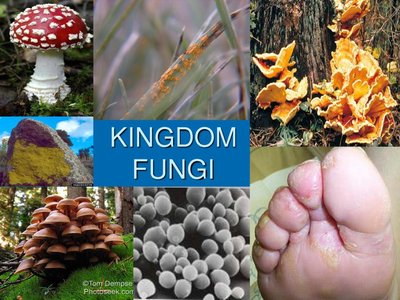
Chitin: Structural polysaccharide found in the exoskeleton of arthropods and cell walls of fungi.

Lipids
Fats (Triglycerides)
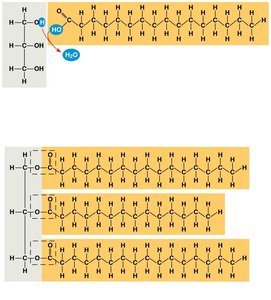
Lipids are hydrophobic molecules, including fats, phospholipids, and steroids. Fats are constructed from glycerol and fatty acids through dehydration reactions, forming ester linkages.
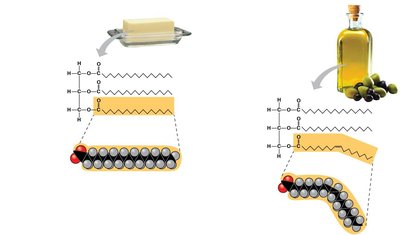
Saturated Fatty Acids: No double bonds between carbon atoms; solid at room temperature (e.g., butter).
Unsaturated Fatty Acids: One or more double bonds; liquid at room temperature (e.g., olive oil).
Phospholipids
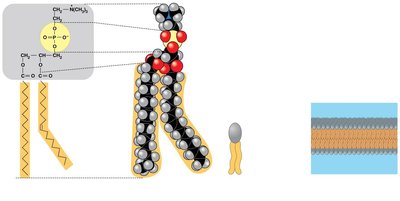
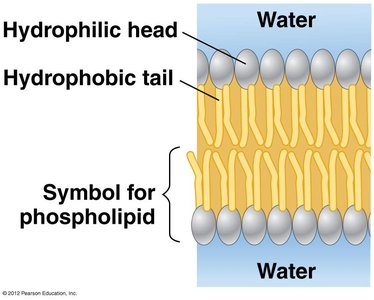
Phospholipids are major components of cell membranes. They have hydrophilic heads and hydrophobic tails, forming bilayers in aqueous environments.
Structure: Glycerol backbone, two fatty acids, and a phosphate group.
Function: Form the structural basis of biological membranes.
Steroids
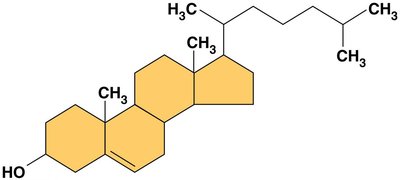
Steroids are lipids characterized by a carbon skeleton consisting of four fused rings. Cholesterol is a crucial steroid in animal cell membranes and a precursor for other steroids, including hormones.
Cholesterol: Maintains membrane fluidity and serves as a precursor for steroid hormones.
Proteins
Amino Acids and Peptide Bonds
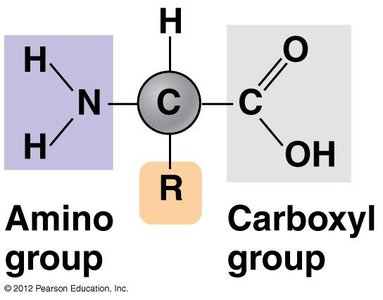
Proteins are polymers of amino acids, linked by peptide bonds. Each amino acid contains an amino group, a carboxyl group, a hydrogen atom, and a variable R group attached to a central carbon.
Peptide Bond: Covalent bond formed between the amino group of one amino acid and the carboxyl group of another via a dehydration reaction.

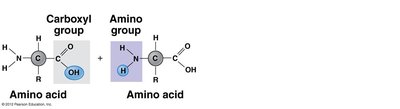
Levels of Protein Structure
Protein structure is organized into four levels:
Primary Structure: Linear sequence of amino acids.
Secondary Structure: Local folding into α-helices and β-pleated sheets, stabilized by hydrogen bonds.
Tertiary Structure: Overall 3D shape of a polypeptide, determined by interactions among R groups.
Quaternary Structure: Association of multiple polypeptide chains.
Protein Functions
Proteins perform a vast array of functions in cells, including catalysis, defense, storage, transport, communication, movement, and structural support.
Type | Function | Example |
|---|---|---|
Enzymatic | Selective acceleration of chemical reactions | Digestive enzymes |
Defensive | Protection against disease | Antibodies |
Storage | Storage of amino acids | Casein, ovalbumin |
Transport | Transport of substances | Hemoglobin |
Hormonal | Coordination of activities | Insulin |
Receptor | Response to chemical stimuli | Receptors in nerve cells |
Contractile & Motor | Movement | Actin, myosin |
Structural | Support | Collagen, keratin |
Nucleic Acids
Structure and Function
Nucleic acids, including DNA and RNA, store and transmit hereditary information. They are polymers of nucleotides, each consisting of a phosphate group, a pentose sugar, and a nitrogenous base.
DNA (Deoxyribonucleic Acid): Stores genetic information; double helix structure.
RNA (Ribonucleic Acid): Involved in protein synthesis; usually single-stranded.
Nucleotide: Monomer of nucleic acids, composed of a nitrogenous base, a pentose sugar, and a phosphate group.
Nucleotide Structure
Pyrimidines: Cytosine (C), Thymine (T, in DNA), Uracil (U, in RNA)
Purines: Adenine (A), Guanine (G)
DNA and Evolution
The linear sequence of nucleotides in DNA is inherited from parents to offspring. Molecular biology uses DNA comparisons to assess evolutionary relationships among species.
Example: Closely related species have more similar DNA sequences than distantly related species.
