 Indietro
Membrane Transport and Osmosis: Structure and Function in Cells
Guida di studio - Note intelligenti
 Appunti personalizzati basati sui tuoi materiali, ampliati con definizioni chiave, esempi e contesto.
Membrane Structure and Function
Types of Membrane Transport Proteins
Membrane transport proteins are essential for moving substances across the cell membrane. They facilitate the transport of polar and charged molecules that cannot diffuse freely through the lipid bilayer.
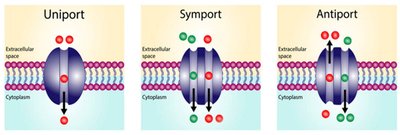
Uniporter: Transports a single type of molecule down its concentration gradient via facilitated diffusion. Example: GLUT1 protein transports glucose.
Symporter: Moves two different molecules in the same direction; one molecule moves down its gradient, while the other is transported against its gradient (co-transport).
Antiporter: Transports two molecules in opposite directions; one moves down its gradient, the other against its gradient. Can be involved in primary active transport or co-transport.
Facilitated Diffusion
Facilitated diffusion is the passive movement of molecules across the membrane with the help of transport proteins. It is essential for polar and charged molecules, such as glucose and ions, which cannot pass through the hydrophobic lipid bilayer unaided.
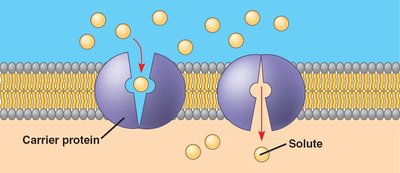
Carrier Proteins: Bind to the solute and change shape to transport it across the membrane.
Channel Proteins: Form pores that allow specific molecules or ions to pass through.
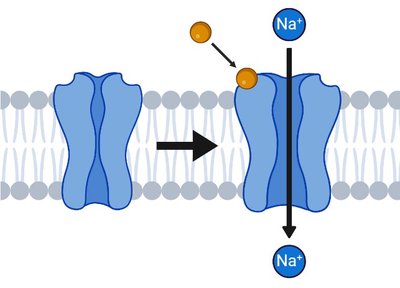
Gated Ion Channels: Open or close in response to specific stimuli (ligand binding or voltage changes).
Gated Ion Channels and Membrane Potentials
Gated ion channels regulate the flow of ions across the membrane, contributing to the cell's electrochemical gradient and membrane potential. These channels can be:
Ligand-gated: Open in response to the binding of a specific molecule (ligand).
Voltage-gated: Open or close in response to changes in membrane potential.
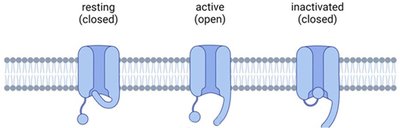
The movement of cations (positively charged ions) creates a charge imbalance, resulting in membrane potential. The channel can exist in three states: resting (closed), active (open), and inactivated (closed).
Membrane Transport Mechanisms
Active Transport
Active transport is the movement of molecules across the membrane against their concentration gradient, requiring energy (usually ATP). It is essential for maintaining cellular homeostasis.
Primary Active Transport: Direct use of ATP to transport molecules.
Secondary Active Transport (Co-transport): Uses the energy from one molecule moving down its gradient to drive another molecule against its gradient.
Transmembrane Proteins: All proteins involved in active transport span the membrane and are called transporters.
Endocytosis
Endocytosis is the process by which cells take in molecules and particulate matter by forming new vesicles from the plasma membrane. There are three main types:
Phagocytosis: Cell engulfs large particles or cells.
Pinocytosis: Cell takes in extracellular fluid and dissolved solutes.
Receptor-mediated Endocytosis: Specific molecules are taken in after binding to receptors.
Osmosis and Tonicity
Osmosis
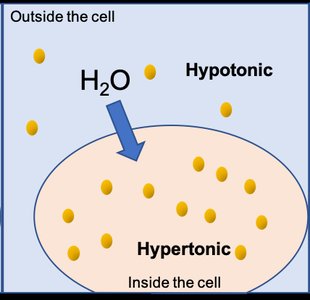
Osmosis is the diffusion of water across a selectively permeable membrane, often through protein channels called aquaporins. Water moves from areas of higher concentration to lower concentration of solute.
Hypertonic Solution: Higher solute concentration outside the cell; water moves out, causing animal cells to shrink and plant cells to become plasmolyzed.
Isotonic Solution: Equal solute concentration inside and outside; water moves equally in both directions. Animal cells prefer isotonic environments.
Hypotonic Solution: Lower solute concentration outside; water moves in, causing animal cells to lyse and plant cells to become turgid (preferred by plants).
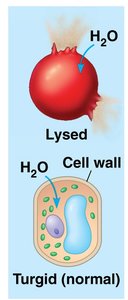
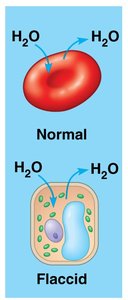
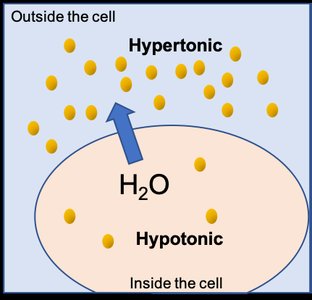
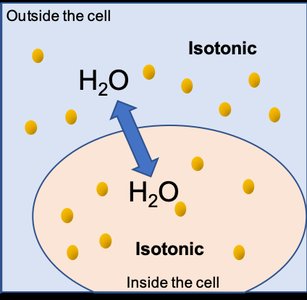
Summary Table: Tonicity Effects on Cells
Solution Type | Animal Cell | Plant Cell |
|---|---|---|
Hypertonic | Shriveled | Plasmolyzed |
Isotonic | Normal | Flaccid |
Hypotonic | Lysed | Turgid (normal) |
Key Terms and Concepts
Facilitated Diffusion: Passive transport aided by proteins.
Active Transport: Movement against gradient, requires energy.
Electrochemical Gradient: Combined effect of concentration and charge differences across membrane.
Osmosis: Diffusion of water across membrane.
Tonicity: Relative concentration of solutes in solution compared to cell.
Relevant Equations
Osmotic pressure can be calculated using:
\Pi: Osmotic pressure
i: van 't Hoff factor (number of particles)
M: Molarity
R: Gas constant
T: Temperature (Kelvin)
Additional Info
Membrane transport is crucial for nutrient uptake, waste removal, and maintaining cellular homeostasis.
Plants prefer hypotonic environments to maintain turgor pressure, while animals prefer isotonic environments to prevent cell lysis or shrinkage.
