 Indietro
Mendelian Genetics and Genetic Variation: Study Notes for General Biology
Guida di studio - Note intelligenti
 Appunti personalizzati basati sui tuoi materiali, ampliati con definizioni chiave, esempi e contesto.
Meiosis and Genetic Variation
Meiosis: Process and Significance
Meiosis is a specialized type of cell division that reduces the chromosome number by half, producing four haploid cells from one diploid cell. This process is essential for sexual reproduction and ensures genetic diversity among offspring.
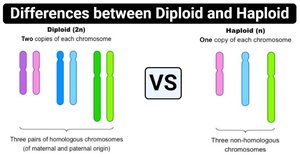
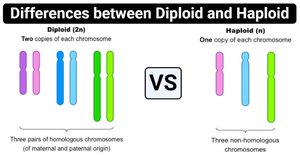
Diploid (2n) cells contain two sets of chromosomes, one from each parent.
Haploid (n) cells contain a single set of chromosomes and are produced by meiosis.
Meiosis consists of two consecutive divisions: Meiosis I and Meiosis II.
Each daughter cell has half as many chromosomes as the parent cell.
Mechanisms Contributing to Genetic Variation
Genetic variation is crucial for evolution and adaptation. Three main mechanisms contribute to this variation during sexual reproduction:
Independent assortment of chromosomes: Chromosomes are randomly distributed to gametes.
Crossing over: Homologous chromosomes exchange genetic material during meiosis.
Random fertilization: Any sperm can fertilize any egg, increasing genetic diversity.
Mendelian Genetics
Genes, Alleles, and Chromosomes
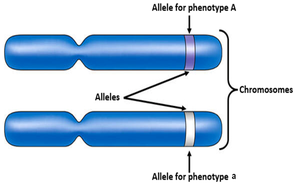
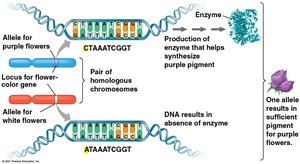
A gene is the basic unit of heredity, located at a specific locus on a chromosome.
An allele is a variant form of a gene.
Each gene resides at a specific locus (plural: loci) on a chromosome.
Genotype and Phenotype
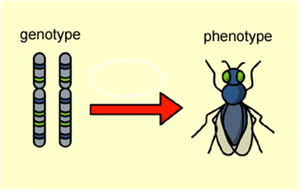
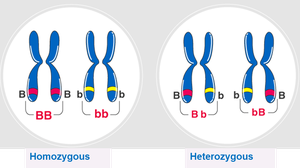
Genotype: The genetic makeup of an organism (e.g., BB, Bb, bb).
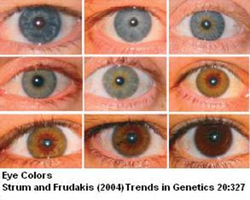
Phenotype: The observable physical traits of an organism.
Homozygous: Two identical alleles for a gene (e.g., BB or bb).
Heterozygous: Two different alleles for a gene (e.g., Bb).
Dominant and Recessive Alleles
Dominant allele: Expressed in the phenotype if present; masks the effect of the recessive allele.
Recessive allele: Expressed only when both alleles are recessive.
Mendel’s Experiments and Laws
Mendel’s Experimental Approach
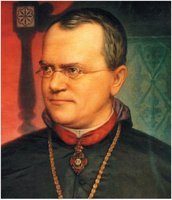
Gregor Mendel used pea plants to study inheritance patterns, identifying fundamental laws of genetics.
Character: A heritable feature (e.g., flower color).
Trait: Variant of a character (e.g., purple or white flowers).
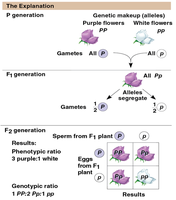
P generation: True-breeding parents.
F1 generation: Hybrid offspring of P generation.
F2 generation: Offspring of F1 individuals.
Mendel’s Law of Segregation
The two alleles for a heritable character separate during gamete formation and end up in different gametes.
Each gamete receives only one allele for each gene.
The Testcross
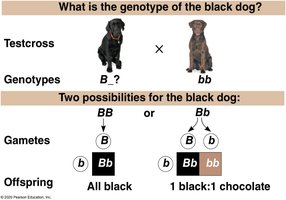
A testcross is used to determine the genotype of an individual with a dominant phenotype by crossing it with a homozygous recessive individual.
If any offspring display the recessive phenotype, the parent must be heterozygous.
Mendel’s Law of Independent Assortment
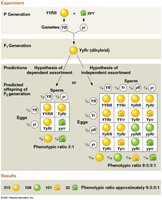
Each pair of alleles segregates independently during gamete formation.
This law applies to genes on different chromosomes or far apart on the same chromosome.
Extensions of Mendelian Genetics
Degrees of Dominance
Complete dominance: One allele completely masks the other.
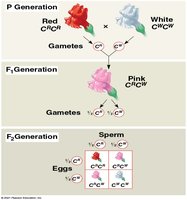
Incomplete dominance: The phenotype is intermediate between the two parental phenotypes.
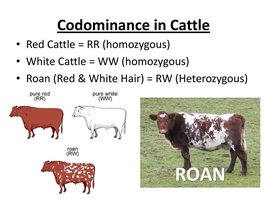
Codominance: Both alleles are fully expressed in the phenotype.
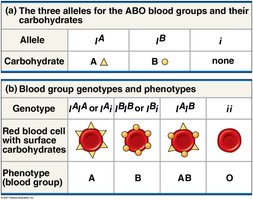
Multiple Alleles
Some genes have more than two alleles, such as the ABO blood group system in humans.
Three alleles: IA, IB, and i.
Four blood group phenotypes: A, B, AB, and O.
Allele | Carbohydrate |
|---|---|
IA | A |
IB | B |
i | none |
Genotype | Phenotype (Blood Group) |
|---|---|
IAIA or IAi | A |
IBIB or IBi | B |
IAIB | AB |
ii | O |
Pleiotropy
Pleiotropy: One gene influences multiple phenotypic traits.
Example: Sickle-cell disease affects multiple systems in the body.
Epistasis
Epistasis: One gene affects the expression of another gene.
Example: Labrador retriever coat color depends on two genes.
Polygenic Inheritance
Polygenic inheritance: Multiple genes independently affect a single trait.
Example: Human skin color is controlled by several genes.
Pedigree Analysis
Pedigrees in Human Genetics
A pedigree is a family tree that tracks the inheritance of traits across generations.
Pedigrees help predict the probability of traits appearing in future generations.
Summary of Mendelian Laws
Law of Segregation: The two alleles for a character separate during gamete formation.
Law of Independent Assortment: Each pair of alleles segregates independently during gamete formation.
Inheritance patterns may deviate from simple Mendelian rules when alleles are not completely dominant or recessive, when a gene has more than two alleles, or when a gene produces multiple phenotypes.
Key Equations
Punnett Square Ratios
Phenotypic ratio for monohybrid cross: 3:1
Genotypic ratio for monohybrid cross: 1:2:1
Probability of Genotype
For a monohybrid cross:
Chromosome Number
Diploid:
Haploid:
Blood Group Genotypes
Possible genotypes: , , , , ,
Additional info:
Polygenic traits often show continuous variation, such as height or skin color.
Environmental factors can influence phenotype, even for traits with a strong genetic basis.
