 Indietro
Lecture 16 (unit 2) Mitosis and Meiosis: Cell Division and Genetic Variation
Guida di studio - Note intelligenti
 Appunti personalizzati basati sui tuoi materiali, ampliati con definizioni chiave, esempi e contesto.
Mitosis and Meiosis: Cell Division and Genetic Variation
Introduction to Genetics
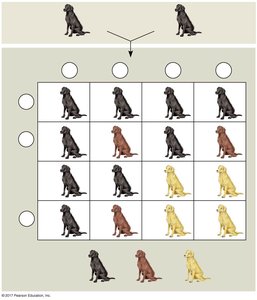
Genetics is the scientific study of heredity and variation. Heredity refers to the transmission of traits from one generation to the next, while variation is the difference in appearance or traits among offspring, parents, and siblings.
Genes: Hereditary units made of DNA, transmitted from parent to progeny.
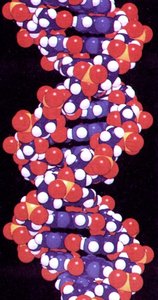
Chromosomes: DNA is packaged into chromosomes, each a long double-stranded DNA molecule.
Variation: Arises from genetic recombination and mutation.
Applications: Genetics is used in medicine, agriculture, environmental science, and forensics.
Gene Expression: Genes are expressed as RNA and proteins, regulated by cellular mechanisms.
Chromosome Structure and Organization
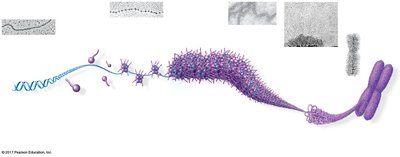
Chromosomes are composed of DNA and proteins, mainly histones, forming chromatin. Chromatin condenses to form visible chromosomes during cell division.
Chromatid: One of two identical halves of a replicated chromosome.
Centromere: The constricted region of a chromosome, important for segregation during cell division.
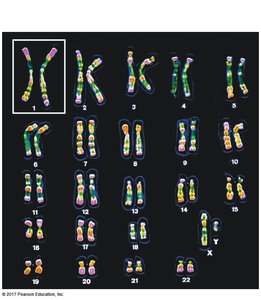
Karyotype: The complete set of chromosomes in a cell, arranged by pairs.
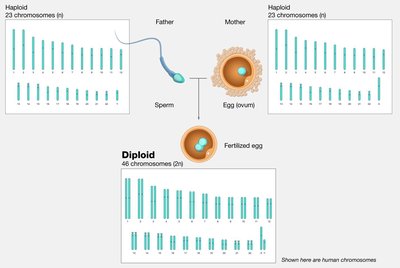
Human Chromosome Number: 46 chromosomes (22 pairs of autosomes, 1 pair of sex chromosomes).
The Cell Cycle
Phases of the Cell Cycle
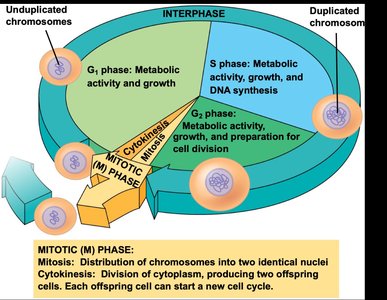
The cell cycle is the life of a cell from its formation to its division into two progeny cells. It consists of interphase and the mitotic (M) phase.
Interphase: Includes G1 (growth), S (DNA synthesis), and G2 (preparation for division).
M Phase: Includes mitosis (nuclear division) and cytokinesis (cytoplasmic division).
DNA Replication: Occurs during S phase.
Regulation of the Cell Cycle
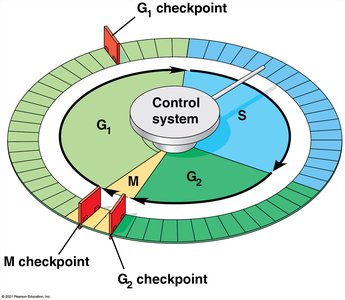
The cell cycle is regulated by checkpoints that ensure proper division and DNA integrity.
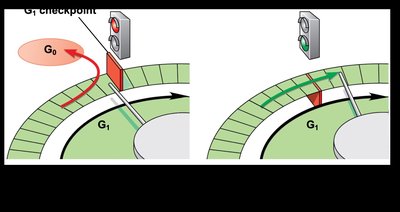
G1 Checkpoint: Determines if the cell will proceed to division or enter G0 (quiescent state).
G2 Checkpoint: Ensures DNA replication is complete and the cell is ready for mitosis.
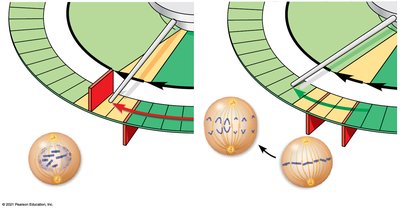
M Checkpoint: Ensures all chromosomes are properly attached to spindle fibers before anaphase.
Mitosis: Asexual Cell Division
Stages of Mitosis
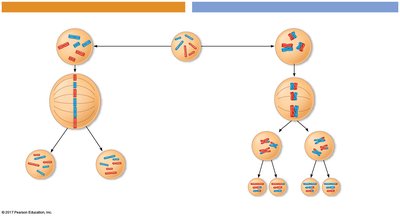
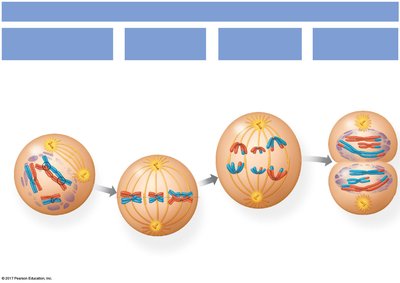
Mitosis is the process by which a parent cell divides to produce two genetically identical daughter cells. It is conventionally broken down into four major stages:
Prophase: Chromosomes condense, spindle forms.
Metaphase: Chromosomes align at the metaphase plate.
Anaphase: Chromatids separate and move to opposite poles.
Telophase: Chromosomes decondense, nuclear envelope reforms.
Cytokinesis: Division of cytoplasm, forming two cells.
Example: Skin cells divide by mitosis to replace lost or damaged cells.
Meiosis: Sexual Cell Division and Genetic Diversity
Overview of Meiosis
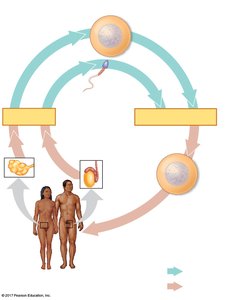
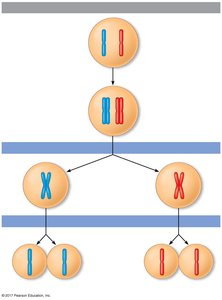
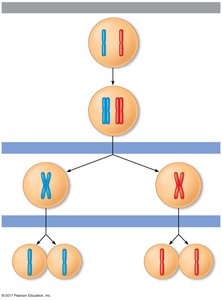
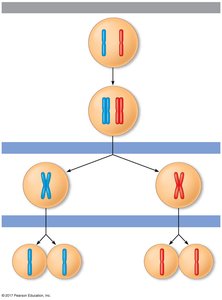
Meiosis is a special type of cell division that reduces the chromosome number by half, producing four genetically distinct haploid gametes. It is essential for sexual reproduction and genetic diversity.
Diploid (2n): Cells with two sets of chromosomes (e.g., somatic cells).
Haploid (n): Cells with one set of chromosomes (e.g., gametes).
Meiosis I: Separates homologous chromosomes.
Meiosis II: Separates sister chromatids.
Fertilization: Fusion of two gametes restores diploid chromosome number.
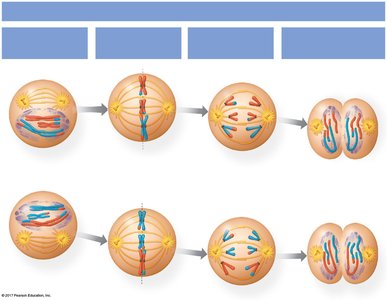

Comparison of Mitosis and Meiosis
Mitosis and meiosis are both forms of cell division, but they differ in their outcomes and mechanisms.
Mitosis: Produces two genetically identical diploid cells.
Meiosis: Produces four genetically distinct haploid cells.
Genetic Diversity: Meiosis introduces variation through independent assortment and crossing over.
Key Mechanisms of Genetic Variation in Meiosis
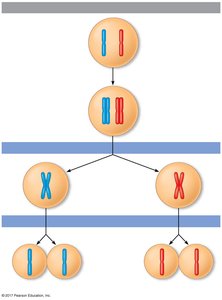
Law of Segregation
The maternal and paternal copies of each chromosome separate during meiosis and end up in different gametes at random.
Random Distribution: Each gamete receives one copy of each chromosome.
Probability: The chance of inheriting a maternal or paternal chromosome is 50%.

Law of Independent Assortment
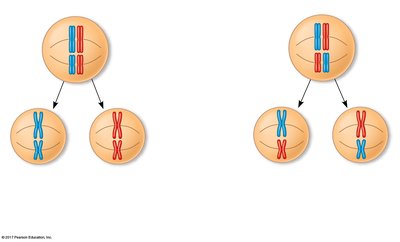
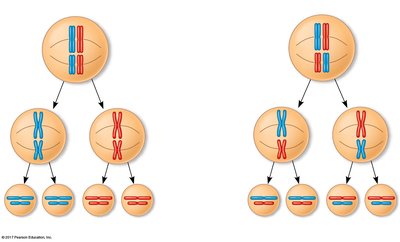
Each pair of homologous chromosomes segregates independently of all other pairs during meiosis, resulting in a variety of possible combinations in gametes.
Independent Assortment: The selection of one chromosome does not affect the selection of others.
Formula: The number of possible gamete combinations is , where n is the haploid number.
Example: For humans (n = 23), possible combinations.

Crossing Over
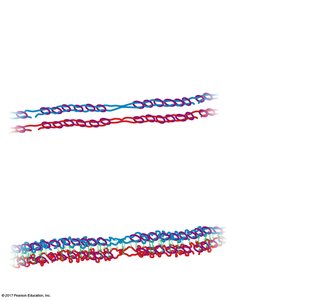
During prophase I of meiosis, homologous chromosomes pair up and exchange genetic material, resulting in recombinant chromosomes and increased genetic diversity.
Synaptonemal Complex: Protein structure that holds homologous chromosomes together.
Chiasmata: Visible points where crossing over occurs.
Recombinant Chromosomes: Chromosomes with mixed maternal and paternal DNA.
Random Fertilization
Any sperm can fuse with any egg, further increasing genetic variation. The combination of independent assortment, crossing over, and random fertilization results in unique genetic identities for each individual.
Example: Fusion of two gametes (each with 8.4 million possible combinations) produces a zygote with about 70 trillion possible diploid combinations.
Summary Table: Comparison of Mitosis and Meiosis
Feature | Mitosis | Meiosis |
|---|---|---|
Number of Divisions | 1 | 2 |
Number of Daughter Cells | 2 | 4 |
Chromosome Number | Diploid (2n) | Haploid (n) |
Genetic Identity | Identical | Distinct |
Function | Growth, repair, asexual reproduction | Sexual reproduction, genetic diversity |
Conclusion
Mitosis and meiosis are fundamental processes in biology, ensuring the continuity of life and the generation of genetic diversity. Mitosis produces genetically identical cells for growth and repair, while meiosis produces genetically distinct gametes for sexual reproduction. The mechanisms of segregation, independent assortment, crossing over, and random fertilization collectively drive genetic variation, which is essential for evolution and adaptation.
