 Indietro
Mitosis, Meiosis, and Chromosomal Disorders Study Guidance
Guida di studio - Note intelligenti
 Appunti personalizzati basati sui tuoi materiali, ampliati con definizioni chiave, esempi e contesto.
Q31. Mitosis Diagram and DNA Distribution
Background
Topic: Cell Division – Mitosis and Meiosis
This question tests your understanding of the stages of mitosis, the process by which genetically identical cells are produced, and how DNA is distributed during both mitosis and meiosis.
Key Terms and Concepts
Mitosis: A type of cell division that results in two genetically identical daughter cells from a single parent cell.
Stages of Mitosis: Prophase, Metaphase, Anaphase, Telophase.
Meiosis: A type of cell division that reduces the chromosome number by half, producing four genetically unique gametes.
DNA Replication: The process by which DNA is copied before cell division.
Step-by-Step Guidance
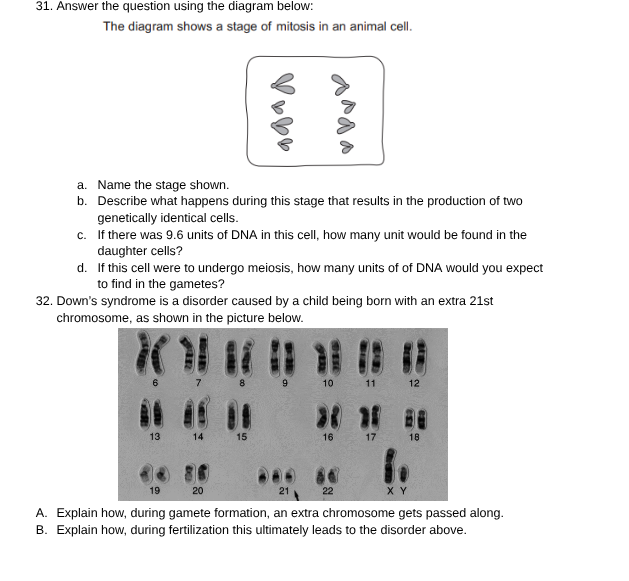
Examine the diagram and identify the stage of mitosis shown. Look for the arrangement and separation of chromosomes to help determine the stage.
Describe the key events that occur during this stage, focusing on how the chromosomes are separated and how this ensures that each daughter cell receives an identical set of genetic material.
Consider the amount of DNA present in the parent cell (9.6 units). Think about how mitosis distributes DNA to the daughter cells and what this means for the DNA content in each new cell.
For meiosis, recall that the process results in gametes with half the DNA content of the original cell. Set up the calculation to determine the DNA content in each gamete.
Try solving on your own before revealing the answer!
Final Answers:
a. The stage shown is Anaphase.
b. During anaphase, the sister chromatids are pulled apart toward opposite poles of the cell. This ensures that each daughter cell will receive an identical set of chromosomes, resulting in two genetically identical cells after cytokinesis.
c. Each daughter cell would have 9.6 units of DNA (the same as the original cell, since mitosis produces identical cells).
d. If the cell underwent meiosis, each gamete would have 4.8 units of DNA (half the original amount, because meiosis reduces the chromosome number by half).
These answers reflect the fundamental differences between mitosis (producing identical cells) and meiosis (producing gametes with half the DNA content).
Q32. Down's Syndrome and Chromosome Number
Background
Topic: Chromosomal Disorders – Nondisjunction and Down's Syndrome
This question tests your understanding of how errors during meiosis can lead to chromosomal disorders such as Down's syndrome, which is caused by an extra copy of chromosome 21 (trisomy 21).
Key Terms and Concepts
Nondisjunction: The failure of homologous chromosomes or sister chromatids to separate properly during meiosis.
Gamete: A reproductive cell (sperm or egg) with half the usual number of chromosomes.
Fertilization: The fusion of two gametes to form a zygote.
Trisomy: The presence of an extra chromosome (three instead of two) in a pair.
Step-by-Step Guidance
Recall what happens during meiosis when chromosomes fail to separate properly (nondisjunction). Think about how this affects the chromosome number in the resulting gametes.
Consider what happens when a gamete with an extra chromosome (e.g., two copies of chromosome 21) fuses with a normal gamete during fertilization.
Set up your explanation for how the zygote ends up with three copies of chromosome 21, leading to Down's syndrome.
Try solving on your own before revealing the answer!
Final Answers:
A. During gamete formation, nondisjunction can occur, causing homologous chromosomes (or sister chromatids) to fail to separate. This results in a gamete with an extra chromosome (24 instead of 23).
B. When this gamete fuses with a normal gamete during fertilization, the resulting zygote has three copies of chromosome 21 (trisomy 21), which causes Down's syndrome.
This process explains how chromosomal nondisjunction during meiosis can lead to genetic disorders in offspring.
