 Indietro
Patterns of Inheritance: Mendelian and Non-Mendelian Genetics
Guida di studio - Note intelligenti
 Appunti personalizzati basati sui tuoi materiali, ampliati con definizioni chiave, esempi e contesto.
Patterns of Inheritance
Key Genetic Terms
Understanding inheritance requires familiarity with several fundamental genetic terms:
Alleles: Variants of a gene found at the same locus on homologous chromosomes. Each individual inherits two alleles for each gene, one from each parent.
Dominant Allele: An allele that masks the expression of another allele at the same locus. Its trait is expressed in the phenotype even if only one copy is present.
Recessive Allele: An allele whose trait is only expressed when two copies are present (homozygous).
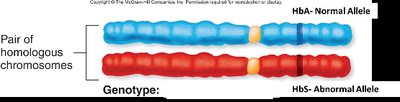
Genotype: The genetic makeup of an organism, represented by the alleles present (e.g., HbA/HbS).
Phenotype: The observable traits or characteristics of an organism resulting from its genotype.
Homozygous: Having two identical alleles for a particular gene (e.g., HbA/HbA or HbS/HbS).
Heterozygote: Having two different alleles for a particular gene (e.g., HbA/HbS).
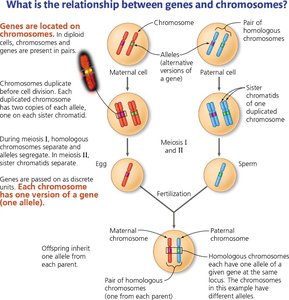
Inheritance and Meiosis
Genes are inherited through the process of meiosis, which produces gametes (egg and sperm) with half the number of chromosomes. During fertilization, these gametes combine to restore the diploid chromosome number, and each parent contributes one allele for each gene.
Homologous chromosomes carry the same genes but may have different alleles.
Meiosis ensures genetic diversity through independent assortment and crossing over.
Each offspring inherits one allele from each parent for every gene.
Mendelian Patterns of Inheritance
Mendel's laws describe how traits are passed from parents to offspring:
Law of Segregation: Each individual has two alleles for each gene, which segregate during gamete formation so that each gamete carries only one allele.
Punnett Squares: Used to predict the probability of offspring genotypes based on parental genotypes.
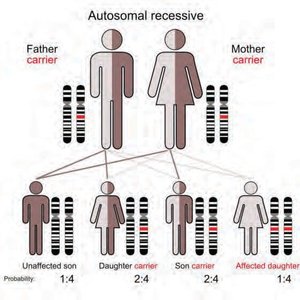
For example, if both parents are heterozygous for sickle cell (HbA/HbS), the possible genotypes for their children are:
HbA/HbA (normal)
HbA/HbS (carrier)
HbS/HbS (affected)
Non-Mendelian Patterns of Inheritance
Not all traits follow simple Mendelian rules. Several other patterns exist:
Incomplete Dominance: The phenotype of heterozygotes is intermediate between the two homozygotes. Example: Red and white snapdragons produce pink offspring.
Codominance: Both alleles are fully expressed in the heterozygote. Example: Sickle cell trait (HbA/HbS) shows both normal and abnormal hemoglobin.
Pleiotropy: One gene affects multiple traits. Example: Sickle cell gene affects red blood cell shape and other symptoms.
Polygenic Inheritance: Multiple genes contribute to a single trait. Example: Skin color, height.
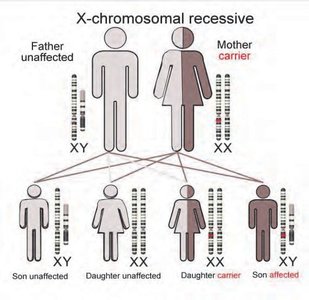
Sex Linkage: Traits associated with genes on sex chromosomes (X or Y). Example: Hemophilia and color blindness are X-linked recessive traits.
Blood Type and Paternity Testing
ABO blood typing is used in paternity cases. Blood type inheritance follows codominance and multiple alleles:
Type A: IAIA or IAi
Type B: IBIB or IBi
Type AB: IAIB
Type O: ii
ABO testing can exclude paternity if the alleged father cannot contribute the necessary allele, but it cannot always confirm paternity due to the presence of common alleles in the population.
Inherited Diseases: Dominant and Recessive Disorders
Several diseases are inherited in dominant or recessive patterns:
Tay Sachs: Autosomal recessive. Caused by two copies of a recessive allele (tt). Leads to lipid accumulation in brain cells.
Cystic Fibrosis: Autosomal recessive. Caused by mutations in the CFTR gene.
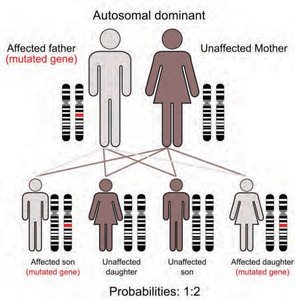
Huntington's Disease: Autosomal dominant. One copy of the dominant allele (H) causes the disease.
Sickle Cell Disease: Autosomal recessive. Two copies of HbS allele cause the disease; heterozygotes (HbA/HbS) are carriers.
Pedigrees and Patterns of Inheritance
A pedigree is a diagram that shows the occurrence of phenotypes in several generations of a family. Symbols:
Circle: Female
Square: Male
Shaded: Affected
Unshaded: Unaffected
Half-shaded: Carrier
Pedigrees help identify inheritance patterns (autosomal dominant, autosomal recessive, X-linked dominant, X-linked recessive).
Distribution of Recessive Diseases
Recessive diseases are not evenly distributed due to factors such as:
Carrier frequency in certain populations
Consanguinity (marriage between relatives)
Genetic drift and founder effects
These factors increase the chance of passing on recessive traits.
Chromosome Theory of Inheritance
The chromosome theory states that genes are located on chromosomes, and inheritance patterns are determined by the behavior of chromosomes during meiosis.
Sex Chromosome Inheritance
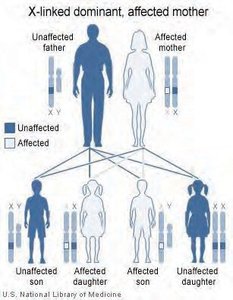
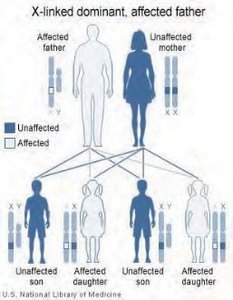
Sex chromosomes (X and Y) determine gender and carry sex-linked genes:
Males (XY) pass their X chromosome to daughters and Y chromosome to sons.
Females (XX) pass one X chromosome to each child.
Summary Table: Modes of Inheritance
Mode | Key Features | Example Disease |
|---|---|---|
Autosomal Dominant | Affects both sexes, does not skip generations | Huntington's Disease |
Autosomal Recessive | Affects both sexes, can skip generations | Tay Sachs, Cystic Fibrosis, Sickle Cell Disease |
X-linked Dominant | Affects both sexes, fathers pass to daughters only | Hypophosphatemic rickets |
X-linked Recessive | More males affected, mothers pass to sons | Hemophilia A |
