 Indietro
Photosynthesis: Structure, Function, and Process in Plants
Guida di studio - Note intelligenti
 Appunti personalizzati basati sui tuoi materiali, ampliati con definizioni chiave, esempi e contesto.
Photosynthesis
How Organisms Obtain Energy
Organisms acquire energy either by producing their own food or by consuming other organisms. This fundamental distinction forms the basis of ecological roles:
Autotrophs (Producers): Organisms that synthesize their own food by building organic molecules from inorganic substances, primarily through photosynthesis.
Heterotrophs (Consumers): Organisms that obtain energy by consuming other organisms.
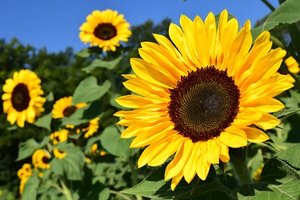
Example: Plants are autotrophs, while animals such as bears are heterotrophs.

Plant Anatomy Basics
Structure and Function of Plant Organs
Plants have specialized organs that facilitate the processes necessary for photosynthesis and growth:
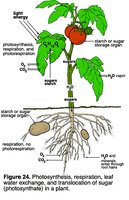
Roots: Absorb water and nutrients from the soil; also store excess sugars.
Stems: Transport water and nutrients upward via capillary action.
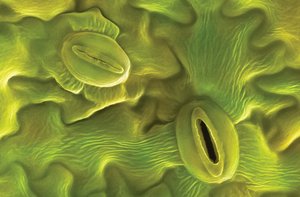
Leaves: Exchange gases through pores called stomata.
Transpiration: The evaporation of water through stomata, which helps drive water movement from roots to leaves.
Example: Stomata are microscopic openings on leaf surfaces that regulate gas exchange and water loss.
Photosynthesis Requirements
Inputs and Sources
Plants require several key resources to carry out photosynthesis and build organic molecules:
Light energy: Captured by leaves and stored in chloroplasts.
Building block atoms and gases: Carbon (C), Hydrogen (H), Oxygen (O), Nitrogen (N), Phosphorus (P), Sulfur (S), Potassium (K), Magnesium (Mg), Carbon dioxide (CO2), Oxygen (O2), water, and nutrients.
Organic molecules: All macromolecules necessary for growth are produced by plants.
Photosynthesis Equation
Chemical Representation
The overall equation for photosynthesis summarizes the conversion of light energy into chemical energy:
Equation:
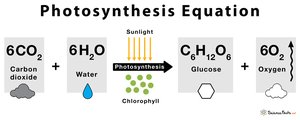
Comparison: This equation is essentially the reverse of cellular respiration, where glucose and oxygen are used to produce carbon dioxide, water, and energy.
The Chloroplast
Structure and Function
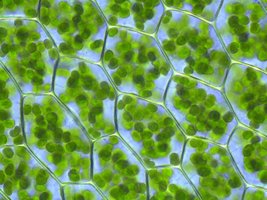
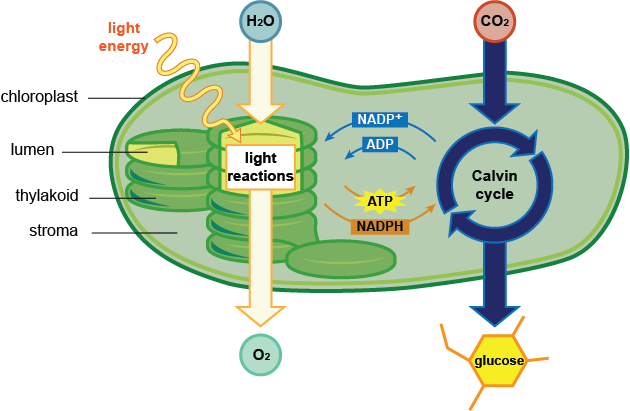
Photosynthesis occurs within the chloroplast, a specialized organelle in plant cells:
Grana: Stacks of thylakoids where light reactions occur.
Stroma: Fluid inside the chloroplast where the Calvin cycle takes place.
Thylakoid membrane: Coin-shaped membranes containing chlorophyll.
Double membrane, ribosomes, and DNA: Chloroplasts share these features with mitochondria, indicating their evolutionary origin.
Photosynthesis Overview
Two Sets of Reactions
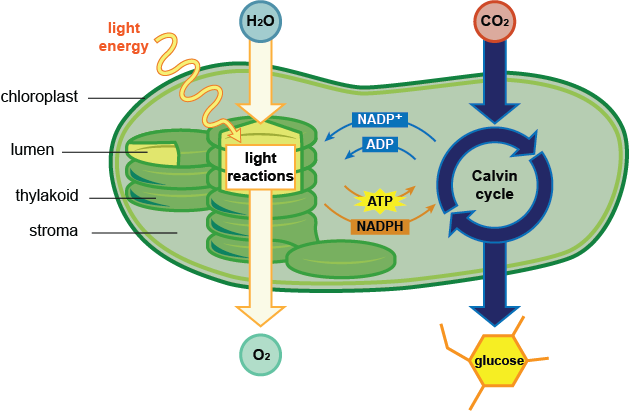
Photosynthesis consists of two main stages, both occurring inside the chloroplast:
Light reactions (Light dependent): Convert sunlight into ATP and NADPH.
Calvin Cycle (Light independent): Use CO2 to synthesize glucose.
Light Absorption
Properties of Visible Light
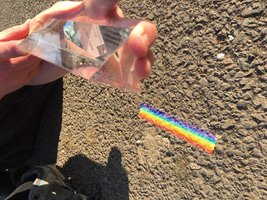
Visible light consists of different wavelengths, each corresponding to a specific color. Sunlight is a mixture of these wavelengths, appearing as "white" light.
The Spectrum of Color
Wavelengths and Energy
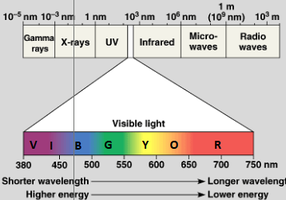
The visible spectrum ranges from violet (shortest wavelength, highest energy) to red (longest wavelength, lowest energy). Plants absorb specific wavelengths for photosynthesis.
Pigments of Photosynthesis
Types and Functions
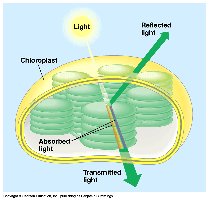
Pigments are molecules that absorb light energy. The main pigment in photosynthesis is chlorophyll a, which absorbs red and blue wavelengths most efficiently. Accessory pigments, such as chlorophyll b, carotenoids, and xanthophylls, expand the range of light absorption.
Pigments and Leaf Color Changes
Accessory Pigments and Seasonal Variation
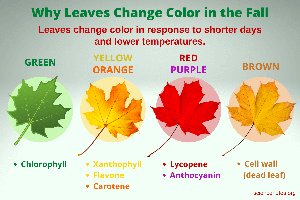
Accessory pigments absorb light in other portions of the spectrum. In autumn, decreased chlorophyll production reveals accessory pigments, causing leaves to change color.
Chlorophyll: Green pigment, dominant in spring and summer.
Xanthophylls, Carotene: Yellow/orange pigments, visible in fall.
Example: Leaves turn red, orange, or yellow as chlorophyll breaks down.
Light Dependent Reactions
Overview and Location
Light-dependent reactions occur in the thylakoid membrane. Chlorophyll absorbs light and converts it into chemical energy (ATP and NADPH). Water is split, releasing oxygen as a byproduct. Two photosystems (I and II) are involved.
Light Reactions: Electron Transport Chain (ETC)
Mechanism and Products
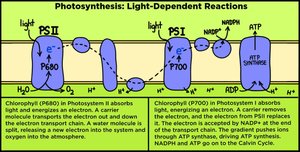
Light reactions use an electron transport chain to create a proton (H+) gradient, similar to cellular respiration. This gradient powers ATP synthesis. Two ETCs are paired with photosystems:
ETC 1: Pairs with Photosystem II to make ATP.
ETC 2: Pairs with Photosystem I to make NADPH.
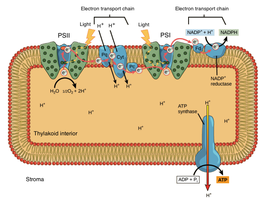
Step 1: Photosystem II / ETC 1
Process and Oxygen Production
Light is absorbed by pigments in Photosystem II, exciting electrons in chlorophyll. Electrons enter the ETC, and water is split to replenish electrons, producing H+, e-, and O2. The ETC powers H+ transport into the thylakoid, and ATP is produced as H+ diffuses back out through ATP synthase.
Step 2: Photosystem I / ETC 2
NADPH Production
Electrons from Photosystem II are re-energized in Photosystem I. NADP+ reductase reduces NADP+ to NADPH. Both ATP and NADPH are transferred to the stroma for use in the Calvin cycle.
Calvin Cycle (Light Independent Reactions)
Overview and Location
The Calvin cycle occurs in the stroma and uses ATP and NADPH from light reactions to fix carbon dioxide and synthesize glucose. This process is endergonic and involves the reduction of CO2.
The Calvin Cycle: Steps and Enzymes
Major Phases
Carbon Fixation: CO2 is fixed by the enzyme RuBisCo, combining with RuBP (a 5-carbon molecule).
Reduction: 3-PGA is reduced to G3P using ATP and NADPH.
Regeneration: RuBP is regenerated to continue the cycle.
G3P: Used to make glucose, starch, cellulose, etc.
Carbon Fixing Enzyme: RuBisCo
Function and Importance
RuBisCo (ribulose bisphosphate carboxylase) is the enzyme responsible for fixing carbon from atmospheric CO2. It is the most abundant and important enzyme on Earth, enabling life by converting inorganic carbon into organic molecules.
Calvin Cycle Summary
Inputs and Outputs
6 turns of the Calvin cycle produce 1 molecule of glucose (C6H12O6).
Consumes 6 CO2, 18 ATP, and 12 NADPH.
Any leftover ATP is used elsewhere in the cell.
Summary of Photosynthesis
Key Points
Light Reactions: Use H2O, produce ATP and NADPH, release O2 as a byproduct.
Calvin Cycle: Uses ATP, NADPH, and CO2; produces glucose; regenerates ADP and NADP+.
The Energy Cycle
Global Importance
Photosynthesis is the most important process for life on Earth, capturing vast amounts of CO2 and synthesizing carbohydrates. Producers and consumers depend on each other for survival, supporting the biosphere.
