 Indietro
Photosynthesis: Structure, Process, and Adaptations
Guida di studio - Note intelligenti
 Appunti personalizzati basati sui tuoi materiali, ampliati con definizioni chiave, esempi e contesto.
Photosynthesis: The Process That Feeds the Biosphere
Relevance of Photosynthesis to Living Things
Photosynthesis is a fundamental biological process that converts solar energy into chemical energy, sustaining nearly all life on Earth. It occurs in plants, algae, certain unicellular eukaryotes, and some prokaryotes. Autotrophs, such as plants, produce organic molecules from carbon dioxide and water, while heterotrophs depend on these producers for food and oxygen.
Autotrophs: "Self-feeders" that synthesize their own food from inorganic substances.
Photoautotrophs: Use sunlight to convert CO2 and H2O into organic molecules.
Heterotrophs: Obtain organic material by consuming other organisms.
Importance: Provides food and O2 for heterotrophs.
Main Structures Involved in Photosynthesis
Chloroplasts and Leaf Anatomy
Photosynthesis primarily occurs in the chloroplasts of plant cells, especially within the mesophyll tissue of leaves. Chloroplasts contain thylakoids, grana, and stroma, which are essential for the light reactions and Calvin cycle.
Chloroplast: Organelle with a double membrane and internal thylakoid system.
Thylakoids: Membranous sacs where light reactions occur; stacked into grana.
Stroma: Fluid surrounding thylakoids; site of the Calvin cycle.
Stomata: Pores for gas exchange (CO2 in, O2 out).
Substrates and Products of Photosynthesis
Chemical Equation and Atom Tracking
The overall process of photosynthesis can be summarized by the following equation:
Substrates: CO2, H2O, and light energy
Products: Glucose (C6H12O6), O2, and H2O
Photosynthesis Equation:
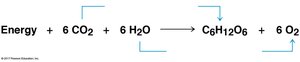
Summary of the Photosynthesis Process
Two Stages: Light Reactions and Calvin Cycle
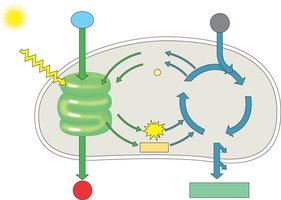
Photosynthesis consists of two main stages: the light reactions and the Calvin cycle. The light reactions occur in the thylakoid membranes and convert solar energy into ATP and NADPH, while the Calvin cycle takes place in the stroma and uses these products to fix carbon and synthesize sugars.
Light Reactions: Split water, release O2, produce ATP and NADPH.
Calvin Cycle: Fixes CO2 into organic molecules using ATP and NADPH.
Absorption of Energy from Sunlight
Nature of Sunlight and Photosynthetic Pigments
Light is electromagnetic energy, and its wavelength determines its energy and color. Pigments in chloroplasts absorb specific wavelengths of light, driving photosynthesis. Chlorophylls absorb violet, red, and blue light, reflecting green, while carotenoids absorb in the violet-blue-green range and reflect yellow-orange.
Chlorophyll a: Main pigment, absorbs violet-blue and red.
Chlorophyll b: Accessory pigment, broadens absorption spectrum.
Carotenoids: Accessory pigments, provide photoprotection.
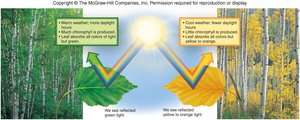
Photosynthetic Pigments and Light Absorption
Why Leaves Are Green and Seasonal Changes
Leaves appear green because chlorophyll reflects and transmits green light. In autumn, as chlorophyll degrades, carotenoids become visible, giving leaves yellow-orange colors.
Absorption Spectrum: Graph showing pigment absorption versus wavelength.
Action Spectrum: Profiles effectiveness of different wavelengths in driving photosynthesis.
Photosystems and Light Reactions
Structure and Function of Photosystems
A photosystem consists of a reaction-center complex surrounded by light-harvesting complexes. There are two types: Photosystem II (PS II) and Photosystem I (PS I), each with distinct roles in the light reactions.
PS II: Absorbs 680 nm wavelength, splits water, releases O2.
PS I: Absorbs 700 nm wavelength, produces NADPH.
Linear Electron Flow: Involves both photosystems, produces ATP and NADPH.
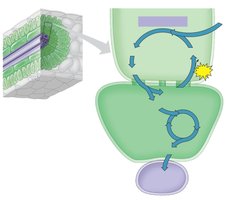
The Calvin Cycle
Reduction of CO2 to Sugar
The Calvin cycle is an anabolic pathway that uses ATP and NADPH to convert CO2 into glyceraldehyde 3-phosphate (G3P), a sugar. The cycle has three phases: carbon fixation, reduction, and regeneration of the CO2 acceptor (RuBP).
Carbon Fixation: CO2 is attached to RuBP by rubisco.
Reduction: ATP and NADPH reduce 3-phosphoglycerate to G3P.
Regeneration: RuBP is regenerated for the next cycle.
Alternative Mechanisms of Carbon Fixation
C4 and CAM Pathways in Hot, Arid Climates
Plants in hot, dry environments have evolved alternative carbon fixation mechanisms to minimize water loss and photorespiration. C4 plants spatially separate carbon fixation and the Calvin cycle, while CAM plants temporally separate these processes.
C4 Plants: Fix CO2 in mesophyll cells, then transfer it to bundle sheath cells for the Calvin cycle.
CAM Plants: Open stomata at night to fix CO2 into organic acids; release CO2 during the day for the Calvin cycle.
Photorespiration: Occurs when O2 substitutes for CO2 in rubisco, reducing photosynthetic efficiency.
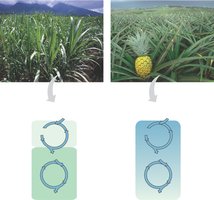
Photosynthesis Review
Summary of Light Reactions and Calvin Cycle
Light reactions occur in the thylakoid membranes, converting light energy to ATP and NADPH, splitting water, and releasing O2. The Calvin cycle takes place in the stroma, using ATP and NADPH to convert CO2 to G3P, and regenerating ADP, inorganic phosphate, and NADP+ for reuse.
Light Reactions: Provide energy and reducing power for the Calvin cycle.
Calvin Cycle: Synthesizes sugars and other organic molecules.
Additional info: The notes expand on brief points from the original slides, providing definitions, examples, and context for each topic. The included images directly reinforce the explanations of the photosynthesis equation, pigment function, photosystem structure, C4/CAM adaptations, and the overall process.
