 Indietro
Photosynthesis: The Process That Feeds the Biosphere
Guida di studio - Note intelligenti
 Appunti personalizzati basati sui tuoi materiali, ampliati con definizioni chiave, esempi e contesto.
Photosynthesis: The Process That Feeds the Biosphere
Overview of Photosynthesis
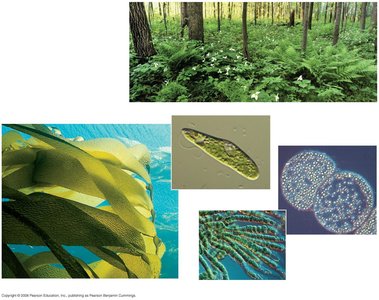
Photosynthesis is the biological process that converts solar energy into chemical energy, sustaining almost all life on Earth. It is performed by autotrophs, which are organisms capable of producing organic molecules from inorganic substances, primarily using sunlight.
Autotrophs: Producers of the biosphere, including plants, algae, and some prokaryotes. They use CO2 and other inorganic molecules to synthesize organic compounds.
Photoautotrophs: Autotrophs that use sunlight as their energy source. Most plants fall into this category.
Heterotrophs: Organisms that obtain organic material by consuming other organisms. They depend on photoautotrophs for food and oxygen.
Sites and Structure of Photosynthesis
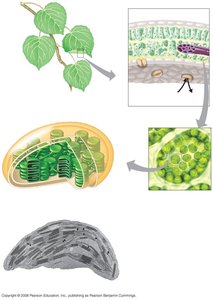
Photosynthesis primarily occurs in the chloroplasts of plant cells, especially within the mesophyll tissue of leaves. The green pigment chlorophyll is responsible for capturing light energy.
Chloroplasts: Organelles containing thylakoids (membranous sacs) stacked into grana, and surrounded by a dense fluid called stroma.
Stomata: Microscopic pores on leaves that allow gas exchange (CO2 in, O2 out).
Mesophyll: Leaf tissue rich in chloroplasts; a typical cell contains 30–40 chloroplasts.
Summary Equation and Redox Nature
The overall chemical equation for photosynthesis is:
Photosynthesis is a redox process in which water is oxidized and carbon dioxide is reduced.
Stages of Photosynthesis
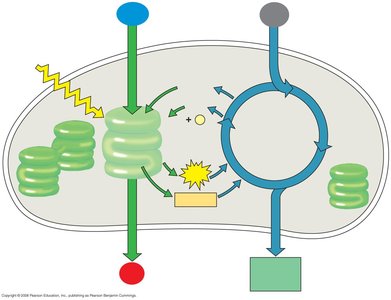
Photosynthesis consists of two main stages: the light reactions and the Calvin cycle.
Light Reactions: Occur in the thylakoid membranes. They split water, release O2, reduce NADP+ to NADPH, and generate ATP by photophosphorylation.
Calvin Cycle: Occurs in the stroma. It uses ATP and NADPH to convert CO2 into sugar (G3P) through carbon fixation, reduction, and regeneration of RuBP.
The Light Reactions: Converting Solar Energy
The Nature of Sunlight
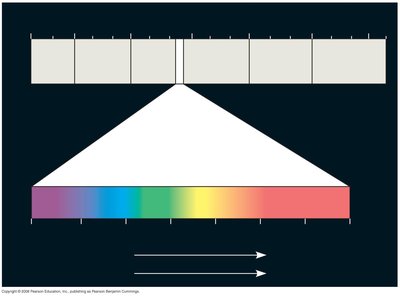
Light is a form of electromagnetic radiation, traveling in waves. The wavelength determines the type of electromagnetic energy, and visible light is the range that drives photosynthesis.
Photons: Discrete particles of light energy.
Electromagnetic Spectrum: The full range of electromagnetic radiation, with visible light between 380–750 nm.
Photosynthetic Pigments
Pigments are substances that absorb visible light. Different pigments absorb different wavelengths; those not absorbed are reflected or transmitted, giving leaves their green color.
Chlorophyll a: The main photosynthetic pigment.
Chlorophyll b and Carotenoids: Accessory pigments that broaden the spectrum and protect chlorophyll from damage.
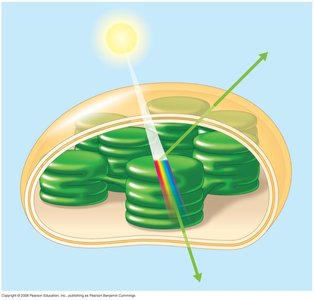
Measuring Pigment Absorption
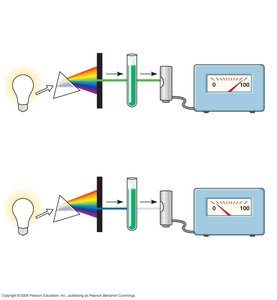
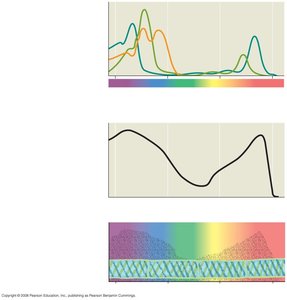
A spectrophotometer measures a pigment’s ability to absorb various wavelengths. The absorption spectrum plots absorption versus wavelength, while the action spectrum shows the effectiveness of different wavelengths in driving photosynthesis.
Excitation of Chlorophyll
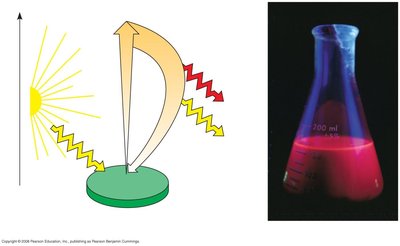
When chlorophyll absorbs light, electrons are excited to a higher energy state. As they return to the ground state, energy is released as fluorescence (light and heat).
Photosystems and Electron Flow
A photosystem consists of a reaction-center complex surrounded by light-harvesting complexes. There are two types: Photosystem II (PS II, P680) and Photosystem I (PS I, P700).
Linear Electron Flow: Involves both photosystems, producing ATP and NADPH.
Cyclic Electron Flow: Involves only PS I, producing ATP but not NADPH.
The Calvin Cycle: Converting CO2 to Sugar
Phases of the Calvin Cycle
The Calvin cycle uses ATP and NADPH to convert CO2 into glyceraldehyde-3-phosphate (G3P). It has three phases:
Carbon Fixation: CO2 is attached to ribulose bisphosphate (RuBP) by the enzyme rubisco.
Reduction: ATP and NADPH are used to convert 3-phosphoglycerate into G3P.
Regeneration: Some G3P is used to regenerate RuBP, enabling the cycle to continue.
For one G3P molecule, the cycle must turn three times, fixing three CO2 molecules.
Adaptations in Carbon Fixation
Photorespiration and Its Consequences
On hot, dry days, plants close stomata to conserve water, reducing CO2 intake and increasing O2. This leads to photorespiration, where rubisco adds O2 instead of CO2 to RuBP, consuming energy and releasing CO2 without producing sugar.
C4 and CAM Pathways
Some plants have evolved mechanisms to minimize photorespiration:
C4 Plants: Use PEP carboxylase to fix CO2 into four-carbon compounds in mesophyll cells, which are then transported to bundle-sheath cells for the Calvin cycle.
CAM Plants: Open stomata at night to fix CO2 into organic acids, which release CO2 during the day for the Calvin cycle.
Importance of Photosynthesis
Photosynthesis stores solar energy as chemical energy in organic molecules, providing food and oxygen for nearly all life. Plants store excess sugar as starch and supply carbon skeletons for biosynthesis.
Key Terms and Concepts
Autotroph: An organism that produces its own food from inorganic substances.
Chloroplast: Organelle where photosynthesis occurs.
Thylakoid: Membranous sac within chloroplasts, site of light reactions.
Stroma: Fluid surrounding thylakoids, site of the Calvin cycle.
Chlorophyll: Green pigment that absorbs light energy.
Rubisco: Enzyme that catalyzes carbon fixation in the Calvin cycle.
Photorespiration: Process that consumes O2 and releases CO2 without producing ATP or sugar.
PEP Carboxylase: Enzyme in C4 plants that fixes CO2 efficiently.
CAM: Crassulacean acid metabolism, a water-conserving carbon fixation pathway.
