 Indietro
Principles of Animal Form and Function: Anatomy, Physiology, and Homeostasis (Ch. 40 Study Guide)
Guida di studio - Note intelligenti
 Appunti personalizzati basati sui tuoi materiali, ampliati con definizioni chiave, esempi e contesto.
Basic Principles of Animal Form and Function
Anatomy vs. Physiology
Animal biology is structured around the study of anatomy (the physical structure of organisms) and physiology (the functions and processes that occur within those structures). Understanding both is essential for explaining how animals survive and adapt to their environments.
Anatomy: The study of the structure of organisms and their parts.
Physiology: The study of the functions and mechanisms occurring in living organisms.
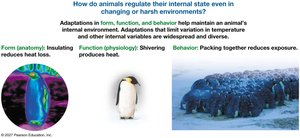
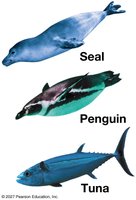
Example: The anatomy of penguin feathers (insulation) relates directly to their physiological function (heat retention).
Constraints on Organism Size: Surface Area to Volume Ratio
Why There Are No Large Unicellular Organisms
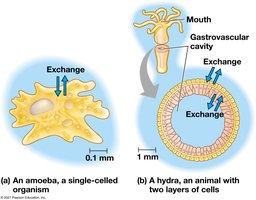
Unicellular organisms rely on direct exchange with their environment for nutrients, gases, and waste removal. As size increases, the surface area to volume ratio (SA/V) decreases, limiting efficient exchange and making large unicellular life impossible.
SA/V Ratio: The ratio of an organism's surface area to its volume. High SA/V allows efficient exchange; low SA/V restricts it.
As size increases: Volume grows faster than surface area, reducing SA/V.
Adaptation: Multicellular organisms have many small cells and specialized structures to increase surface area for exchange.
Example: Amoeba (unicellular) vs. Hydra (simple multicellular) both rely on direct exchange, but larger animals require complex transport systems.
Internal Exchange Surfaces in Complex Animals
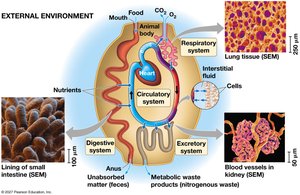
Complex animals have specialized internal surfaces for the exchange of gases, nutrients, and wastes. These surfaces maximize surface area and facilitate efficient transport throughout the body.
Examples: Lungs (O2/CO2 exchange), kidneys (nitrogenous waste removal), intestines (nutrient absorption).
Transport: Circulatory system moves materials between exchange surfaces and body cells.
Hierarchical Organization of Animal Body Plans
Levels of Organization
Animal bodies are organized hierarchically, from cells to tissues, organs, and organ systems. Each level has distinct structural and functional properties.
Cell: Basic unit of life.
Tissue: Group of cells with similar structure and function.
Organ: Structure composed of multiple tissues performing specific functions.
Organ System: Group of organs working together for a common purpose.
Types of Animal Tissues
There are four main types of animal tissues, each with unique characteristics and functions.
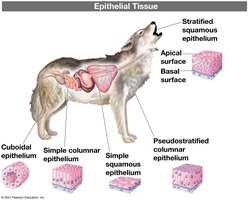
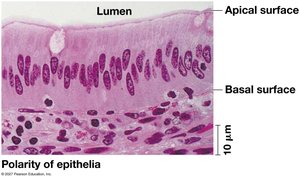
Epithelial Tissue: Covers body surfaces and lines internal cavities; tightly packed cells; shapes include cuboidal, columnar, squamous.
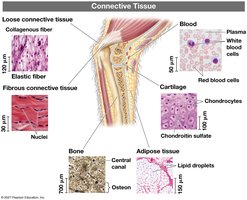
Connective Tissue: Supports and binds other tissues; contains cells in an extracellular matrix (fibers in liquid, gel, or solid).
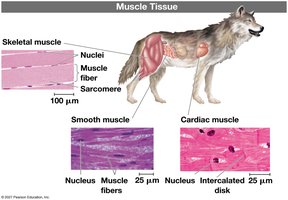
Muscle Tissue: Responsible for movement; contains actin and myosin filaments; types include skeletal (voluntary), smooth (involuntary), and cardiac (heart).
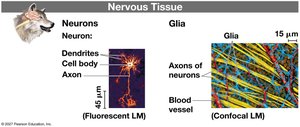
Nervous Tissue: Receives, processes, and transmits information; consists of neurons (impulse transmission) and glial cells (support).
Epithelial Tissue
Epithelial tissue forms protective barriers and is involved in absorption, secretion, and sensation.
Connective Tissue
Connective tissue provides structural support and connects different parts of the body.
Muscle Tissue
Muscle tissue enables movement and force generation in animals.
Nervous Tissue
Nervous tissue is essential for communication and coordination within the body.
Coordination and Control: Endocrine vs. Nervous Systems
Regulation of Body Functions
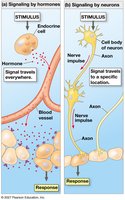
Animals use two major systems for regulation: the endocrine system (hormones) and the nervous system (electrical impulses). Each system has distinct roles in maintaining homeostasis and responding to stimuli.
Endocrine System: Releases hormones into the bloodstream; effects are widespread and gradual; important for growth, development, and reproduction.
Nervous System: Transmits electrical signals along neurons; effects are rapid and localized; important for immediate responses.
Comparison: Endocrine is slow and broad; nervous is fast and specific.
Regulation: Homeostasis
Regulators vs. Conformers
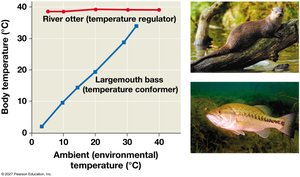
Animals can be classified as regulators (maintain internal conditions despite external changes) or conformers (internal conditions change with the environment).
Regulator: River otter maintains constant body temperature.
Conformer: Largemouth bass body temperature varies with ambient temperature.
Mechanisms of Homeostasis
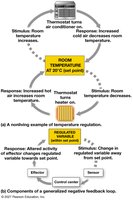
Homeostasis is the maintenance of a stable internal environment. It involves set points, sensors, control centers, and responses.
Set Point: Target value for a physiological variable.
Sensor: Detects changes from the set point.
Control Center: Processes information and triggers responses.
Response: Returns variable to set point.
Feedback Control
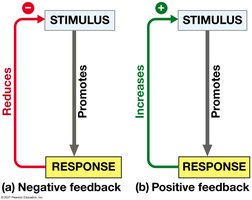
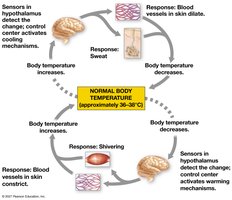
Feedback mechanisms regulate homeostasis. Negative feedback reduces deviations from the set point, while positive feedback amplifies changes.
Negative Feedback: Damps stimulus; e.g., temperature regulation.
Positive Feedback: Amplifies stimulus; e.g., childbirth.
Thermoregulation: Maintaining Body Temperature
Types of Thermy
Animals regulate body temperature through various strategies. These include endothermy (internal heat generation) and ectothermy (external heat absorption), as well as homeothermy (constant temperature) and poikilothermy (variable temperature).
Endotherms: Birds, mammals; generate heat metabolically.
Ectotherms: Fish, amphibians, reptiles; gain heat from environment.
Homeotherms: Maintain constant body temperature.
Poikilotherms: Body temperature varies with environment.
Heat Exchange Mechanisms
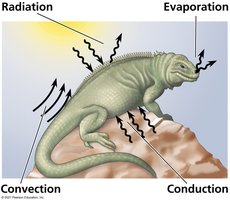
Animals exchange heat with their environment through four main processes: radiation, evaporation, convection, and conduction.
Radiation: Absorption of heat from sunlight.
Evaporation: Loss of heat via water evaporation.
Convection: Heat transfer through air or water movement.
Conduction: Direct transfer of heat between surfaces.
Adaptations for Thermoregulation
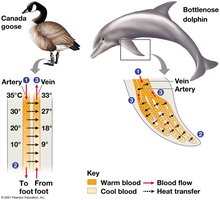
Animals use various adaptations to balance heat loss and gain, including insulation, circulatory adaptations, evaporative cooling, behavioral responses, and metabolic adjustments.
Insulation: Fur, feathers, blubber reduce heat loss.
Circulatory Adaptations: Vasodilation and vasoconstriction regulate blood flow; countercurrent exchange conserves heat.
Evaporative Cooling: Sweating, panting.
Behavioral Responses: Huddling, seeking shade.
Metabolic Adjustments: Shivering, hormone regulation.
Thermoregulation in Mammals: The Hypothalamus
The hypothalamus acts as the control center for thermoregulation in mammals, detecting temperature changes and triggering appropriate responses.
Responses: Sweating, shivering, vasodilation, vasoconstriction.
Fever: Elevated body temperature regulated by hypothalamus; can enhance immune response.
Bioenergetics: Energy Flow in Animals
Overview of Animal Bioenergetics
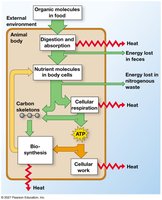
Bioenergetics is the study of how animals acquire, transform, and use energy. Energy is required for cellular work, biosynthesis, and maintaining homeostasis.
Energy Sources: Organic molecules from food.
Processes: Digestion, absorption, cellular respiration, biosynthesis.
Energy Loss: Heat, waste products.
Equation:
Summary Table: Animal Tissue Types
Tissue Type | Main Function | Key Characteristics |
|---|---|---|
Epithelial | Protection, absorption, secretion | Tightly packed cells, various shapes |
Connective | Support, binding | Cells in extracellular matrix |
Muscle | Movement | Actin and myosin filaments |
Nervous | Information processing | Neurons and glial cells |
Additional info:
Some explanations and examples were expanded for clarity and completeness.
Table 40.1 (Organ Systems in Mammals) was not included due to lack of detailed content in the provided materials.
