 Indietro
Specific Immune Response: Humoral and Cell-Mediated Immunity
Guida di studio - Note intelligenti
 Appunti personalizzati basati sui tuoi materiali, ampliati con definizioni chiave, esempi e contesto.
Specific Immune Response
Overview of Immunity
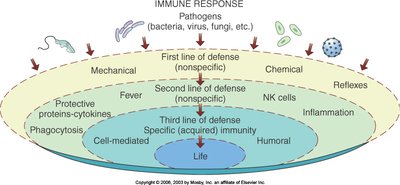
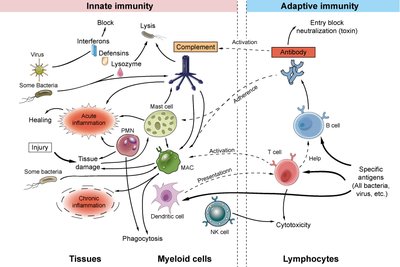
The immune system protects the body from pathogens through a coordinated response involving both nonspecific (innate) and specific (adaptive) mechanisms. The adaptive immune response is characterized by specificity, memory, and systemic action, allowing for targeted defense against a wide variety of infectious agents and abnormal cells.
Innate Immunity: Provides immediate, nonspecific defense through barriers, phagocytes, and chemical mediators.
Adaptive Immunity: Requires priming by antigen exposure and involves highly specific responses mediated by lymphocytes.
Immunologic Memory: Enables rapid and vigorous response upon re-exposure to the same antigen.
Types of Specific Immune Response
Humoral Immunity
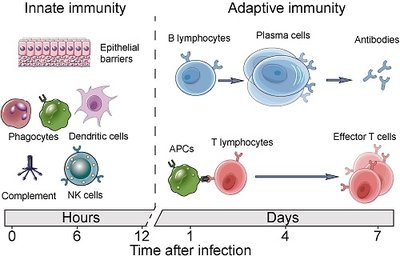
Humoral immunity is mediated by antibodies produced by B lymphocytes. These antibodies circulate in body fluids and bind to antigens, marking them for destruction or neutralization.
Antibody-Mediated: Antibodies bind to antigens in blood and lymph.
Effector Functions: Includes agglutination, neutralization, opsonization, antibody-dependent cell-mediated cytotoxicity (ADCC), and complement activation.
Cell-Mediated Immunity
Cell-mediated immunity is carried out by T lymphocytes, which act directly or indirectly against infected or abnormal cells. This response is essential for eliminating pathogens residing within host cells.
Direct Action: Cytotoxic T cells kill infected cells.
Indirect Action: Helper T cells release cytokines to activate other immune cells.
Cells of the Specific Immune Response
B Lymphocytes (B Cells)
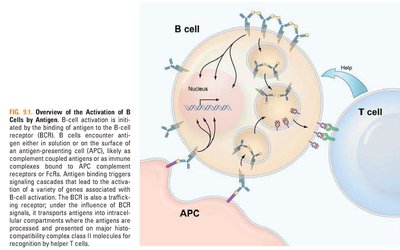
B cells express immunoglobulins (antibodies) as B-cell receptors (BCRs) on their surface. Each B cell is specific to a unique epitope. Upon activation, B cells differentiate into plasma cells (antibody-secreting) and memory cells.
Plasma Cells: Secrete antibodies specific to the encountered antigen.
Memory B Cells: Provide rapid response upon re-exposure.
T Lymphocytes (T Cells)
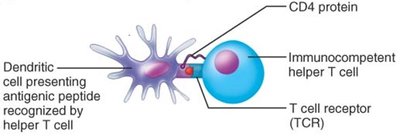
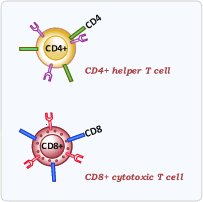
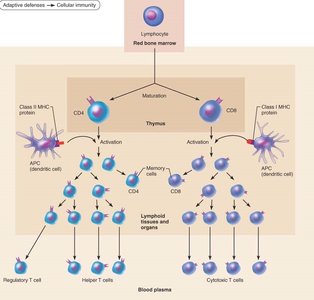
T cells express T-cell receptors (TCRs) that recognize peptide antigens presented by major histocompatibility complex (MHC) molecules. There are two main types: helper T cells (CD4+) and cytotoxic T cells (CD8+).
Helper T Cells (CD4+): Activate other immune cells via cytokine secretion.
Cytotoxic T Cells (CD8+): Directly kill infected or abnormal cells.
Antigen-Presenting Cells (APCs)
APCs, such as dendritic cells, macrophages, and B cells, engulf antigens and present fragments on their surface for recognition by lymphocytes. This process is essential for initiating adaptive immune responses.
Dendritic Cells: Present in tissues and epidermis.
Macrophages: Engulf pathogens and present antigens.
B Cells: Can act as APCs in addition to antibody production.


Humoral Immune Response: Steps and Mechanisms
Antigen Recognition
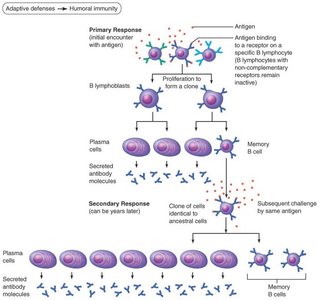
Naïve B cells recognize antigens via membrane-bound antibodies. These antigens may be free in the blood or attached to microbes.
BCRs: Bind to specific epitopes on antigens.
Difference from T Cells: B cells recognize free antigens; T cells recognize peptides presented by APCs.

Clonal Expansion
Upon activation, B cells undergo clonal selection and expansion, producing a population of cells specific to the antigen.
Clone: Genetically identical B cells responding to a single antigen.
Clonal Selection: Activation of B cells based on specificity.
Differentiation
Activated B cells differentiate into plasma cells and memory cells. Plasma cells secrete antibodies, while memory cells provide long-term immunity.
Helper T Cells: Release cytokines to enhance B cell response.
Antigen Elimination
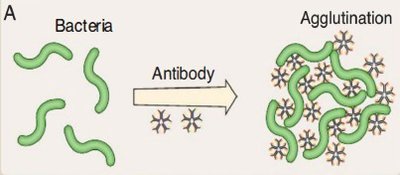
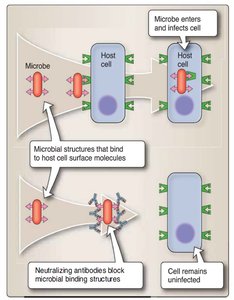
Antibodies produced by plasma cells eliminate antigens through several mechanisms:
Agglutination: Antibodies cross-link cells or particles, forming aggregates.
Neutralization: Antibodies block microbial binding to host cells.
Opsonization: Antibodies tag microbes for phagocytosis.
ADCC: Antibody-dependent cell-mediated cytotoxicity.
Complement Activation: Antibodies activate the classical complement pathway.
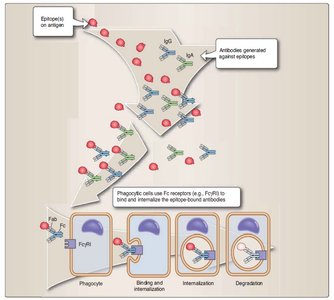
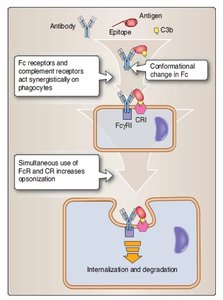
Memory
Memory B cells persist after infection, enabling rapid and effective response upon re-exposure to the same antigen.
Secondary Response: Faster and more robust than the primary response.
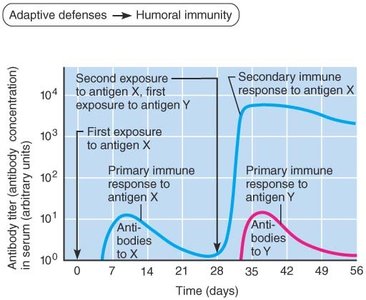

Cell-Mediated Immune Response: Steps and Mechanisms
Antigen Recognition
T cells recognize peptide antigens presented by MHC molecules on APCs. Helper T cells (CD4+) interact with MHC II, while cytotoxic T cells (CD8+) interact with MHC I.
APCs: Display antigens for T cell recognition.
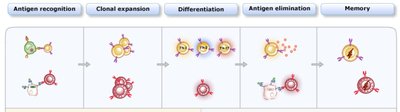
Clonal Expansion
Activated T cells undergo rapid division, expanding the pool of effector cells.
Helper T Cells: Secrete cytokines to induce division.
Cytotoxic T Cells: Expand similarly to B cells and helper T cells.
Differentiation
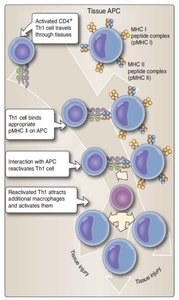
T cells differentiate into effector cells with specialized functions. Helper T cells secrete cytokines (e.g., interferon gamma, IL-4, IL-5, IL-13, IL-17), while cytotoxic T cells mature to kill infected cells.
Effector Functions: Recruitment and activation of macrophages, stimulation of B cells, promotion of inflammation.
Antigen Elimination
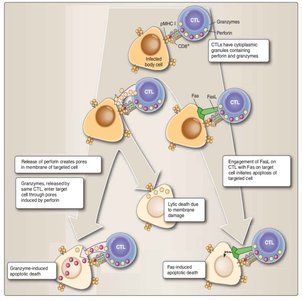
Cytotoxic T cells kill infected cells by releasing perforins and granzymes, inducing apoptosis. Helper T cells recruit and activate other immune cells.
Perforins: Create pores in target cell membranes.
Granzymes: Enter cells and induce apoptosis.
FasL-Fas Interaction: Induces apoptosis in target cells.
Memory
Memory T cells persist after infection, providing rapid and effective response upon re-exposure to the same antigen.
Helper and Cytotoxic T Cells: Both can be activated in the same response.
Summary of Adaptive Immune Response
Sequence of Processes Upon Re-Exposure
When the body is re-exposed to an antigen, the adaptive immune response follows a sequence of steps:
Antigen Recognition: Memory cells recognize the antigen.
Clonal Expansion: Rapid proliferation of memory cells.
Differentiation: Formation of effector cells (plasma cells, helper T cells, cytotoxic T cells).
Antigen Elimination: Effector mechanisms remove the antigen.
Memory: Maintenance of long-lived memory cells for future responses.

Table: Comparison of Humoral and Cell-Mediated Immunity
Feature | Humoral Immunity | Cell-Mediated Immunity |
|---|---|---|
Effector Cells | B lymphocytes (plasma cells) | T lymphocytes (helper and cytotoxic) |
Effector Molecules | Antibodies | Cytokines, perforins, granzymes |
Target | Extracellular pathogens | Intracellular pathogens, abnormal cells |
Memory | Memory B cells | Memory T cells |
