 Indietro
The Cell Cycle: Mechanisms and Regulation of Eukaryotic Cell Division
Guida di studio - Note intelligenti
 Appunti personalizzati basati sui tuoi materiali, ampliati con definizioni chiave, esempi e contesto.
The Cell Cycle and Its Importance
Key Roles of Cell Division
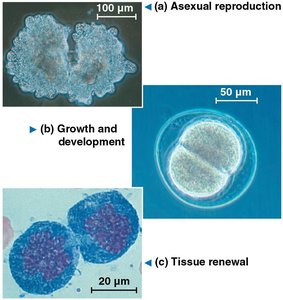
The ability of organisms to reproduce their own kind is a defining characteristic of life. Cell division is essential for reproduction, growth, development, and tissue renewal in both unicellular and multicellular organisms.
Asexual reproduction: Single-celled organisms reproduce by dividing, producing genetically identical offspring.
Growth and development: Multicellular organisms grow and develop from a single cell through repeated cell divisions.
Tissue renewal: In mature organisms, cell division replaces cells that are lost due to normal wear and tear or injury.
Genetic Material Organization
Genome Structure and Chromosomes
The genome is the complete set of DNA in a cell, containing all the genetic instructions for cellular structure, function, and regulation.
Prokaryotic cells: Typically have a single, circular DNA molecule.
Eukaryotic cells: Possess multiple, linear DNA molecules organized into chromosomes.
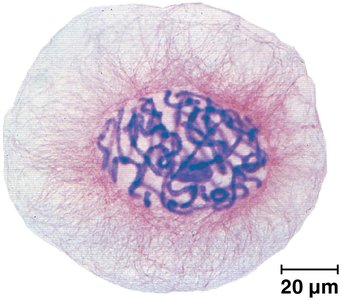
DNA is packaged with proteins into chromatin, which condenses to form visible chromosomes during cell division. Each chromosome contains hundreds to thousands of genes.
Chromosome Number and Types of Cells
Somatic cells: Non-reproductive body cells, diploid (2n), containing two sets of chromosomes (one from each parent).
Gametes: Reproductive cells (sperm and eggs), haploid (n), containing one set of chromosomes.
Humans: 46 chromosomes in somatic cells, 23 in gametes.
Chromosome Duplication and Distribution
DNA Replication and Chromosome Structure
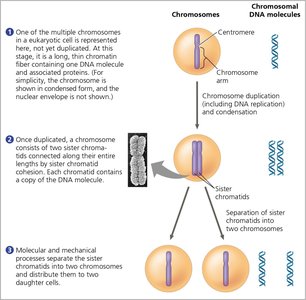
Before a cell divides, its DNA is replicated, resulting in duplicated chromosomes. Each duplicated chromosome consists of two sister chromatids joined at a region called the centromere. During mitosis, sister chromatids separate and are distributed to daughter cells, ensuring genetic continuity.
Overview of Eukaryotic Cell Division
Mitosis and Cytokinesis
Eukaryotic cell division consists of two main processes:
Mitosis: Division of the nucleus and genetic material, producing two genetically identical daughter cells. Occurs in somatic cells.
Cytokinesis: Division of the cytoplasm, resulting in two separate cells.
Meiosis is a variation of cell division that produces gametes with half the chromosome number and introduces genetic diversity.
The Cell Cycle: Phases and Regulation
Phases of the Cell Cycle
The cell cycle is the ordered sequence of events in the life of a cell, consisting of:
Mitotic (M) phase: Includes mitosis and cytokinesis.
Interphase: Period of cell growth and DNA replication, subdivided into:
G1 phase (first gap): Cell growth and normal metabolic roles.
S phase (synthesis): DNA replication.
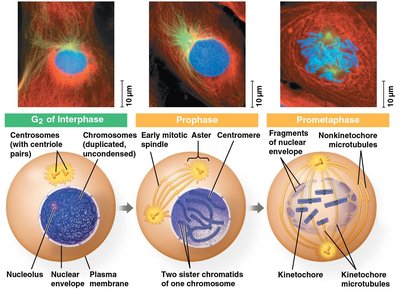
G2 phase (second gap): Preparation for mitosis.
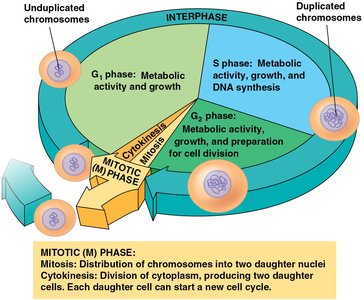
Cells may spend variable amounts of time in each phase, with some cells rarely dividing and remaining in G1.
Mitosis: Stages and Key Events
Stages of Mitosis
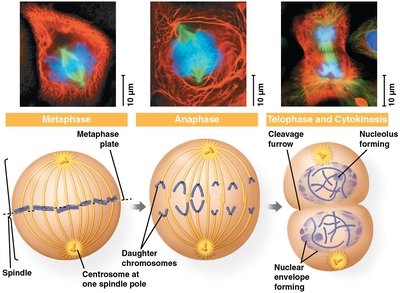
Mitosis is conventionally divided into five stages:
Prophase: Chromosomes condense, spindle apparatus begins to form.
Prometaphase: Nuclear envelope fragments, spindle microtubules attach to kinetochores.
Metaphase: Chromosomes align at the metaphase plate.
Anaphase: Sister chromatids separate and move toward opposite poles.
Telophase: Nuclear envelopes reform, chromosomes decondense.
Key Structures in Mitosis
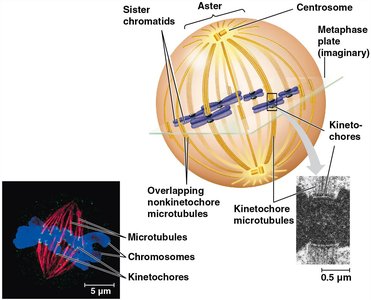
Spindle apparatus: Microtubule structure that separates chromosomes.
Kinetochore: Protein complex at the centromere where spindle fibers attach.
Metaphase plate: Imaginary plane where chromosomes align during metaphase.
Cytokinesis: Division of the Cytoplasm
Mechanisms of Cytokinesis
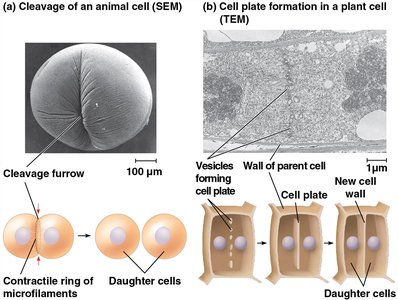
Animal cells: Cytokinesis occurs by cleavage, forming a cleavage furrow that pinches the cell in two.
Plant cells: Cytokinesis involves the formation of a cell plate, which develops into a new cell wall separating the daughter cells.
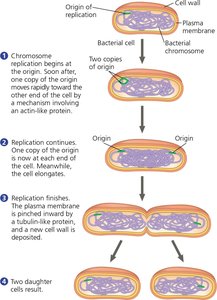
Binary Fission in Prokaryotes
Mechanism of Binary Fission
Prokaryotes (bacteria and archaea) reproduce by binary fission, a process distinct from mitosis but functionally similar in distributing genetic material to daughter cells.
Chromosome replication begins at the origin of replication.
Two copies of the chromosome move to opposite ends of the cell.
The plasma membrane pinches inward, dividing the cell into two genetically identical daughter cells.
Summary Table: Comparison of Cell Division Mechanisms
Feature | Mitosis (Eukaryotes) | Binary Fission (Prokaryotes) |
|---|---|---|
Chromosome Structure | Multiple, linear | Single, circular |
Spindle Apparatus | Present | Absent |
Site of DNA Replication | Nucleus | Cytoplasm |
Number of Daughter Cells | 2 | 2 |
Genetic Identity | Identical to parent | Identical to parent |
Key Terms and Concepts
Chromosome: A DNA molecule with associated proteins, carrying genetic information.
Chromatin: The complex of DNA and proteins that makes up chromosomes.
Sister chromatids: Identical copies of a chromosome, joined at the centromere.
Centromere: Region where sister chromatids are most closely attached.
Kinetochore: Protein structure on the centromere where spindle fibers attach.
Cleavage furrow: Indentation that begins the process of cytokinesis in animal cells.
Cell plate: Structure that forms during cytokinesis in plant cells, leading to cell wall formation.
Equations and Formulas
Diploid number (2n): Total number of chromosomes in somatic cells.
Haploid number (n): Number of chromosomes in gametes.
DNA replication:
