 Indietro
The Skeletal System: Structure, Function, and Physiology
Guida di studio - Note intelligenti
 Appunti personalizzati basati sui tuoi materiali, ampliati con definizioni chiave, esempi e contesto.
The Skeletal System
General Functions of the Skeletal System
The skeletal system is a dynamic organ system composed of osseous tissue and other supporting connective tissues. It is constantly remodeled and serves several essential functions in the human body.
Support and Movement: Provides a framework for muscle attachment, acts as levers, and forms joints for movement.
Protection: Encloses and protects vital organs such as the brain, heart, lungs, and spinal cord.
Storage, Electrolyte, and Acid-Base Balance: Stores minerals like calcium and phosphate, regulates electrolyte balance, and contributes to acid-base homeostasis.
Hematopoiesis: Site for new blood cell production in red marrow.
Energy Storage: Stores triglycerides in yellow marrow.
Hormone Production: Produces osteocalcin, which influences metabolism.
Classification of Bones by Shape
Bones are classified based on their shapes, which relate to their functions.
Long Bones: Longer than wide; found in limbs (e.g., humerus).
Short Bones: Cube-shaped; found in wrist and ankle (e.g., talus).
Flat Bones: Thin, flat, and slightly curved; found in sternum, scapulae, ribs, and skull.
Irregular Bones: Complex shapes; found in vertebrae and os coxae.
Gross Structure of Bone
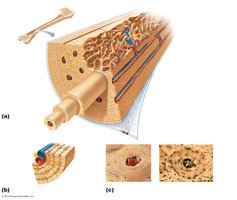
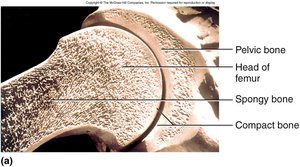
All bones consist of a compact bone layer sandwiching spongy bone.
Compact (Cortical) Bone: Organized into osteons, provides strength and protection.
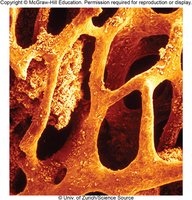
Spongy (Trabecular) Bone: Organized into a latticework of trabeculae, reduces bone weight and absorbs shock.
Microscopic Anatomy of Bone
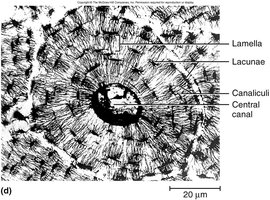
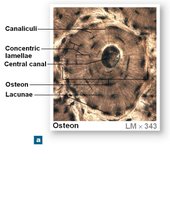
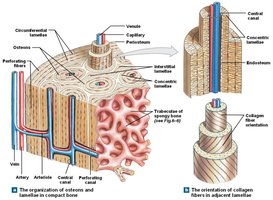
The functional unit of compact bone is the osteon, which consists of concentric rings (lamellae) surrounding a central canal.
Osteon: Contains osteocytes in lacunae, blood vessels, lamellae, and canaliculi.
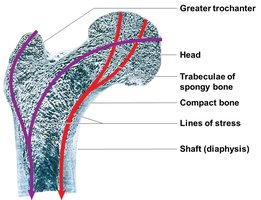
Spongy Bone: Lattice of spicules and trabeculae, no central canals, irregular arrangement reflecting stress patterns.
Bone Tissue Composition
Bone is composed of living tissues, including osseous tissue, nervous tissue, cartilage, fibrous connective tissue, smooth muscle, and epithelia.
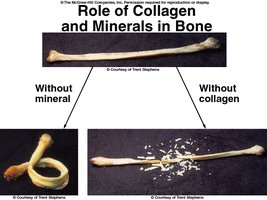
Organic Material (Osteoid): Produced by osteoblasts, includes collagen fibers and glycosaminoglycans (GAGs), resists bending and stretching.
Inorganic Material: Mainly hydroxyapatite (Ca10(PO4)6(OH)2), resists compression.
Bone Properties
Bones are strong yet flexible due to their composite structure.
Compression vs. Tension: Bones withstand compression better than tension.
Comparison to Steel: Bones are half as strong as steel in compression, equally strong in tension.
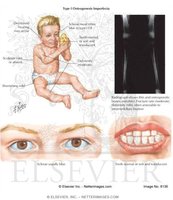
Imbalances: Diseases like rickets and osteogenesis imperfecta result from imbalance in bone composition.
Structural Components of Long Bones
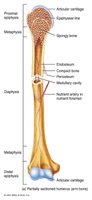
Long bones have distinct anatomical regions:
Diaphysis: Shaft of the bone.
Epiphysis: Ends of the bone.
Metaphysis: Region between diaphysis and epiphysis.
Medullary Cavity: Contains yellow marrow.
Endosteum: Lines the medullary cavity, contains osteogenic cells.
Periosteum: Outer covering, has fibrous and cellular layers.
Articular Cartilage: Hyaline cartilage at joint surfaces.
Cells of Bone Tissue
Five major cell types are involved in bone physiology:
Bone Lining Cells: Flat cells maintaining matrix on bone surfaces.
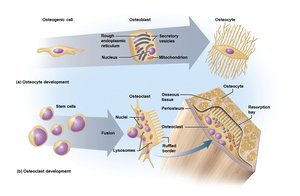
Osteogenic Cells: Stem cells that divide and differentiate into osteoblasts.
Osteoblasts: Bone-forming cells that synthesize/build bone matrix.
Osteocytes: Mature bone cells trapped in matrix, respond to mechanical stress.
Osteoclasts: Bone-dissolving cells, derived from hematopoietic stem cells, responsible for bone resorption.
Bone Marrow
Red Marrow: Site of hematopoiesis (blood cell production).
Yellow Marrow: Stores fat (triglycerides).
Microscopic Structure: Osteon and Spongy Bone
Osteon: Functional unit of compact bone, contains central canal, lamellae, canaliculi, and osteocytes in lacunae.
Spongy Bone: Trabeculae align along lines of stress, can realign to new stress patterns.
Bone Matrix
Organic Component: Osteoid, collagen fibers, GAGs.
Inorganic Component: Hydroxyapatite, calcium phosphate, calcium carbonate.
Bone Growth and Development
Ossification (Bone Formation)
Bone formation occurs via two main processes:
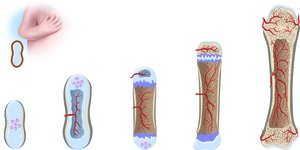
Endochondral Ossification: Bone forms from a cartilage model; most long, short, and irregular bones.
Intramembranous Ossification: Bone forms directly from mesenchymal tissue; flat bones like cranial bones and clavicle.
Endochondral Ossification Steps
Bone collar forms around the diaphysis of the hyaline cartilage model.
Primary ossification center forms; cartilage dies and calcifies.
Periosteal bud invades, forming spongy bone.
Diaphysis elongates, medullary cavity forms.
Secondary ossification centers appear in epiphyses.
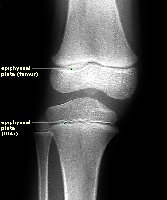
Epiphyses ossify; articular cartilage and epiphyseal plate remain.
Bone Growth: Length and Width
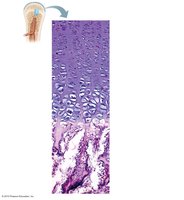
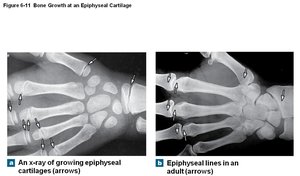
Lengthwise Growth (Interstitial): Occurs at epiphyseal plate, maintained through adolescence.
Appositional Growth (Width): Occurs at periosteum, bone widens via intramembranous ossification.
Hormonal Regulation of Bone Growth
Growth Hormone: Stimulates bone growth.
Thyroid Hormone: Modulates growth hormone activity.
Sex Hormones: Estrogen and testosterone stimulate bone growth and epiphyseal plate closure; estrogen acts sooner, resulting in earlier plate closure in females.
Bone Remodeling and Repair
Bone is constantly remodeled throughout life, with turnover every 5-10 years in young adults.
Osteoclasts: Break down bone (resorption).
Osteoblasts: Build new bone (deposition).
Mechanical Stress: Stimulates bone thickening and remodeling.
Calcium Homeostasis
Maintaining blood calcium levels (9-11 mg/100 mL) is critical for survival.
Calcitriol (Active Vitamin D): Regulates Ca2+ absorption in intestines.
Calcitonin: Lowers blood calcium by stimulating osteoblasts.
Parathyroid Hormone (PTH): Raises blood calcium by stimulating osteoclasts.
Summary Table: Bone Cell Functions
Cell Type | Function |
|---|---|
Osteogenic Cells | Stem cells, differentiate into osteoblasts |
Osteoblasts | Bone formation, secrete osteoid |
Osteocytes | Maintain bone matrix, respond to stress |
Osteoclasts | Bone resorption, dissolve bone matrix |
Bone Lining Cells | Maintain bone surface matrix |
Summary Table: Hormonal Regulation of Calcium
Hormone | Effect on Bone | Effect on Blood Ca2+ |
|---|---|---|
Calcitriol | Promotes Ca2+ absorption | Increases |
Calcitonin | Stimulates osteoblasts | Decreases |
PTH | Stimulates osteoclasts | Increases |
Additional info:
Bone remodeling is influenced by mechanical stress, nutrition, and hormonal signals.
Diseases such as osteoporosis, rickets, and osteogenesis imperfecta highlight the importance of balanced bone composition and regulation.
