 Indietro
Tour Through the Cell: Structure and Function of Cell Components
Guida di studio - Note intelligenti
 Appunti personalizzati basati sui tuoi materiali, ampliati con definizioni chiave, esempi e contesto.
Tour Through the Cell (Chapter 6)
Introduction to Cell Biology
Cells are the fundamental units of life, forming the basis of all living organisms. Understanding cell structure and function is essential for studying biology at the molecular and organismal levels.
Microscopy and Cell Observation
Types of Microscopes
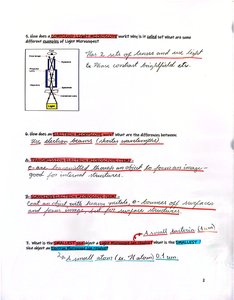
Light Microscope (LM): Uses visible light to illuminate specimens. Suitable for viewing living cells and tissues.
Electron Microscope (EM): Uses electron beams for much higher resolution, allowing visualization of subcellular structures.
Magnification is the ratio of an object's image size to its real size. Resolution is the minimum distance two points can be separated and still be distinguished as two points.
Microscope Limitations
Light microscopes are limited by the wavelength of light (~0.2 μm).
Electron microscopes can resolve structures as small as 2 nm.
Cell Size and Surface Area-to-Volume Ratio
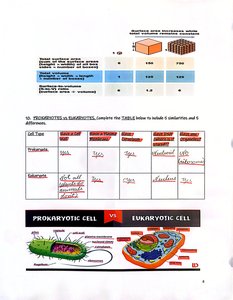
Cells are small to maximize surface area relative to volume, facilitating efficient exchange of materials with the environment.
Cell Types: Prokaryotes vs. Eukaryotes
Comparison Table
Feature | Prokaryotes | Eukaryotes |
|---|---|---|
Nucleus | No | Yes |
Membrane-bound organelles | No | Yes |
Size | Small (1-10 μm) | Larger (10-100 μm) |
Examples | Bacteria, Archaea | Plants, Animals, Fungi, Protists |
Cell Organelles and Their Functions
Nucleus
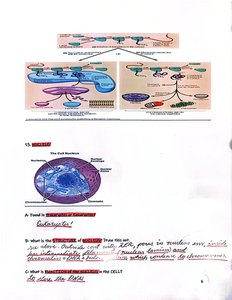
Function: Stores genetic material (DNA) and coordinates cell activities such as growth, metabolism, and reproduction.
Structure: Surrounded by a double membrane (nuclear envelope) with nuclear pores.
Ribosomes
Function: Synthesize proteins by translating messenger RNA (mRNA).
Location: Free in cytoplasm or bound to rough endoplasmic reticulum (RER).
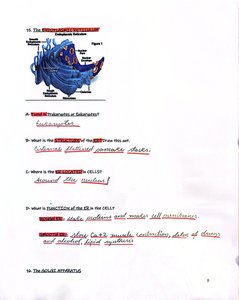
Endoplasmic Reticulum (ER)
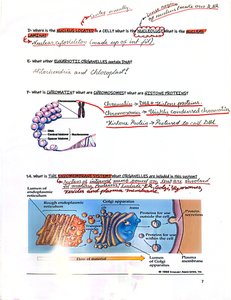
Rough ER (RER): Studded with ribosomes; synthesizes proteins for secretion or membrane insertion.
Smooth ER (SER): Lacks ribosomes; synthesizes lipids, detoxifies drugs, and stores calcium ions.
Golgi Apparatus
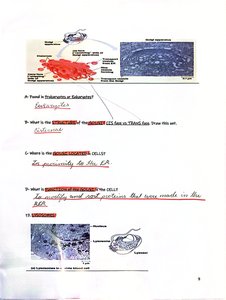
Function: Modifies, sorts, and packages proteins and lipids for storage or transport out of the cell.
Structure: Stacks of flattened membranous sacs (cisternae).
Lysosomes
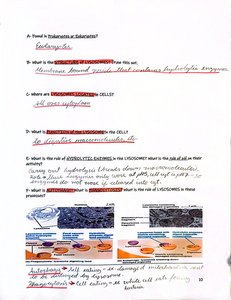
Function: Digest macromolecules, old organelles, and foreign substances.
Contains: Hydrolytic enzymes for intracellular digestion.
Vacuoles and Vesicles
Vacuoles: Large vesicles for storage and maintaining cell rigidity (especially in plants).
Vesicles: Small membrane-bound sacs for transport within cells.
Mitochondria
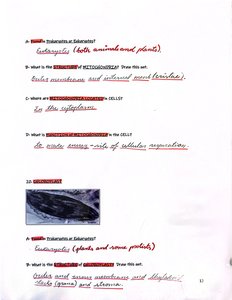
Function: Site of cellular respiration; produces ATP from glucose and oxygen.
Structure: Double membrane with inner folds (cristae) to increase surface area.
Chloroplasts
Function: Site of photosynthesis in plant cells; converts solar energy to chemical energy (glucose).
Structure: Double membrane, contains thylakoids stacked into grana.
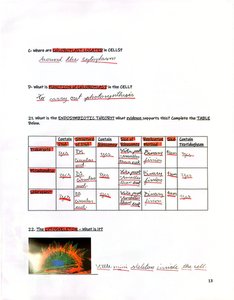
Cytoskeleton
Microtubules: Hollow rods that shape the cell, guide organelle movement, and separate chromosomes during cell division.
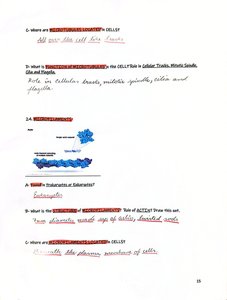
Microfilaments: Thin rods of actin that support cell shape and are involved in movement.
Intermediate Filaments: Provide mechanical support for the cell.
Cell Surface Structures
Cell Wall: Found in plants, fungi, and some protists; provides structural support and protection.
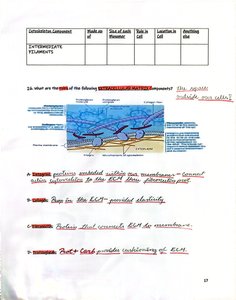
Extracellular Matrix (ECM): Network of proteins and carbohydrates outside animal cells that provides support and regulates cell behavior.
Summary Table: Organelle Functions and Locations
Organelle | Function | Location | Found in |
|---|---|---|---|
Nucleus | Stores DNA, controls cell | Center of cell | Eukaryotes |
Ribosome | Protein synthesis | Cytoplasm, RER | All cells |
ER (Rough/Smooth) | Protein/lipid synthesis | Near nucleus | Eukaryotes |
Golgi Apparatus | Modifies, sorts, ships proteins | Cytoplasm | Eukaryotes |
Lysosome | Digestion | Cytoplasm | Animals |
Mitochondria | ATP production | Cytoplasm | Eukaryotes |
Chloroplast | Photosynthesis | Cytoplasm | Plants, some protists |
Key Concepts and Equations
Surface Area to Volume Ratio:
Magnification:
Resolution Limit (Light Microscope):
Additional info: These notes cover the structure and function of cell components, microscopy, and the differences between prokaryotic and eukaryotic cells, as outlined in a typical General Biology curriculum.
