 Indietro
Translation: Decoding mRNA into Protein
Guida di studio - Note intelligenti
 Appunti personalizzati basati sui tuoi materiali, ampliati con definizioni chiave, esempi e contesto.
Translation: mRNA to Protein
Overview of Translation
Translation is the process by which messenger RNA (mRNA) is decoded by ribosomes to produce a specific polypeptide (protein). This process is fundamental to gene expression and occurs in the cytoplasm of cells. - Key Point 1: Translation converts the nucleotide sequence of mRNA into the amino acid sequence of a protein. - Key Point 2: The process follows the central dogma: DNA → RNA → Protein. 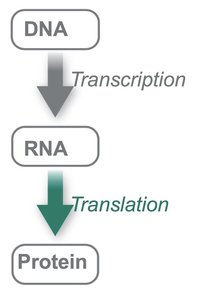
Genetic Code and Codons
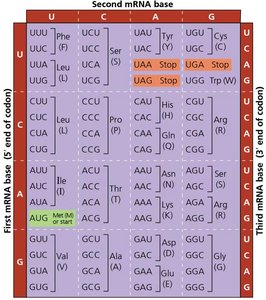
The genetic code is composed of triplets of nucleotides called codons, each of which specifies an amino acid or a stop signal. - Key Point 1: There are 64 possible codons (4 bases^3), but only 20 amino acids, making the code redundant. - Key Point 2: The start codon (AUG) codes for methionine and signals the beginning of translation. - Key Point 3: Stop codons (UAA, UAG, UGA) signal the end of translation. 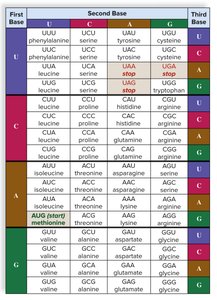
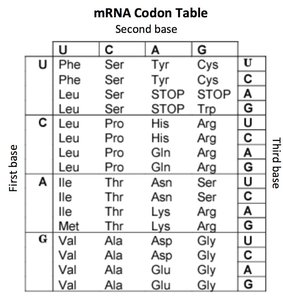
Codon Table Example
Codon | Amino Acid |
|---|---|
AUG | Methionine (Start) |
UAA | Stop |
CAU | Histidine |
CAA | Glutamine |
GCA | Alanine |
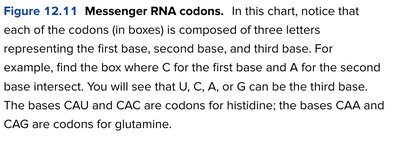
Transcription and Translation Relationship
Transcription produces mRNA from a DNA template, which is then translated into protein. - Key Point 1: The coding strand of DNA matches the mRNA sequence (except T is replaced by U). - Key Point 2: The template strand is used to synthesize mRNA. - Example: DNA sequence 5'-ATG GCC AAT GAC TTT CAA TAA-3' is transcribed to mRNA 5'-AUG GCC AAU GAC UUU CAA UAA-3' and translated as Met-Ala-Asn-Asp-Phe-Gln-(stop). 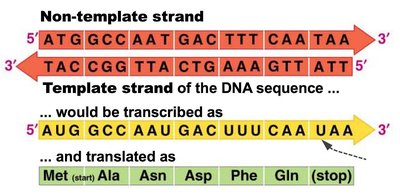
Components Required for Translation
Several molecular components are essential for translation: - Messenger RNA (mRNA): Carries the genetic code from DNA. - Transfer RNA (tRNA): Brings amino acids to the ribosome; each tRNA has an anticodon complementary to the mRNA codon. - Ribosome: The molecular machine composed of rRNA and proteins that catalyzes peptide bond formation. - Aminoacyl tRNA synthetases: Enzymes that attach the correct amino acid to its tRNA. 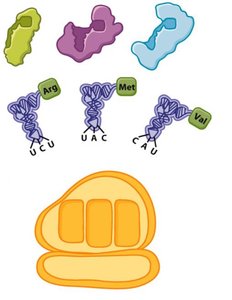

tRNA Structure and Function
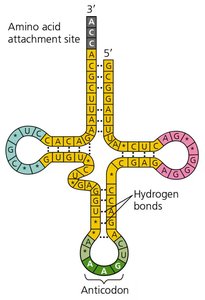
tRNA molecules have a characteristic cloverleaf structure and play a critical role in translation. - Key Point 1: Each tRNA has an anticodon that base-pairs with the mRNA codon. - Key Point 2: The amino acid attachment site is at the 3' end of the tRNA. - Key Point 3: Aminoacyl tRNA synthetases ensure the correct amino acid is attached to the corresponding tRNA. 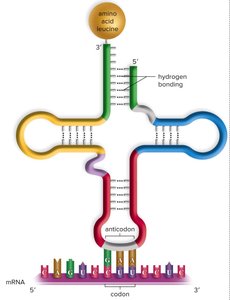
Translation Initiation
Translation begins when the small ribosomal subunit binds to the mRNA and scans for the start codon (AUG). - Key Point 1: Initiation factors help assemble the initiation complex. - Key Point 2: The initiator tRNA carrying methionine binds to the start codon. - Key Point 3: The large ribosomal subunit then joins, and translation begins at the P site. 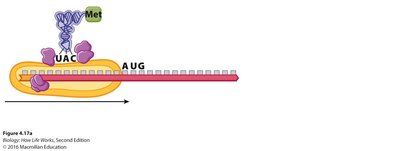
Translation Elongation
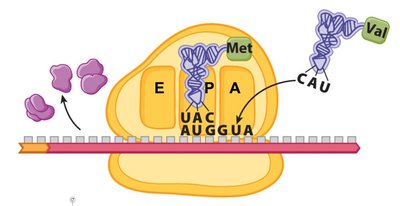
During elongation, the ribosome moves along the mRNA, adding amino acids to the growing polypeptide chain. - Key Point 1: tRNAs enter the A site, match their anticodon to the mRNA codon, and bring the correct amino acid. - Key Point 2: Peptide bonds are formed between amino acids in the P site and A site. - Key Point 3: The ribosome shifts, moving tRNAs through the E (exit), P (peptidyl), and A (aminoacyl) sites.
Translation Termination
Termination occurs when a stop codon enters the A site. - Key Point 1: Release factors bind to the stop codon, causing the polypeptide to be released. - Key Point 2: The ribosome dissociates, and translation ends.
Polyribosomes (Polysomes)
Multiple ribosomes can translate a single mRNA simultaneously, forming a polyribosome. - Key Point 1: This increases the efficiency of protein synthesis. - Key Point 2: Each ribosome moves independently along the mRNA. 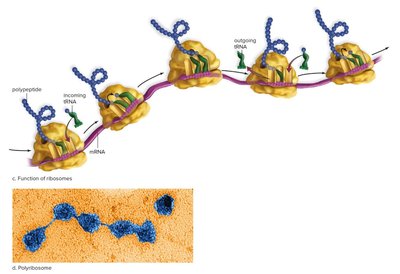
Summary Table: Translation Steps
Step | Description |
|---|---|
Initiation | Small ribosomal subunit binds mRNA, scans for AUG, initiator tRNA binds, large subunit joins |
Elongation | tRNAs bring amino acids, peptide bonds form, ribosome shifts along mRNA |
Termination | Stop codon reached, release factor binds, polypeptide released |
Application: Decoding mRNA
To determine the amino acid sequence from an mRNA, use the codon table and read the mRNA in the 5' to 3' direction. - Example: mRNA sequence 5'-AUG GCC AAU GAC UUU CAA UAA-3' translates to Met-Ala-Asn-Asp-Phe-Gln-(stop).
Key Definitions
- Codon: A sequence of three mRNA nucleotides that codes for an amino acid or stop signal. - Anticodon: A sequence of three nucleotides in tRNA that pairs with the mRNA codon. - Peptide bond: The chemical bond formed between amino acids during protein synthesis.
Equations and Formulas
- Number of possible codons: - Peptide bond formation:
Additional info:
The redundancy of the genetic code means that most amino acids are specified by more than one codon, providing a buffer against mutations. The translation process is highly regulated and essential for cellular function. ----------------------------------------
