 Indietro
Translation, tRNA, and the Genetic Code: Codon-Anticodon Pairing, Wobble, and Reading Frames
Guida di studio - Note intelligenti
 Appunti personalizzati basati sui tuoi materiali, ampliati con definizioni chiave, esempi e contesto.
Translation and the Genetic Code
Codons and the Genetic Code
The genetic code is a set of rules by which information encoded in mRNA sequences is translated into proteins. Each codon is a three-nucleotide sequence on mRNA that specifies a particular amino acid or a stop signal during protein synthesis.
Codons are always written 5' to 3'.
There are 64 possible codons, but only 20 amino acids, leading to redundancy (degeneracy) in the code.
Start codon: 5'AUG3' (codes for methionine, Met).
Stop codons: 5'UAA3', 5'UGA3', 5'UAG3' (signal termination of translation).
The code is nearly universal across all organisms.
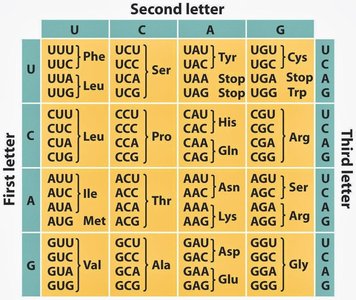
Example: The codon ACU codes for threonine (Thr).
Codon-Anticodon Pairing
During translation, codons on mRNA are recognized by complementary anticodons on tRNA molecules. The orientation is crucial: codons are read 5' to 3', while anticodons are written 3' to 5'.
Base pairing rules: A pairs with U, G pairs with C.
For codon 5'AAU3', the anticodon is 3'UUA5'.
For anticodon 3'CCA5', the codon is 5'GGU3'.
tRNA Structure and Function
tRNA Structure
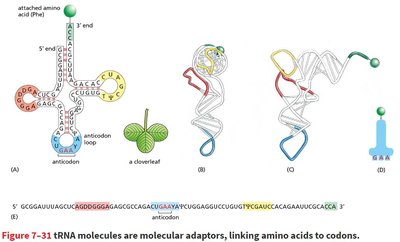
Transfer RNAs (tRNAs) are adaptor molecules that link codons in mRNA to their corresponding amino acids during translation. tRNAs fold into a characteristic cloverleaf secondary structure stabilized by intramolecular hydrogen bonds.
tRNAs are classified as non-coding RNAs.
Each tRNA has an anticodon loop and an amino acid attachment site (always ending with 5'CCA3', added post-transcriptionally).
Intramolecular base pairing (hydrogen bonds within the same molecule) stabilizes the structure.
tRNA Charging
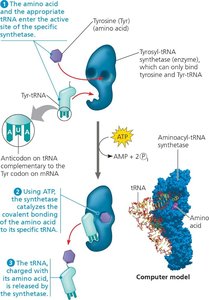
tRNA charging is the process by which a specific amino acid is attached to its corresponding tRNA by an enzyme called aminoacyl-tRNA synthetase. There are 20 different synthetases, one for each amino acid.
The enzyme recognizes both the amino acid and the correct tRNA(s).
ATP is used to form a high-energy bond between the amino acid and tRNA, powering peptide bond formation during translation.
Wobble Base Pairing and Redundancy
Wobble Hypothesis
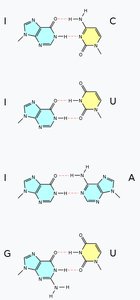
The wobble hypothesis explains how some tRNAs can recognize more than one codon due to flexible base pairing at the third codon position (5' end of the anticodon, 3' end of the codon). This contributes to the redundancy of the genetic code.
Inosine (I), a modified base in tRNA, can pair with U, C, or A in the codon.
Wobble allows fewer tRNAs to cover all codons for an amino acid.
Wobble Pairing Rules Table
Anticodon (5' position) | Codon (3' position) |
|---|---|
U | A, G |
G | U, C |
I (inosine) | U, C, A |
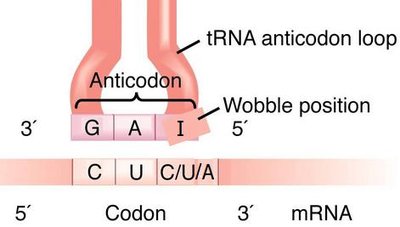
Example: The three isoleucine codons (AUU, AUC, AUA) can all be recognized by a single tRNA with the anticodon 3'UA5'.
Application: Leucine Codons and Wobble
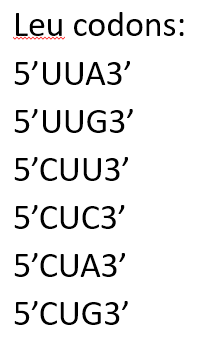
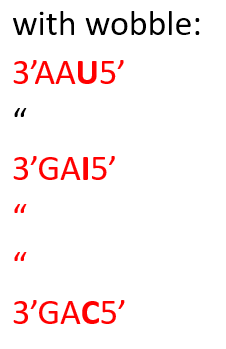
Leucine is encoded by six codons. Using wobble rules, the minimum number of tRNAs required to recognize all leucine codons can be determined.
Reading Frames and Open Reading Frames (ORFs)
Reading Frames
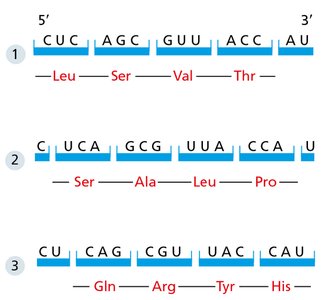
A reading frame is a way of dividing the sequence of nucleotides in mRNA or DNA into consecutive, non-overlapping triplets (codons). The correct reading frame is set by the start codon (AUG).
Each mRNA has three possible reading frames.
Double-stranded DNA has six possible reading frames (three per strand).
Only one reading frame will produce the correct protein sequence.
Open Reading Frames (ORFs)
An open reading frame (ORF) is a sequence of DNA or mRNA that starts with a start codon and ends with an in-frame stop codon. ORFs are potential protein-coding regions.
ORFs are identified by searching for start and stop codons in all reading frames.
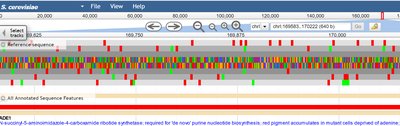
Bioinformatics tools scan all six reading frames in genomic DNA to find ORFs.
Translating mRNA to Protein
To translate an mRNA sequence, identify the start codon, read each codon in the correct frame, and use the genetic code to determine the amino acid sequence.
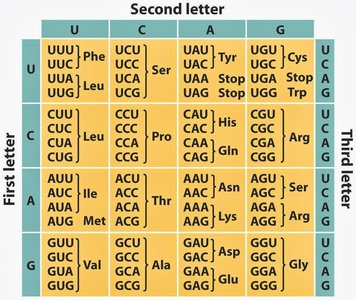
Example: mRNA: 5' AUG CCG AUC GAU CUA UAG 3' translates to the protein sequence: Met–Pro–Ile–Asp–Leu (stop).
Mutations Affecting Protein Coding
Types of Mutations
Missense mutation: A single nucleotide change results in a codon that codes for a different amino acid.
Nonsense mutation: A single nucleotide change creates a stop codon, leading to premature termination.
Insertion: Addition of one or more nucleotides, potentially causing a frameshift.
Deletion: Removal of one or more nucleotides, potentially causing a frameshift.
Frameshift mutations (insertions or deletions not in multiples of three) alter the reading frame, often resulting in nonfunctional proteins.
Summary Table: Codon-Anticodon Pairing and Wobble
Codon (mRNA, 5'→3') | Anticodon (tRNA, 3'→5') | Amino Acid |
|---|---|---|
AAU | UUA | Asn |
CCA | GGU | Pro |
UGG | ACC | Trp |
GAU | CUA | Asp |
Additional info: The above table illustrates standard Watson-Crick base pairing. Wobble base pairing allows for flexibility at the third codon position, reducing the number of tRNAs needed.
