 Indietro
Implicit Differentiation and Applications in Calculus
Guida di studio - Note intelligenti
 Appunti personalizzati basati sui tuoi materiali, ampliati con definizioni chiave, esempi e contesto.
Implicit Differentiation
Introduction to Implicit Functions
In calculus, not all curves can be represented as explicit functions of the form y = f(x). Some curves are defined implicitly by equations involving both x and y. To analyze such curves, we use implicit differentiation, a technique that allows us to find derivatives even when y is not isolated.
Implicit Function: An equation involving both x and y that defines y as a function of x only implicitly, not explicitly.
Example: The equation defines a curve that is not the graph of a single function y = f(x), but can be analyzed in segments.
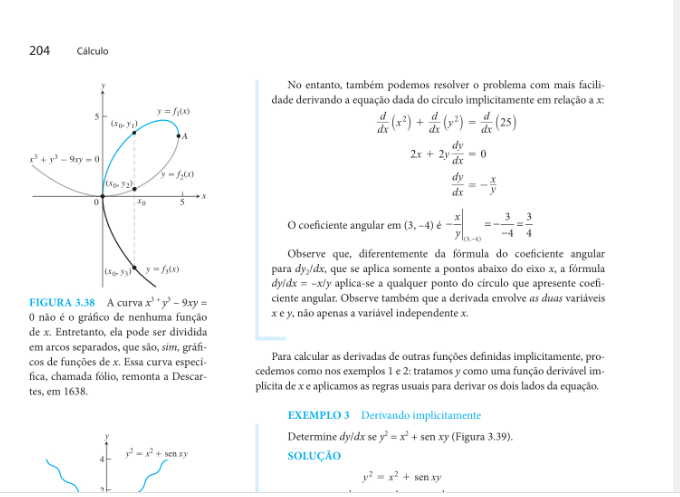
Additional info: The curve shown is known as a folium of Descartes, first studied in 1638.
Implicit Differentiation Process
To differentiate an equation involving both x and y, we treat y as a differentiable function of x (i.e., y = y(x)) and apply the derivative to both sides, using the chain rule where necessary.
Step 1: Differentiate both sides of the equation with respect to x.
Step 2: Apply the chain rule to terms involving y (e.g., ).
Step 3: Solve for .
Example: Differentiating the Circle Equation
Consider the circle equation .
Differentiating both sides with respect to x:
This formula for the slope of the tangent applies at any point on the circle, not just below the x-axis.
Example: At the point (3, -4) on the circle, the slope is:
General Approach for Implicit Differentiation
For any equation involving x and y, follow these steps:
Differentiating both sides with respect to x.
Apply the chain rule to terms involving y.
Collect all terms involving on one side.
Solve for .
Example: Implicit Differentiation with Trigonometric Functions
Problem: Find if .
Differentiating both sides with respect to x:
Apply the product rule to :
Substitute back:
Expand and collect terms:
Summary: Implicit differentiation is a powerful tool for finding derivatives of equations where y is not isolated. It is essential for analyzing curves defined implicitly, such as circles, ellipses, and more complex relations.
