


Ch. 3 - Derivatives
Briggs - Calculus: Early Transcendentals 3rd Edition
Briggs3rd EditionCalculus: Early TranscendentalsISBN: 9780136847243Non è quello che usi tu?Cambia libro di testo
Capitolo 3, Problema 3.2.23b

21–30. Derivatives
b. Evaluate f'(a) for the given values of a.
f(x) = 4x²+1; a= 2,4

Guida verificata passo dopo passo
1
Step 1: Identify the function f(x) = 4x^2 + 1 and the values of a for which we need to evaluate the derivative, which are a = 2 and a = 4.
Step 2: Find the derivative of the function f(x) with respect to x. Use the power rule, which states that the derivative of x^n is n*x^(n-1).
Step 3: Apply the power rule to f(x) = 4x^2 + 1. The derivative of 4x^2 is 8x, and the derivative of the constant 1 is 0.
Step 4: Write the derivative function f'(x) = 8x.
Step 5: Evaluate the derivative at the given values of a. Calculate f'(2) by substituting x = 2 into f'(x), and calculate f'(4) by substituting x = 4 into f'(x).

Risposta video verificata per un problema simile:

Questa soluzione video è stata consigliata dai nostri tutor come utile per risolvere questo problema.
Durata del video:
5m

Concetti chiave

Ecco i concetti essenziali che devi comprendere per rispondere correttamente alla domanda.

Derivatives

A derivative represents the rate of change of a function with respect to its variable. It is a fundamental concept in calculus that provides information about the slope of the tangent line to the curve of the function at any given point. The derivative is denoted as f'(x) and can be calculated using various rules, such as the power rule, product rule, and quotient rule.
Video consigliato:

Power Rule

The power rule is a basic differentiation rule used to find the derivative of functions in the form f(x) = x^n, where n is a real number. According to this rule, the derivative f'(x) is calculated as n*x^(n-1). This rule simplifies the process of differentiation, especially for polynomial functions, making it easier to evaluate derivatives at specific points.
Video consigliato:
5:50
Power Rules

Evaluating Derivatives at Specific Points

Evaluating the derivative at a specific point involves substituting the value of that point into the derivative function. For example, if f'(x) is found, to evaluate f'(a) for a given value of a, simply replace x with a in the derivative expression. This process yields the instantaneous rate of change of the function at that particular point, providing insights into the function's behavior.
Video consigliato:
04:50
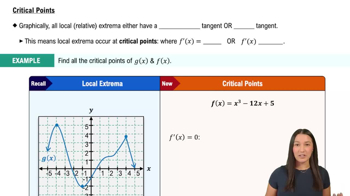
Critical Points