Ch. 3 - Derivatives
Briggs - Calculus: Early Transcendentals 3rd Edition
Briggs3rd EditionCalculus: Early TranscendentalsISBN: 9780136847243Non è quello che usi tu?Cambia libro di testo
Capitolo 3, Problema 3.8.44b

Volume of a torus The volume of a torus (doughnut or bagel) with an inner radius of a and an outer radius of b is V=π²(b+a)(b−a)²/4.
b. Evaluate this derivative when a=6 and b=10.

Guida verificata passo dopo passo
1
First, identify the formula for the volume of the torus: \( V = \frac{\pi^2 (b+a)(b-a)^2}{4} \).
To find the derivative of the volume with respect to the outer radius \( b \), apply the product rule and chain rule to the expression \( V = \frac{\pi^2}{4} (b+a)(b-a)^2 \).
Differentiate \( (b+a) \) with respect to \( b \), which is simply 1, since \( a \) is a constant.
Differentiate \( (b-a)^2 \) with respect to \( b \) using the chain rule: \( 2(b-a) \cdot 1 \).
Substitute \( a = 6 \) and \( b = 10 \) into the derivative expression to evaluate it at these values.

Risposta video verificata per un problema simile:

Questa soluzione video è stata consigliata dai nostri tutor come utile per risolvere questo problema.
Durata del video:
11m

Concetti chiave

Ecco i concetti essenziali che devi comprendere per rispondere correttamente alla domanda.

Volume of a Torus

The volume of a torus is calculated using the formula V=π²(b+a)(b−a)²/4, where 'a' is the inner radius and 'b' is the outer radius. This formula derives from integrating the area of circular cross-sections of the torus, taking into account the geometry of the shape. Understanding this formula is essential for evaluating the volume based on given radii.
Video consigliato:
08:29
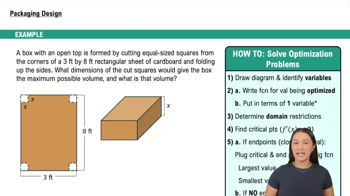
Example 5: Packaging Design

Derivative

A derivative represents the rate of change of a function with respect to a variable. In this context, evaluating the derivative of the volume function with respect to the radii 'a' and 'b' will provide insights into how changes in these dimensions affect the volume of the torus. Mastery of differentiation techniques is crucial for solving problems involving rates of change.
Video consigliato:

Evaluation of Functions

Evaluating a function involves substituting specific values into the function to compute a result. In this case, substituting a=6 and b=10 into the volume formula allows for the calculation of the torus's volume. This concept is fundamental in calculus, as it connects theoretical functions to practical numerical results.
Video consigliato:
Percorso guidato
4:26
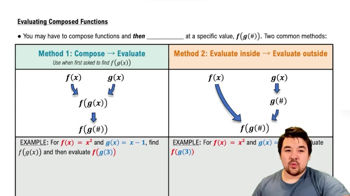
Evaluating Composed Functions
Pratica correlata
Domanda del libro di testo

Tangents and inverses Suppose L(x)=ax+b (with a≠0) is the equation of the line tangent to the graph of a one-to-one function f at (x0,y0). Also, suppose M(x)=cx+d is the equation of the line tangent to the graph of f^−1 at (y0,x0).


c. Prove that L^−1(x)=M(x).

154
views
Domanda del libro di testo

21–30. Derivatives

b. Evaluate f'(a) for the given values of a.

f(x) = 4x²+1; a= 2,4

367
views
Domanda del libro di testo

Surface area of a cone The lateral surface area of a cone of radius r and height h (the surface area excluding the base) is A = πr√r²+h².

b. Evaluate this derivative when r=30 and h=40.

292
views
Domanda del libro di testo

Deriving trigonometric identities

c. Differentiate both sides of the identity sin 2t = 2 sin t cost to prove that cos 2t = cos²t−sin²t.

478
views
Domanda del libro di testo

Suppose f(3) = 1 and f′(3) = 4. Let g(x) = x2 + f(x) and h(x) = 3f(x).

Find an equation of the line tangent to y = h(x) at x = 3.

192
views
Domanda del libro di testo

97–100. Logistic growth Scientists often use the logistic growth function P(t) = P₀K / P₀+(K−P₀)e^−r₀t to model population growth, where P₀ is the initial population at time t=0, K is the carrying capacity, and r₀ is the base growth rate. The carrying capacity is a theoretical upper bound on the total population that the surrounding environment can support. The figure shows the sigmoid (S-shaped) curve associated with a typical logistic model. <IMAGE>


{Use of Tech} Gone fishing When a reservoir is created by a new dam, 50 fish are introduced into the reservoir, which has an estimated carrying capacity of 8000 fish. A logistic model of the fish population is P(t) = 400,000 / 50+7950e^−0.5t, where t is measured in years.


c. How fast (in fish per year) is the population growing at t=0? At t=5?

200
views