
Ch. 5 - Integration
Briggs - Calculus: Early Transcendentals 3rd Edition
Briggs3rd EditionCalculus: Early TranscendentalsISBN: 9780136847243Non è quello che usi tu?Cambia libro di testo
Capitolo 5, Problema 5.1.71c

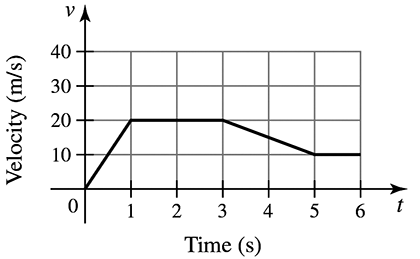
Displacement from a velocity graph Consider the velocity function for an object moving along a line (see figure).
(c) Use geometry to find the displacement of the object between t = 2 and t = 5.
Velocity graph showing time in seconds on the x-axis and velocity in meters per second on the y-axis.

Guida verificata passo dopo passo
1
Step 1: Understand the problem. The displacement of the object between t = 2 and t = 5 can be found by calculating the area under the velocity graph between these time intervals. The graph consists of geometric shapes (rectangles and triangles) that can be used to compute the area.
Step 2: Identify the shapes under the graph between t = 2 and t = 5. From t = 2 to t = 3, the graph forms a rectangle. From t = 3 to t = 5, the graph forms a triangle.
Step 3: Calculate the area of the rectangle from t = 2 to t = 3. The height of the rectangle is the velocity at t = 2, which is 20 m/s, and the width is the time interval, which is 1 second. Use the formula for the area of a rectangle: A=l×w.
Step 4: Calculate the area of the triangle from t = 3 to t = 5. The base of the triangle is the time interval, which is 2 seconds, and the height is the change in velocity, which is 20 m/s - 10 m/s = 10 m/s. Use the formula for the area of a triangle: A=b×h2.
Step 5: Add the areas of the rectangle and triangle to find the total displacement of the object between t = 2 and t = 5. The sum of these areas represents the total displacement in meters.

Risposta video verificata per un problema simile:

Questa soluzione video è stata consigliata dai nostri tutor come utile per risolvere questo problema.
Durata del video:
4m

Concetti chiave

Ecco i concetti essenziali che devi comprendere per rispondere correttamente alla domanda.

Velocity Function

The velocity function describes how the velocity of an object changes over time. It is a graphical representation where the y-axis represents velocity (in meters per second) and the x-axis represents time (in seconds). Understanding this function is crucial for analyzing the motion of the object, as it provides insights into how fast and in what direction the object is moving at any given moment.
Video consigliato:
Percorso guidato
10:17
Using The Velocity Function

Displacement

Displacement is the overall change in position of an object over a specific time interval. It can be calculated by finding the area under the velocity graph between two time points. In this case, the displacement from t = 2 to t = 5 seconds can be determined by calculating the area of the geometric shapes formed by the velocity graph within that interval, which represents the total distance traveled in that time frame.
Video consigliato:
Percorso guidato
10:17
Using The Velocity Function

Area Under the Curve

In calculus, the area under a curve on a graph represents the integral of a function over a specified interval. For a velocity graph, this area corresponds to the displacement of the object. By using geometric shapes such as rectangles and triangles, one can calculate the area under the curve between two time points, which provides the total displacement of the object during that time period.
Video consigliato:
Percorso guidato
05:59
Estimating the Area Under a Curve with Right Endpoints & Midpoint
Pratica correlata
Domanda del libro di testo

Explain why or why not Determine whether the following statements are true and give an explanation or counterexample.

(c) The average value of a linear function on an interval [a, b] is the function value at the midpoint of [a, b] .

55
views
Domanda del libro di testo

Zero net area Consider the function ƒ(𝓍) = 𝓍² ― 4𝓍 .                                                                                                                                       

                                                                                                                                                                                     c) In general, for the function ƒ(𝓍) = 𝓍² ― a𝓍, where a > 0, for what value of b > 0 (as a function of a) is ∫₀ᵇ ƒ(𝓍) d𝓍 = 0 ? 

49
views
Domanda del libro di testo

Matching functions with area functions Match the functions ƒ, whose graphs are given in a― d, with the area functions A (𝓍) = ∫₀ˣ ƒ(t) dt, whose graphs are given in A–D.


70
views
Domanda del libro di testo

Explain why or why not Determine whether the following statements are true and give an explanation or counterexample.                                                                          

                                                                                                                                                                                     (c) The functions p(𝓍) = sin 3𝓍 and q(𝓍) = 4 sin 3𝓍 are antiderivatives of the same function. 

38
views
Domanda del libro di testo

Use Table 5.6 to evaluate the following definite integrals.                                                                                                                    

 (c) ∫₃√₂^⁶ d𝓍/(𝓍² ―9)

87
views
Domanda del libro di testo

{Use of Tech} Approximating definite integrals Complete the following steps for the given integral and the given value of n. 

(c) Calculate the left and right Riemann sums for the given value of n.

∫₁⁷ 1/𝓍 d𝓍 ; n = 6

65
views