
Ch. 5 - Integration
Briggs - Calculus: Early Transcendentals 3rd Edition
Briggs3rd EditionCalculus: Early TranscendentalsISBN: 9780136847243Non è quello che usi tu?Cambia libro di testo
Capitolo 5, Problema 5.3.107c

Explain why or why not Determine whether the following statements are true and give an explanation or counterexample.                                                                          
                                                                                                                                                                                     (c) The functions p(𝓍) = sin 3𝓍 and q(𝓍) = 4 sin 3𝓍 are antiderivatives of the same function. 

Guida verificata passo dopo passo
1
Recall the definition of antiderivatives: Two functions are antiderivatives of the same function if their derivatives are equal.
Find the derivative of the first function \(p(\mathcal{x}) = \sin 3\mathcal{x}\) using the chain rule: \(p'(\mathcal{x}) = 3 \cos 3\mathcal{x}\).
Find the derivative of the second function \(q(\mathcal{x}) = 4 \sin 3\mathcal{x}\) similarly: \(q'(\mathcal{x}) = 4 \cdot 3 \cos 3\mathcal{x} = 12 \cos 3\mathcal{x}\).
Compare the derivatives \(p'(\mathcal{x}) = 3 \cos 3\mathcal{x}\) and \(q'(\mathcal{x}) = 12 \cos 3\mathcal{x}\). Since they are not equal, \(p\) and \(q\) are not antiderivatives of the same function.
Conclude that the statement is false because the derivatives differ by a constant factor, so \(p\) and \(q\) cannot both be antiderivatives of the same function.

Risposta video verificata per un problema simile:

Questa soluzione video è stata consigliata dai nostri tutor come utile per risolvere questo problema.
Durata del video:
2m

Concetti chiave

Ecco i concetti essenziali che devi comprendere per rispondere correttamente alla domanda.

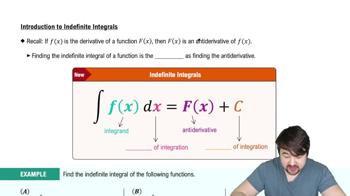
Antiderivative (Indefinite Integral)

An antiderivative of a function f(x) is another function F(x) whose derivative is f(x). It represents the family of all functions differing by a constant, since differentiation eliminates constants. For example, if F'(x) = f(x), then F(x) + C is the general antiderivative.
Video consigliato:
Percorso guidato
05:04
Introduction to Indefinite Integrals

Linearity of Differentiation

Differentiation is a linear operation, meaning the derivative of a constant multiple of a function is the constant times the derivative of the function. For instance, if g(x) = k·f(x), then g'(x) = k·f'(x). This property helps compare functions to determine if they share the same derivative.
Video consigliato:

Checking if Two Functions are Antiderivatives of the Same Function

Two functions are antiderivatives of the same function if their derivatives are identical. If their derivatives differ, they cannot be antiderivatives of the same function. For example, p(x) = sin(3x) and q(x) = 4 sin(3x) have different derivatives, so they are not antiderivatives of the same function.
Video consigliato:
Percorso guidato
06:21
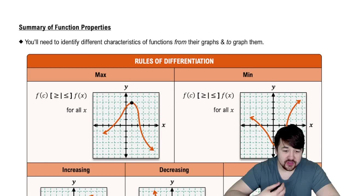
Properties of Functions
Pratica correlata
Domanda del libro di testo

Explain why or why not Determine whether the following statements are true and give an explanation or counterexample.

(c) The average value of a linear function on an interval [a, b] is the function value at the midpoint of [a, b] .

55
views
Domanda del libro di testo

{Use of Tech} Approximating definite integrals Complete the following steps for the given integral and the given value of n. 

(d) Determine which Riemann sum (left or right) underestimates the value of the definite integral and which overestimates the value of the definite integral.


∫₁⁷ 1/𝓍 d𝓍 ; n = 6

51
views
Domanda del libro di testo

Matching functions with area functions Match the functions ƒ, whose graphs are given in a― d, with the area functions A (𝓍) = ∫₀ˣ ƒ(t) dt, whose graphs are given in A–D.


70
views
Domanda del libro di testo

{Use of Tech} Approximating definite integrals Complete the following steps for the given integral and the given value of n. 

(c) Calculate the left and right Riemann sums for the given value of n.


∫₀² (𝓍²―2) d𝓍 ; n = 4

80
views
Domanda del libro di testo

Displacement from a velocity graph Consider the velocity function for an object moving along a line (see figure).

(c) Use geometry to find the displacement of the object between t = 2 and t = 5.

100
views
Domanda del libro di testo

Mass from density A thin 10-cm rod is made of an alloy whose density varies along its length according to the function shown in the figure. Assume density is measured in units of g/cm. In Chapter 6, we show that the mass of the rod is the area under the density curve.

(c) Find the mass of the entire rod (0 ≤ x ≤ 10) .

53
views