Ch. 5 - Integration
Briggs - Calculus: Early Transcendentals 3rd Edition
Briggs3rd EditionCalculus: Early TranscendentalsISBN: 9780136847243Non è quello che usi tu?Cambia libro di testo
Capitolo 5, Problema 5.4.45c

Explain why or why not Determine whether the following statements are true and give an explanation or counterexample.
(c) The average value of a linear function on an interval [a, b] is the function value at the midpoint of [a, b] .

Guida verificata passo dopo passo
1
Step 1: Recall the formula for the average value of a function f(x) on an interval [a, b]. It is given by: 1(b-a)∫abf(x)dx.
Step 2: For a linear function, f(x) = mx + c, substitute this into the formula for the average value. The integral becomes: ∫ab(mx+c)dx.
Step 3: Compute the integral of the linear function. The integral of mx is m2x2, and the integral of c is cx. Evaluate these terms at the bounds a and b.
Step 4: Simplify the result of the integral and divide by (b - a) to find the average value. After simplification, the average value of the linear function will be: m((a+b)2)+c, which is the function value at the midpoint of [a, b].
Step 5: Conclude that the statement is true. The average value of a linear function on an interval [a, b] is indeed equal to the function value at the midpoint of [a, b], as shown by the calculation.

Risposta video verificata per un problema simile:

Questa soluzione video è stata consigliata dai nostri tutor come utile per risolvere questo problema.
Durata del video:
4m

Concetti chiave

Ecco i concetti essenziali che devi comprendere per rispondere correttamente alla domanda.

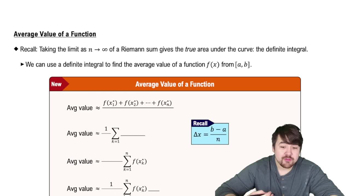
Average Value of a Function

The average value of a function f(x) over an interval [a, b] is calculated using the formula (1/(b-a)) * ∫[a to b] f(x) dx. This concept is crucial for understanding how to find the mean value of a function across a specified range, which can differ from simply evaluating the function at a single point.
Video consigliato:
Percorso guidato
06:37
Average Value of a Function

Linear Functions

A linear function is a polynomial function of degree one, typically expressed in the form f(x) = mx + b, where m is the slope and b is the y-intercept. The properties of linear functions, such as constant slope and direct proportionality, influence how their average value behaves over an interval.
Video consigliato:

Midpoint of an Interval

The midpoint of an interval [a, b] is calculated as (a + b)/2. For linear functions, evaluating the function at this midpoint can yield the average value, but this is not true for non-linear functions. Understanding this concept helps clarify why the statement may hold true specifically for linear functions.
Video consigliato:
Percorso guidato
07:39
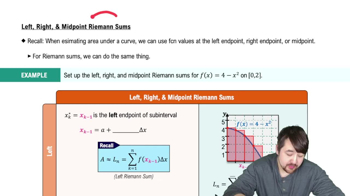
Left, Right, & Midpoint Riemann Sums
Pratica correlata
Domanda del libro di testo

Matching functions with area functions Match the functions ƒ, whose graphs are given in a― d, with the area functions A (𝓍) = ∫₀ˣ ƒ(t) dt, whose graphs are given in A–D.


70
views

Domanda del libro di testo

Explain why or why not Determine whether the following statements are true and give an explanation or counterexample.                                                                          

                                                                                                                                                                                     (c) The functions p(𝓍) = sin 3𝓍 and q(𝓍) = 4 sin 3𝓍 are antiderivatives of the same function. 

38
views
Domanda del libro di testo

Use Table 5.6 to evaluate the following definite integrals.                                                                                                                    

 (c) ∫₃√₂^⁶ d𝓍/(𝓍² ―9)

87
views
Domanda del libro di testo

Displacement from a velocity graph Consider the velocity function for an object moving along a line (see figure).

(c) Use geometry to find the displacement of the object between t = 2 and t = 5.

100
views
Domanda del libro di testo

Mass from density A thin 10-cm rod is made of an alloy whose density varies along its length according to the function shown in the figure. Assume density is measured in units of g/cm. In Chapter 6, we show that the mass of the rod is the area under the density curve.

(c) Find the mass of the entire rod (0 ≤ x ≤ 10) .

53
views
Domanda del libro di testo

{Use of Tech} Approximating definite integrals Complete the following steps for the given integral and the given value of n. 

(c) Calculate the left and right Riemann sums for the given value of n.

∫₁⁷ 1/𝓍 d𝓍 ; n = 6

65
views