 Indietro
Cell Biology Study Guide: Endomembrane System, Cytoskeleton, Bioenergetics, Glycolysis, Gluconeogenesis, and TCA Cycle
Guida di studio - Note intelligenti
 Appunti personalizzati basati sui tuoi materiali, ampliati con definizioni chiave, esempi e contesto.
The Endomembrane System
Overview of the Endomembrane System
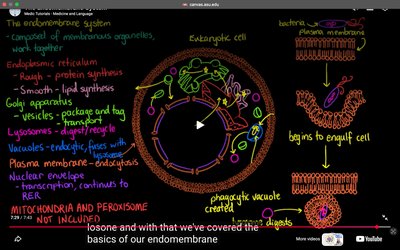
The endomembrane system is a network of interconnected membranous organelles within eukaryotic cells, responsible for the synthesis, processing, and transport of proteins and lipids. It includes the nuclear envelope, endoplasmic reticulum (ER), Golgi apparatus, lysosomes, vacuoles, and the plasma membrane.
Trafficking: Materials move between organelles via transport vesicles, which bud off, transfer, and fuse with target membranes.
Vesicle Transport: Essential for the functioning of the endomembrane system, allowing exchange of contents within the cell or secretion outside.
Endoplasmic Reticulum (ER)
The ER is a network of membrane-enclosed tubules and sacs extending from the nuclear envelope throughout the cytoplasm. It is divided into rough ER (RER) and smooth ER (SER), which are continuous but functionally distinct.
Rough ER: Studded with ribosomes; involved in protein biosynthesis, folding, assembly, and loading of vesicles.
Smooth ER: Lacks ribosomes; involved in lipid synthesis, steroid biosynthesis, drug detoxification, calcium storage, and glycogen metabolism.
Cell Type Specialization: Hepatocytes (liver cells) have abundant RER for protein production; muscle cells have SER for calcium storage; sex organ cells have SER for steroid synthesis.
Golgi Apparatus
The Golgi apparatus processes, modifies, sorts, and packages proteins and lipids received from the ER. It consists of cis, medial, and trans networks, each with specific roles in protein processing.
Modification: Covalent modification and glycosylation (addition of sugars) for cell recognition and signaling.
Sorting: Proteins are tagged for specific destinations (secretion, lysosomes, plasma membrane).
Tagging: Involves signal sequences, sugar side chains, hydrophobic domains, or phosphate groups.
Lysosomes
Lysosomes are organelles containing digestive enzymes (hydrolases, phosphatases, proteases, nucleases, lipases, glycosidases, sulfatases) capable of degrading all major classes of biological macromolecules.
Development: Formed from Golgi vesicles and endosomes.
Types: Herophagic (digest external nutrients) and autophagic (recycle cell components).
Function: Maintenance and recycling of cellular resources; dysfunction can lead to substrate accumulation.
Endocytosis vs Exocytosis
These are two mechanisms for transporting materials across the plasma membrane.
Exocytosis: Secretory vesicles release contents outside the cell.
Endocytosis: Cells internalize external materials via vesicle formation, often involving clathrin-coated vesicles transported by motor proteins.
Vacuoles and Peroxisomes
Vacuoles serve as storage compartments, regulate solutes, maintain turgor pressure, and allow cell expansion. Peroxisomes are small, membrane-enclosed organelles involved in hydrogen peroxide metabolism, fatty acid oxidation, and detoxification. They are not part of the endomembrane system but are often confused with lysosomes.
Peroxisomes: Contain catalases and oxidases; biogenesis occurs by division of preexisting peroxisomes.
Cytoskeletal Systems
Types of Cytoskeletal Elements
The cytoskeleton is a dynamic network of protein filaments that provides structural support, facilitates cell movement, and organizes organelles.
Actin Filaments (Microfilaments): Cell shape changes, motility, cytokinesis, muscle contraction.
Microtubules: Tracks for transport, mitotic spindle fibers, cilia/flagella movement.
Intermediate Filaments: Structural strength, organelle anchoring, nuclear integrity.
Polymeric Nature of Cytoskeletal Proteins
Actin Filament: Monomer (actin), polymer (two intertwined filaments).
Microtubules: Monomer (tubulin dimer), polymer (hollow tube).
Intermediate Filament: Monomer (filamentous protein like keratin), polymer (protofilaments wound together).
Bioenergetics: The Flow of Energy in the Cell
Cellular Energy Laws
Cells obey the first law of thermodynamics (energy conservation) and the second law (spontaneous processes increase disorder/entropy).
Energy Sources: Sunlight (phototrophs), chemical extraction (chemotrophs).
Carbon Sources: CO2 (autotrophs), organic molecules (heterotrophs).
Energy Conversion: Chemical bond energy is converted to electric potential, mechanical energy, or light energy (e.g., bioluminescence).
Energy Flow and Matter Cycling in Ecosystems
Energy: Flows in one direction, cannot be recycled; lost as heat at each trophic level.
Matter: Continuously recycled (carbon, nitrogen, water).
Thermodynamics in Cells
Exergonic: (spontaneous)
Endergonic: (nonspontaneous)
Entropy: Measure of disorder
Metabolic Pathways
Catabolic: Oxidation, breakdown, energy release
Anabolic: Reduction, synthesis, energy requirement
Chemotrophic Energy Metabolism: Glycolysis and Gluconeogenesis
Glycolysis: Overview and Phases
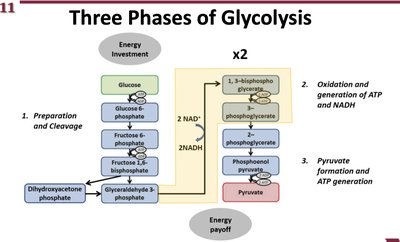
Glycolysis is a fundamental catabolic pathway that breaks down glucose to extract energy, producing ATP and NADH, and generating pyruvate. It occurs in the cytoplasm and functions with or without oxygen.
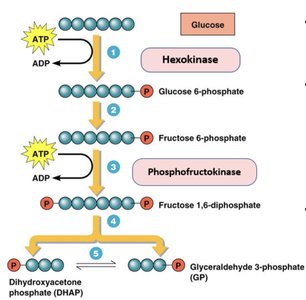
Phase 1: Preparation and Cleavage – Energy investment (2 ATP) to phosphorylate glucose, forming fructose-1,6-bisphosphate, which is cleaved into two triose molecules.
Phase 2: Oxidation and NADH Synthesis – Glyceraldehyde-3-phosphate dehydrogenase oxidizes aldehyde to carboxylic acid, yielding NADH.
Phase 3: Pyruvate Formation and ATP Generation – High-energy intermediates are hydrolyzed to synthesize ATP and form pyruvate.
Key Enzymes and Regulation
Hexokinase: Entry point for glucose; feedback-inhibited by glucose-6-phosphate.
Phosphofructokinase 1: Committed step; inhibited by ATP and citrate, stimulated by AMP.
Pyruvate Kinase: Inhibited by ATP and acetyl-CoA; stimulated when ATP decreases.
Glycolysis and Gluconeogenesis: Opposing Pathways
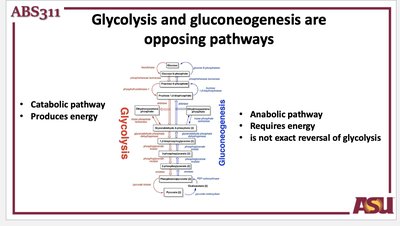
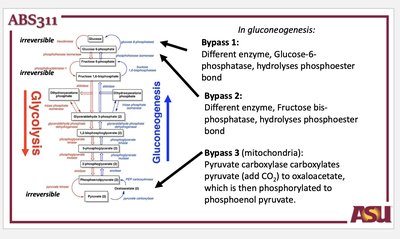
Glycolysis is a catabolic pathway that produces energy, while gluconeogenesis is an anabolic pathway that requires energy and is not the exact reversal of glycolysis.
Glycolysis: Catabolic, produces ATP and NADH.
Gluconeogenesis: Anabolic, requires ATP and NADH; bypasses irreversible steps of glycolysis.
Irreversible Steps and Bypasses in Gluconeogenesis
Bypass 1: Glucose-6-phosphatase hydrolyzes phosphoester bond.
Bypass 2: Fructose bisphosphatase hydrolyzes phosphoester bond.
Bypass 3: Pyruvate carboxylase (mitochondrial) carboxylates pyruvate to oxaloacetate, which is then phosphorylated to phosphoenolpyruvate.
Chemotrophic Metabolism: Aerobic Respiration and the TCA Cycle
TCA Cycle (Krebs Cycle, Citric Acid Cycle)
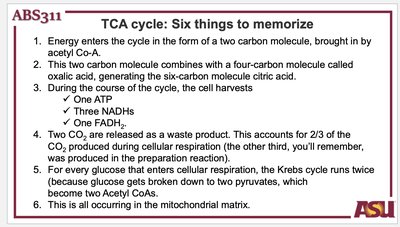
The TCA cycle is a central metabolic pathway that oxidizes acetyl-CoA to CO2, harvesting energy as ATP, NADH, and FADH2. It occurs in the mitochondrial matrix and connects to multiple metabolic pathways.
Entry: Energy enters as a two-carbon molecule (acetyl-CoA).
Combination: Acetyl-CoA combines with a four-carbon molecule (oxaloacetate) to form citric acid (6C).
Harvest: One ATP, three NADH, one FADH2 per cycle.
CO2 Release: Two CO2 released as waste per cycle.
Cycle Runs Twice: For each glucose, the cycle runs twice (two acetyl-CoA).
Location: Occurs in the mitochondrial matrix.
Regulation and Amphibolic Nature
Regulation: High levels of energy-rich compounds inhibit key enzymes; NADH accumulation inhibits dehydrogenases.
Amphibolic Pathway: Functions in both catabolism (energy production) and anabolism (precursor synthesis).
Summary Table: Glycolysis vs. Gluconeogenesis
Pathway | Type | Energy | Key Steps |
|---|---|---|---|
Glycolysis | Catabolic | Produces ATP, NADH | Hexokinase, Phosphofructokinase, Pyruvate kinase |
Gluconeogenesis | Anabolic | Requires ATP, NADH | Glucose-6-phosphatase, Fructose bisphosphatase, Pyruvate carboxylase |
Summary Table: TCA Cycle Key Products
Per Glucose | ATP | NADH | FADH2 | CO2 |
|---|---|---|---|---|
2 cycles | 2 | 6 | 2 | 4 |
Additional info: Academic context was added to clarify the roles of each organelle, pathway, and regulatory mechanism, and to provide self-contained explanations suitable for exam preparation.
