 Indietro
General Chemistry: Module 1 Study Guide
Guida di studio - Note intelligenti
 Appunti personalizzati basati sui tuoi materiali, ampliati con definizioni chiave, esempi e contesto.
Condensed Phases: Liquids and Solids
Intermolecular Forces and Phase Changes
Liquids and solids, known as condensed phases, exist due to intermolecular attractive forces that are strong enough to convert gases into liquids and liquids into solids at high pressures and low temperatures. These forces include van der Waals (dispersion), dipole-dipole, and hydrogen bonding. Breaking or forming these forces results in physical changes (phase changes), not chemical reactions.
Van der Waals Forces: Weak, induced dipole interactions present in all molecules.
Permanent Dipole-Dipole Interactions: Occur between polar molecules.
Hydrogen Bonding: Strongest among intermolecular forces, especially important in water.
Additional info: Hydrogen bonding is responsible for many unique properties of water, such as its high boiling point and surface tension.
Types of Molecular Motion
Molecules in different phases exhibit distinct types of motion:
Translational: Movement in x, y, z directions (gases and liquids).
Rotational: Rotation around an axis (gases, liquids, and solids).
Vibrational: Oscillation of bonds (all phases).
Structure of Solids
Crystalline vs. Amorphous Solids
Solids are classified as crystalline (organized 3D lattice) or amorphous (disordered, e.g., glass). Crystalline solids are composed of repeating units called unit cells.
Crystalline: Regular, repeating structure.
Amorphous: No long-range order.
Unit Cells and Packing
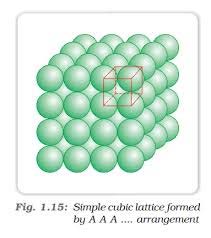
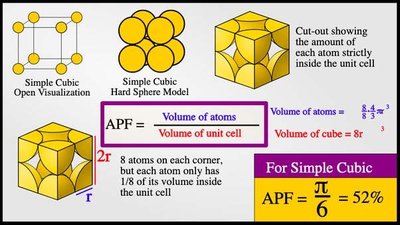
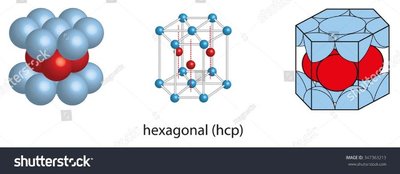
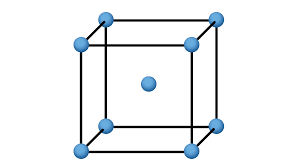
Unit cells are the smallest repeating units in a crystal lattice. Packing efficiency and coordination number are key concepts:
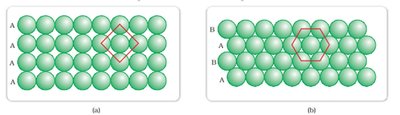
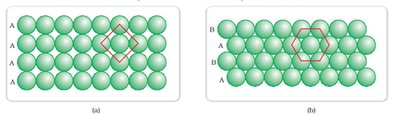
Cubic Packing: Each atom has 6 nearest neighbors; packing efficiency ~50%.
Hexagonal Closest Packing: Each atom has 12 nearest neighbors; packing efficiency ~74%.
Ionic Solids: NaCl Structure
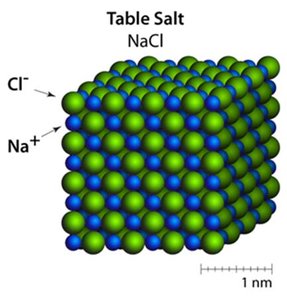
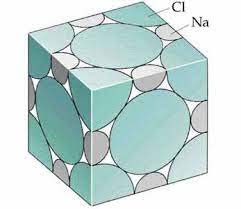
Ionic solids, such as NaCl, are held together by electrostatic forces. The NaCl lattice is face-centered cubic, with Cl- ions at corners and faces, and Na+ ions at edges and the center.
Electrical Neutrality: Number of cations equals number of anions per unit cell.
Types of Crystalline Solids
Type | Bonding | Example |
|---|---|---|
Ionic | Electrostatic | NaCl |
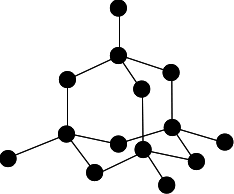
Network Covalent | Covalent | Diamond |
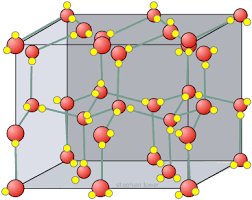
Molecular | Intermolecular | Ice |
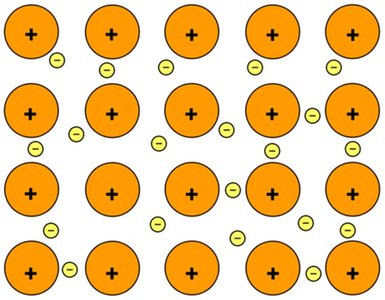
Metallic | Metallic | Na, Fe, Cu |
Thermodynamics and Phase Transitions
System vs. Surroundings
The universe is divided into the system (focus of study) and surroundings. Energy changes are tracked using enthalpy (H), a state function.
First Law of Thermodynamics: Energy is conserved.
Enthalpy Change (ΔH): ΔH = Hfinal - Hinitial
Exothermic: ΔH < 0 (system loses heat).
Endothermic: ΔH > 0 (system gains heat).
Phase Changes and Equilibrium
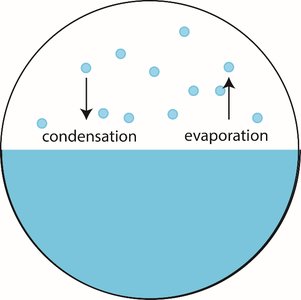
Phase transitions (e.g., melting, vaporization, sublimation) are reversible and occur at equilibrium in closed systems.
Heats of Phase Changes
Heat of Vaporization (ΔHvap): Energy required to convert 1 mole of liquid to gas.
Heat of Fusion (ΔHfus): Energy required to convert 1 mole of solid to liquid.
Heat of Sublimation (ΔHsub): Energy required to convert 1 mole of solid directly to gas.
Heating and Cooling Curves
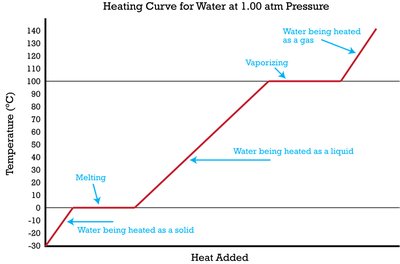
Heating and cooling curves show temperature changes during phase transitions. Temperature remains constant during phase changes.
Phase Diagrams
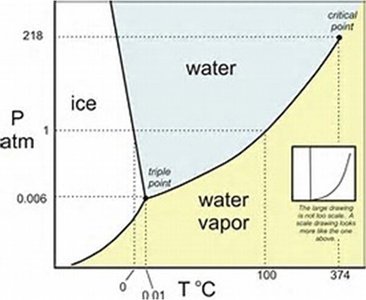
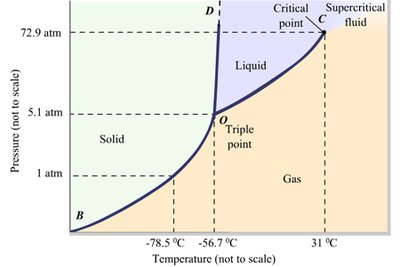
Phase diagrams plot pressure vs. temperature, showing regions of solid, liquid, and gas. The triple point is where all three phases coexist; the critical point marks the transition to a supercritical fluid.
Vapor Pressure and Kinetic Theory
Equilibrium Vapor Pressure
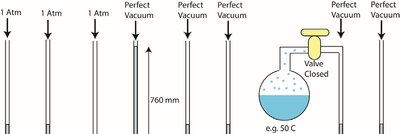
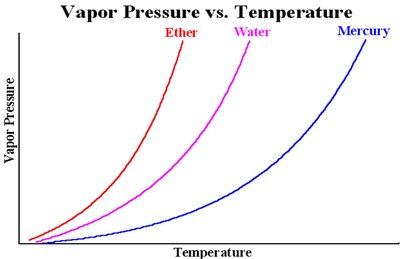
The equilibrium vapor pressure is the pressure exerted by a liquid's vapor at equilibrium. It increases with temperature and is characteristic of each liquid.
Kinetic Energy Distribution
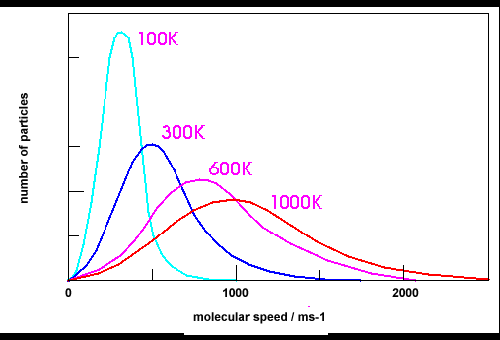
At a given temperature, molecules have a distribution of kinetic energies. Only those in the high-energy tail can escape into the gas phase.
Clausius-Clapeyron Equation
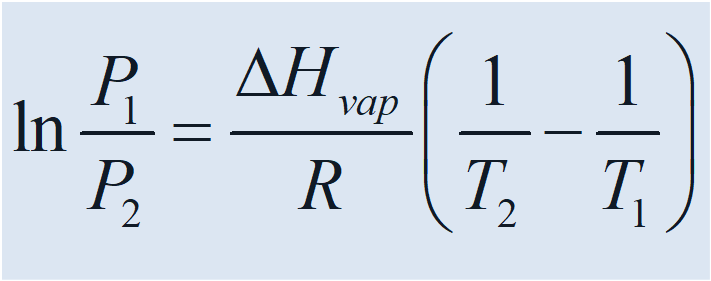
The Clausius-Clapeyron equation relates vapor pressure to temperature and enthalpy of vaporization:
Solutions and Concentration Units
Definitions and Types
A solution is a homogeneous mixture of two or more substances. The solvent is the majority component, and the solute is the minority component.
Homogeneous: Uniform composition throughout.
Heterogeneous: Non-uniform composition.
Concentration Units
Molarity (M): Moles of solute per liter of solution.
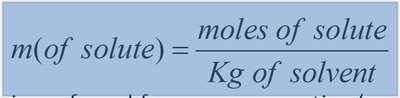
Molality (m): Moles of solute per kilogram of solvent.
Mole Fraction (χ): Moles of solute divided by total moles in solution.
Percent by Weight (w/w): Mass of solute divided by total mass, times 100.
Parts per Million/Billion/Trillion (ppm/ppb/ppt): Mass of solute per million/billion/trillion mass units of solution.
Colligative Properties
Raoult’s Law and Vapor Pressure Lowering
Colligative properties depend only on the concentration of solute particles, not their identity. Raoult’s Law describes vapor pressure lowering:
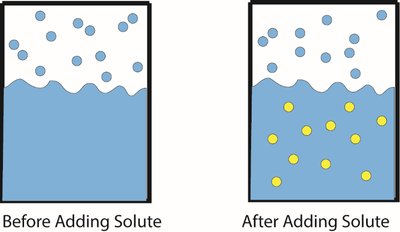
Boiling Point Elevation and Freezing Point Depression
Adding a nonvolatile solute raises the boiling point and lowers the freezing point of the solvent. The changes are proportional to the molality of the solute:
Boiling Point Elevation:
Freezing Point Depression:
Van’t Hoff Factor
The Van’t Hoff factor (i) accounts for the number of particles formed when a solute dissociates in solution. Colligative property equations are modified as:
(osmotic pressure)
Solubility and Heats of Solution
Solubility Rules for Ionic Solids
Salts containing alkali metal cations, ammonium, nitrate, acetate, or halide anions are generally soluble.
Salts containing carbonate, phosphate, sulfide, or hydroxide anions (except Sr(OH)2 and Ba(OH)2) are generally insoluble.
Heats of Solution
The molar enthalpy of solution (ΔHsol) is the heat absorbed or released when one mole of solute dissolves. Dissolution involves breaking ionic bonds, breaking hydrogen bonds in water, and forming new hydration interactions.
Bond-breaking: Absorbs energy.
Bond-making: Releases energy.
Summary Table: Types of Solids and Their Properties
Type | Bonding | Example | Properties |
|---|---|---|---|
Ionic | Electrostatic | NaCl | High melting point, brittle |
Network Covalent | Covalent | Diamond | Very hard, high melting point |
Molecular | Intermolecular | Ice | Low melting point, soft |
Metallic | Metallic | Na, Fe, Cu | Conductive, malleable |
