 Indietro
Crystal Field Theory and d-Orbital Splitting in Transition Metal Complexes
Guida di studio - Note intelligenti
 Appunti personalizzati basati sui tuoi materiali, ampliati con definizioni chiave, esempi e contesto.
Crystal Field Theory
Introduction to Crystal Field Theory
Crystal Field Theory (CFT) is a model used to describe the electronic structure and properties of transition metal complexes. It explains phenomena such as visible absorption spectra, magnetic characteristics, and reaction kinetics by considering the effect of ligands on the energies of the metal's d-orbitals.
Transition metals have partially filled valence d-orbitals, which are crucial for their chemical behavior.
CFT treats ligands as point charges that interact electrostatically with the metal ion's d-electrons.
This interaction leads to the splitting of d-orbital energies, which underlies many observable properties of complexes.
Electronic Structure of Transition Metal Ions
Valence d-Orbitals
In a free transition metal ion, the five 3d-orbitals are degenerate (equal in energy). When ligands approach, their negative charge perturbs the energy levels of these orbitals.
For a first-row transition metal ion (e.g., Ti3+), the single valence electron can occupy any of the five 3d-orbitals with equal probability in the absence of ligands.
Spatial Arrangement of d-Orbitals
Classification of d-Orbitals
The five d-orbitals are grouped based on their orientation relative to the Cartesian axes:
dxy, dxz, dyz: These orbitals are oriented between the axes.
dx2-y2, dz2: These orbitals are oriented along the axes.
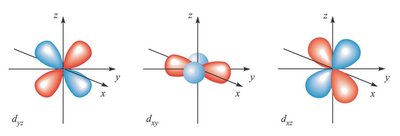
dxy, dxz, and dyz orbitals are directed between the Cartesian axes x, y, and z.
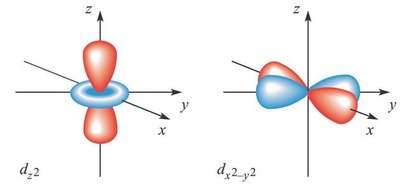
dx2-y2 and dz2 orbitals are directed along the Cartesian axes.
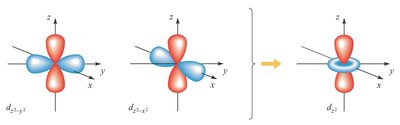
The dz2 orbital can be derived from a linear combination of dz2-x2 and dz2-y2 orbitals.
Crystal Field Splitting in Octahedral Complexes
Formation of the Octahedral Field
When six ligands approach a metal ion along the Cartesian axes, they create an octahedral electrostatic field. This field causes the d-orbitals to split into two sets with different energies:
t2g set: dxy, dxz, dyz (lower energy)
eg set: dx2-y2, dz2 (higher energy)
The energy difference between these sets is called the octahedral crystal field splitting energy ().
The barycentre is the average energy of the d-orbitals before splitting.
After splitting: t2g is stabilized by , eg is destabilized by .
: \text{Octahedral crystal field splitting energy} $
Crystal Field Splitting in Tetrahedral Complexes
Formation of the Tetrahedral Field
When four ligands approach a metal ion in a tetrahedral arrangement, the d-orbitals split in the opposite pattern compared to the octahedral field:
t2 set: dxy, dxz, dyz (higher energy)
e set: dx2-y2, dz2 (lower energy)
The splitting energy () is smaller than in the octahedral case.
: \text{Tetrahedral crystal field splitting energy} $
Crystal Field Splitting in Square Planar Complexes
Relationship to Octahedral Geometry
Square planar geometry can be derived from octahedral geometry by removing the ligands along the z-axis (tetragonal distortion). This leads to a different pattern of d-orbital splitting, with the dx2-y2 orbital being highest in energy.
Applications and Limitations of Crystal Field Theory
Utility and Shortcomings
CFT provides a simple electrostatic model for d-orbital splitting in various ligand environments.
It is physically unrealistic (ligands are not true point charges) and does not account for covalency or p-orbital interactions.
Despite limitations, CFT is widely used for its simplicity, especially in coordination chemistry.
Spin States and Electron Configuration
High Spin vs. Low Spin Complexes
The arrangement of electrons in split d-orbitals depends on the relative magnitude of the crystal field splitting energy () and the electron pairing energy (P):
High spin case: ; electrons occupy higher energy orbitals to avoid pairing.
Low spin case: ; electrons pair in lower energy orbitals.
Hund's Rule states that electrons fill degenerate orbitals singly before pairing. In split d-orbitals, this rule is modified by the energy gap between levels.
Example: 3d1 Case (Ti3+, V4+)
For a single d-electron in an octahedral field, the only possible configuration is t2g1eg0. The crystal field stabilization energy (CFSE) is:
$
Summary Table: d-Orbital Splitting in Different Geometries
Geometry | Lower Energy Set | Higher Energy Set | Splitting Symbol |
|---|---|---|---|
Octahedral | t2g (dxy, dxz, dyz) | eg (dx2-y2, dz2) | |
Tetrahedral | e (dx2-y2, dz2) | t2 (dxy, dxz, dyz) | |
Square Planar | Varies (dxy, dz2, dxz, dyz) | dx2-y2 | Q (related to ) |
Additional info: The images included above directly illustrate the spatial orientation of the d-orbitals, which is essential for understanding their splitting in various ligand fields as described by Crystal Field Theory.
