 Indietro
Crystal Field Theory: Spin States, Ligand Field Strength, and Applications
Guida di studio - Note intelligenti
 Appunti personalizzati basati sui tuoi materiali, ampliati con definizioni chiave, esempi e contesto.
Crystal Field Theory: Spin States and Stabilization
Octahedral Spin States
Crystal Field Theory (CFT) explains the electronic structure and properties of transition metal complexes by considering the effect of ligands on the d-orbitals of the metal ion. In octahedral complexes, the five d-orbitals split into two sets: t2g (lower energy) and eg (higher energy), separated by the crystal field splitting energy, denoted as .
High-spin vs. Low-spin: The arrangement of electrons depends on the relative size of and the pairing energy (P).
High-spin complexes: Occur when is small (weak field ligands), maximizing unpaired electrons.
Low-spin complexes: Occur when is large (strong field ligands), minimizing unpaired electrons.
Crystal Field Stabilization Energy (CFSE): Quantifies the stabilization gained by the specific electron arrangement in the split d-orbitals.
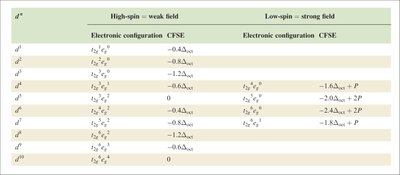
Example: For a d4 metal ion, two possible configurations exist: high-spin (t2g3 eg1) and low-spin (t2g4 eg0), with different CFSE values.
Ligand Field Strength and Spin State Determination
The spin state of a complex is determined by the size of , which depends on the nature of the ligands and the metal ion's oxidation state. Strong field ligands (e.g., CN-) produce large $\Delta_{oct}$, favoring low-spin states, while weak field ligands (e.g., Cl-) produce small $\Delta_{oct}$, favoring high-spin states.
Strong field ligands: → low spin
Weak field ligands: → high spin
Ligand field strength: The ability of a ligand to split the d-orbitals; discussed further in advanced topics.
Tetrahedral and Square Planar Geometries
In tetrahedral complexes, the splitting () is smaller than in octahedral complexes (), making low-spin tetrahedral complexes rare. Square planar complexes exhibit a different splitting pattern, often favoring low-spin configurations for d8 metal ions.
Tetragonal and Jahn-Teller Distortions
Some octahedral complexes undergo distortions to lower symmetry, such as tetragonal distortion or Jahn-Teller distortion, especially for d9 configurations. The Jahn-Teller theorem states that any non-linear molecular system in a degenerate electronic state will distort to remove degeneracy and lower energy.
Practical Application: Magnetism in Complexes
The magnetic properties of a complex (paramagnetic or diamagnetic) depend on the number of unpaired electrons. For example, K4[Fe(CN)6] is diamagnetic (low-spin, strong field ligand), while [Fe(H2O)6]Cl2 is paramagnetic (high-spin, weak field ligand).
Experimental Determination of Unpaired Electrons
Electron Paramagnetic Resonance (EPR/ESR) Spectroscopy
EPR (or ESR) spectroscopy is used to detect unpaired electrons in transition metal complexes. Unpaired electrons behave like tiny magnets and their energy transitions can be monitored in a magnetic field, similar to NMR spectroscopy for nuclei.
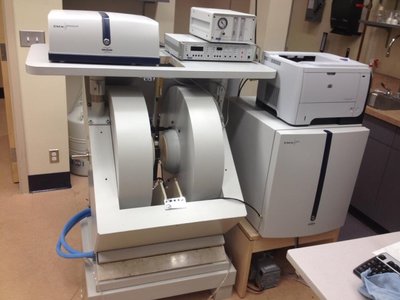
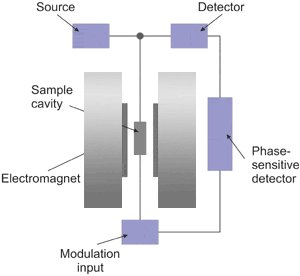
Sample cavity: Where the sample is placed.
Electromagnet: Provides the magnetic field for electron alignment.
Detector: Measures energy transitions as electrons align parallel or antiparallel to the field.
Summary Table: Octahedral CFSE Values
The table below summarizes the electronic configurations and CFSE values for high-spin and low-spin octahedral complexes:
dn | High-spin (weak field) Electronic configuration | High-spin CFSE | Low-spin (strong field) Electronic configuration | Low-spin CFSE |
|---|---|---|---|---|
d1 | t2g1 eg0 | t2g1 eg0 | ||
d2 | t2g2 eg0 | t2g2 eg0 | ||
d3 | t2g3 eg0 | t2g3 eg0 | ||
d4 | t2g3 eg1 | t2g4 eg0 | ||
d5 | t2g3 eg2 | 0 | t2g5 eg0 | |
d6 | t2g4 eg2 | t2g6 eg0 | ||
d7 | t2g5 eg2 | t2g6 eg1 | ||
d8 | t2g6 eg2 | t2g6 eg2 | ||
d9 | t2g6 eg3 | t2g6 eg3 | ||
d10 | t2g6 eg4 | 0 | t2g6 eg4 | 0 |
Homework and Practice Questions
Calculate the CFSE for high-spin and low-spin options for d6-d10 metal ions.
Determine if the following complexes are paramagnetic or diamagnetic:
CoCl6
TiCl4
Fe(CN)6
Pt(PPh3)4 (assume tetrahedral)
Cr(CO)6
Explain, using CFT, the differences between tetrahedral and square planar NiCl4.
Identify the first-row transition metal M that satisfies the requirements:
[M(H2O)6]3+ having 1 UPE
[MBr4]- having the most UPEs
Diamagnetic [M(CN)6]3-
