 Indietro
The Quantum-Mechanical Model of the Atom: Structure, Light, and Electron Behavior
Guida di studio - Note intelligenti
 Appunti personalizzati basati sui tuoi materiali, ampliati con definizioni chiave, esempi e contesto.
The Quantum-Mechanical Model of the Atom
Introduction to Quantum Mechanics
The quantum-mechanical model revolutionized our understanding of atomic structure by explaining the unique behavior of electrons at the subatomic level. Early twentieth-century scientists such as Einstein, Bohr, de Broglie, Planck, Heisenberg, Dirac, and Schrödinger contributed to the development of this model, which forms the foundation of modern chemistry.
Subatomic particles: Electrons, protons, and neutrons are the fundamental constituents of atoms.
Wave–matter duality: Electrons exhibit both particle-like and wave-like properties, depending on experimental conditions.
Electron cloud: Electrons are best described as a cloud of probable positions rather than fixed orbits.
The Nature of Light
Wave Properties of Light
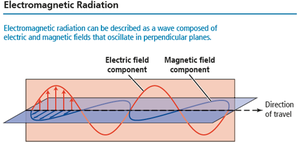
Light is a form of electromagnetic radiation, consisting of oscillating electric and magnetic fields that propagate through space. The behavior of light is central to understanding atomic structure and electron transitions.
Electromagnetic radiation: Composed of perpendicular electric and magnetic field waves.
Speed of light (c): In a vacuum, all electromagnetic waves travel at m/s.
Characteristics of Energy Waves
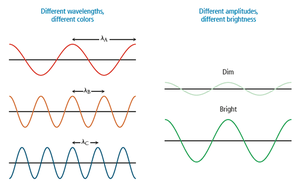
Amplitude: The height of the wave, related to the intensity (brightness) of light.
Wavelength (\( \lambda \)): The distance between successive crests or troughs, determining the color of light.
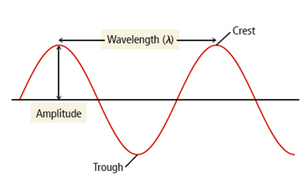
Frequency (\( \nu \)): The number of wave cycles passing a point per second, measured in hertz (Hz).
Relationship: Wavelength and frequency are inversely proportional:
Color and the Electromagnetic Spectrum
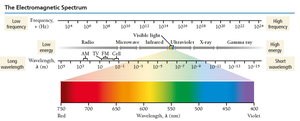
The color of visible light is determined by its wavelength or frequency. White light contains all visible wavelengths, which can be separated into a spectrum using a prism.
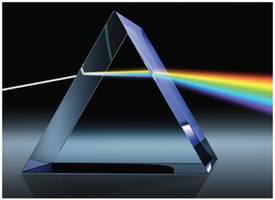
Visible spectrum: Ranges from approximately 400 nm (violet) to 700 nm (red).
Electromagnetic spectrum: Includes radio, microwave, infrared, visible, ultraviolet, X-ray, and gamma-ray regions.
Wave Behavior: Interference and Diffraction
Interference
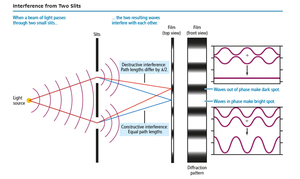
When waves overlap, they can interfere constructively (amplitudes add) or destructively (amplitudes subtract), producing characteristic patterns.
Diffraction
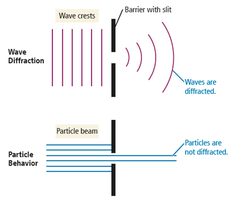
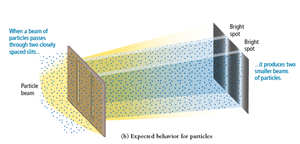
Waves bend around obstacles or openings comparable in size to their wavelength, a phenomenon called diffraction. Particles do not exhibit this behavior.
Two-Slit Interference
When light passes through two closely spaced slits, it produces an interference pattern of bright and dark spots, demonstrating its wave nature.
The Photoelectric Effect
Einstein’s Explanation
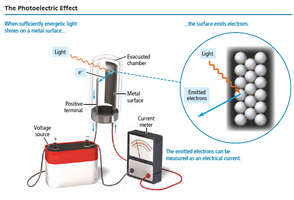
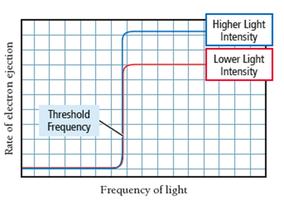
When light of sufficient frequency strikes a metal surface, electrons are emitted—a phenomenon known as the photoelectric effect. Classical wave theory could not explain the existence of a threshold frequency below which no electrons are emitted, regardless of light intensity.
Photon: Einstein proposed that light energy is quantized in packets called photons.
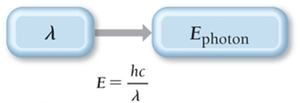
Energy of a photon: , where is Planck’s constant ( J·s).
Atomic Spectra and the Bohr Model
Emission Spectra
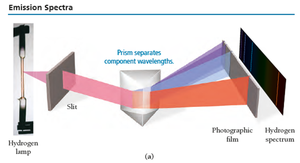
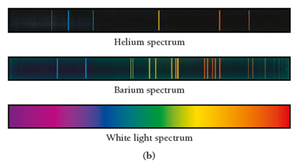
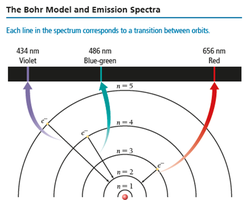
When atoms absorb energy, electrons are excited to higher energy levels. As they return to lower levels, they emit light at specific wavelengths, producing a line spectrum unique to each element.

The Bohr Model of the Atom
Bohr proposed that electrons travel in quantized orbits around the nucleus. Transitions between these orbits correspond to absorption or emission of photons with energy equal to the difference between energy levels.
Quantized energy levels: Only specific electron energies are allowed.
Photon emission:
Wave-Particle Duality of Electrons
De Broglie Hypothesis
De Broglie proposed that particles such as electrons have wave-like properties, with a wavelength inversely proportional to their momentum:
Electron Diffraction
Experiments show that electrons produce interference patterns, confirming their wave nature.
Heisenberg’s Uncertainty Principle
Heisenberg’s uncertainty principle states that it is impossible to simultaneously know both the exact position and momentum of a particle such as an electron:
This principle leads to the concept of indeterminacy: we can only predict the probability of finding an electron in a particular region.
Quantum Numbers and Atomic Orbitals
Quantum Numbers
The quantum-mechanical model describes electrons in terms of quantum numbers derived from Schrödinger’s equation:
Principal quantum number (n): Energy level (n = 1, 2, 3, ...)
Angular momentum quantum number (l): Orbital shape (l = 0, 1, ..., n-1)
Magnetic quantum number (ml): Orbital orientation (ml = -l to +l)
Spin quantum number (ms): Electron spin (+1/2 or -1/2)
Types of Orbitals
s-orbitals (l = 0): Spherical shape
p-orbitals (l = 1): Dumbbell shape, three orientations
d-orbitals (l = 2): Cloverleaf shape, five orientations
f-orbitals (l = 3): Complex shapes, seven orientations
Energy Levels and Electron Transitions
Electron transitions between energy levels result in the absorption or emission of photons. The wavelength of emitted or absorbed light corresponds to the energy difference between the initial and final states.
Summary Table: Key Relationships in Quantum Mechanics
Concept | Equation | Description |
|---|---|---|
Speed of light | Relates wavelength and frequency | |
Photon energy | Energy of a photon | |
De Broglie wavelength | Wavelength of a particle | |
Heisenberg uncertainty | Limits of simultaneous position and momentum knowledge |
Additional info: These notes provide a comprehensive overview of the quantum-mechanical model, including the nature of light, electron behavior, atomic spectra, and the mathematical framework for describing atomic structure. The included images reinforce key concepts such as wave behavior, the photoelectric effect, and atomic emission spectra.
