 Indietro
Cellular Level of Organization: Structure, Size, and Types of Cells
Guida di studio - Note intelligenti
 Appunti personalizzati basati sui tuoi materiali, ampliati con definizioni chiave, esempi e contesto.
Cellular Level of Organization
Cell Theory
The cell theory is a fundamental concept in biology, developed in the 19th century by Schleiden, Schwann, and Virchow. It states that all living organisms are composed of cells, cells arise only from preexisting cells, and cells are the basic units of structure and function in organisms.
All organisms are composed of cells: This principle unifies the diversity of life, from single-celled bacteria to multicellular plants and animals.
Cells come only from preexisting cells: Cells reproduce by division, ensuring continuity of life.
Cells are the basic units of structure and function: Every process in an organism occurs at the cellular level.
Organisms and Cells
Organisms can be unicellular or multicellular. Cells are the smallest units that carry out all life processes, and their organization varies between plants and animals.
Plant cells: Typically have a cell wall, chloroplasts, and large central vacuoles.
Animal cells: Lack cell walls and chloroplasts, but have specialized structures for movement and communication.

Cell Size and Surface-Area-to-Volume Ratio
Sizes of Various Objects
Cells range in size from 1 millimeter (mm) to 1 micrometer (μm) in diameter. The size of cells is limited by the need for efficient exchange of materials across the plasma membrane.
Microscopic scale: Most cells are visible only under a microscope.
Comparison: Atoms < viruses < bacteria < plant/animal cells < multicellular organisms.
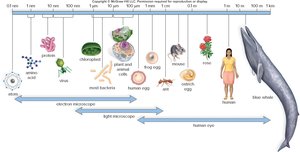
Surface-Area-to-Volume Relationships
The surface-area-to-volume ratio is a critical factor in cell biology. As a cell increases in size, its volume grows faster than its surface area, reducing the efficiency of material exchange.
Small cells: Have a larger surface-area-to-volume ratio, which is advantageous for exchanging molecules.
Large cells: Have a smaller surface-area-to-volume ratio, making transport less efficient.
Formula: Surface area = height × width × number of sides × number of cubes; Volume = height × width × length × number of cubes.
Example: Dividing a large cube into smaller cubes increases the total surface area while keeping the total volume constant, improving exchange efficiency.
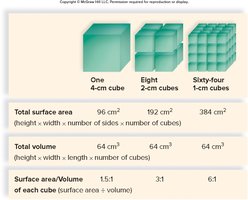
Cube Size | Total Surface Area (cm2) | Total Volume (cm3) | Surface Area/Volume Ratio |
|---|---|---|---|
One 4-cm cube | 96 | 64 | 1.5:1 |
Eight 2-cm cubes | 192 | 64 | 3:1 |
Sixty-four 1-cm cubes | 384 | 64 | 6:1 |
Prokaryotic Cells
Characteristics of Prokaryotic Cells
Prokaryotic cells lack a membrane-bound nucleus and are structurally simpler and smaller than eukaryotic cells. They are classified into two domains: Bacteria and Archaea.
Bacteria: Can cause diseases, act as decomposers, and are useful in biotechnology.
Archaea: Often live in extreme environments and differ biochemically from bacteria.
Size: Typically 1.1–1.5 μm wide and 2.0–6.0 μm long.
Structure of Prokaryotes
Prokaryotes occur in three basic shapes: spherical (coccus), rod-shaped (bacillus), and spiral (spirillum or spirochete). Their cell envelope includes:
Plasma membrane: Lipid bilayer with embedded proteins; may form internal pouches (mesosomes) to increase surface area.
Cell wall: Maintains cell shape and is often strengthened by peptidoglycan.
Glycocalyx: Polysaccharide layer outside the cell wall; when well organized, forms a capsule resistant to removal.
Example: Bacteria such as Escherichia coli have a cell wall and may possess a capsule for protection.
Additional info: Prokaryotic cells also contain ribosomes for protein synthesis and may have flagella for movement.
