 Indietro
Adaptive Immunity: Structure, Function, and Mechanisms
Guida di studio - Note intelligenti
 Appunti personalizzati basati sui tuoi materiali, ampliati con definizioni chiave, esempi e contesto.
Adaptive Immunity
Overview of Adaptive Immunity
Adaptive immunity is the body's highly specific defense mechanism against distinct pathogens and their products. Unlike innate immunity, adaptive immunity is characterized by its ability to recognize a vast array of antigens and to remember previous encounters for a more rapid response upon re-exposure.
Specificity: Targets unique antigens.
Inducibility: Activated in response to specific pathogens.
Clonality: Generates clones of lymphocytes specific to the antigen.
Unresponsiveness to self: Normally does not react to the body's own molecules.
Memory: Remembers previous encounters for faster secondary responses.
Comparison of Innate and Adaptive Immunity
Innate and adaptive immunity are two branches of the immune system with distinct characteristics:
Innate Immunity | Adaptive Immunity | |
|---|---|---|
Distribution | All multicellular eukaryotes | Only vertebrates |
Targets | Limited, conserved microbial structures (PAMPs) | Billions of unique antigens |
Immune Receptors | Pattern recognition receptors (e.g., TLRs) | T cell receptors, antibodies |
Cellular Presence | Almost all cells | Lymphocytes only |
Discrimination | Host cells lack PAMPs | Self-tolerance can fail (autoimmunity) |
Immunological Memory | Absent | Present |
Lymphatic System and Immune Surveillance
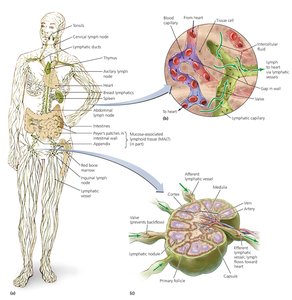
Tissues and Organs of the Lymphatic System
The lymphatic system is essential for immunosurveillance, providing sites for lymphocyte proliferation and screening tissues for foreign molecules.
Lymphatic vessels: One-way system returning lymph to the circulatory system.
Lymph: Fluid similar to plasma, derived from interstitial fluid.
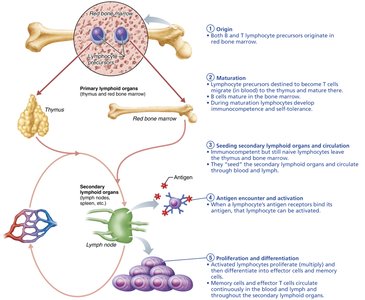
Primary lymphoid organs: Sites of lymphocyte origin and maturation (red bone marrow, thymus).
Secondary lymphoid organs: Sites where lymphocytes reside and encounter antigens (lymph nodes, spleen, tonsils, MALT).

Antigens and Their Types
Definition and Properties of Antigens
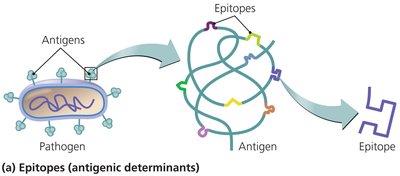
Antigens are molecules recognized as foreign by the immune system, typically large macromolecules with complex structures. Recognition occurs at specific regions called epitopes or antigenic determinants.
Best antigens: Large, complex, foreign macromolecules (e.g., proteins of microbes).
Sources: Bacterial components, viral proteins, fungi, protozoa, food, dust.

Types of Antigens
Exogenous antigens: Toxins and components of microbes found outside cells.
Endogenous antigens: Produced by microbes replicating inside host cells.
Autoantigens: Derived from normal cellular processes (self-antigens).
Major Histocompatibility Complex (MHC) and Antigen Presentation
Roles of MHC Proteins
MHC proteins are glycoproteins on cell membranes that present antigenic peptides to T cells, crucial for immune recognition and tissue compatibility.
MHC class I: Present on all nucleated cells except red blood cells.
MHC class II: Present on antigen-presenting cells (APCs) such as macrophages, B cells, and dendritic cells.


Antigen Processing and Presentation
Antigens must be processed before being displayed by MHC molecules. The process differs for endogenous and exogenous antigens:
Endogenous antigens: Processed within infected cells and presented on MHC I.
Exogenous antigens: Phagocytosed by APCs and presented on MHC II.


Lymphocytes: T Cells and B Cells
T Lymphocytes (T Cells)
T cells are produced in the bone marrow and mature in the thymus. They circulate in the blood and lymph, migrating to secondary lymphoid organs. T cells possess T cell receptors (TCRs) that recognize antigens only when presented with MHC molecules.
Specificity: TCRs bind only to epitopes associated with MHC proteins.
Function: Act against cells harboring intracellular pathogens or abnormal proteins (e.g., tumors).

Types of T Lymphocytes
Cytotoxic T lymphocytes (Tc, CD8+): Directly kill infected or abnormal cells.
Helper T lymphocytes (Th, CD4+): Regulate immune responses, activate B cells and Tc cells. Subtypes include Th1 (cellular immunity, inflammation) and Th2 (B cell activation, allergy, parasite defense).
Regulatory T lymphocytes (Treg, CD4+): Suppress immune responses to prevent autoimmunity.
Lymphocyte | Site of Maturation | Surface Glycoproteins | Notable Secretions |
|---|---|---|---|
Helper T cell type 1 (Th1) | Thymus | CD4, TCR | Interleukin-2, IFN-γ |
Helper T cell type 2 (Th2) | Thymus | CD4, TCR | Interleukin-4, 5 |
Cytotoxic T cell (Tc) | Thymus | CD8, CD95L, TCR | Perforin, granzyme |
Regulatory T cell (Treg) | Thymus | CD4, CD25, TCR | Interleukin-10 |

Clonal Deletion of T Cells
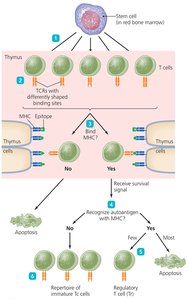
To prevent autoimmunity, T cells undergo selection in the thymus:
Positive selection: T cells must recognize self-MHC; non-recognizers die by apoptosis.
Negative selection: T cells that bind self-antigens are eliminated.
Some self-recognizing T cells become regulatory T cells.
Surviving T cells form the repertoire of protective T cells.

B Lymphocytes (B Cells) and Antibodies
B cells mature in the bone marrow and are primarily found in the spleen, lymph nodes, and MALT. Their main function is the production of antibodies.
Each B cell expresses a unique B cell receptor (BCR) capable of recognizing a specific epitope.
BCR diversity is generated by recombination of gene segments (V, D, J) via the RAG enzyme.
Antibody Structure and Function
Antibodies (immunoglobulins) are secreted by plasma cells and have antigen-binding sites identical to the BCR of the activated B cell.
Functions: Complement activation, neutralization, opsonization, agglutination, antibody-dependent cellular cytotoxicity (ADCC).
Classes of Antibodies
IgM: First antibody produced in response to infection.
IgG: Most common and long-lasting; crosses placenta.
IgA: Found in secretions (tears, saliva, mucus).
IgE: Involved in allergic responses and defense against parasites.
IgD: Functions mainly as a BCR; exact role is unclear.
Clonal Deletion of B Cells
Self-reactive B cells are eliminated or inactivated in the bone marrow to prevent autoimmunity. Some may alter their BCRs instead of undergoing apoptosis.
Cytokines and Immune Regulation
Cytokine Classes and Functions
Cytokines are signaling proteins secreted by leukocytes to regulate immune responses. The cytokine network is a complex web of signals among immune cells.
Interleukins (ILs): Communication between leukocytes.
Interferons (IFNs): Antiviral proteins, also act as cytokines.
Growth factors: Stimulate stem cell division.
Colony stimulating factors: Promote leukocyte production.
Tumor necrosis factor (TNF): Kills tumor cells, regulates inflammation.
Chemokines: Attract leukocytes to infection sites.
Cell-Mediated Immune Responses
Activation and Function of T Cells
Cell-mediated immunity targets intracellular pathogens and abnormal cells. T cell activation requires antigen presentation by APCs and co-stimulation. Helper T cells (Th) play a central role in activating both humoral and cellular immunity.
CD4+ T cells: Become helper or regulatory T cells.
CD8+ T cells: Become cytotoxic T cells, which kill infected cells via perforin-granzyme or CD95 pathways.
Memory T cells: Provide rapid response upon re-exposure to the same antigen.
Antibody (Humoral) Immune Responses
T-Dependent Antibody Immunity
Antibody responses are mounted against exogenous pathogens and require helper T cell involvement. The process involves:
Antigen presentation for Th activation and proliferation.
Differentiation of Th cells into Th2 cells.
Activation of B cells.
Proliferation and differentiation of B cells into plasma cells and memory cells.

Immunological Memory
Memory B cells persist in lymphoid tissue and initiate rapid antibody production upon re-exposure to the antigen, resulting in a faster and more robust secondary immune response compared to the primary response.
Types of Acquired Immunity
Active vs. Passive Immunity
Naturally acquired immunity: Response to antigens encountered in daily life.
Artificially acquired immunity: Response to antigens introduced via vaccination.
Active immunity: Body produces its own antibodies or T cells.
Passive immunity: Antibodies are transferred from another source (e.g., maternal antibodies, antiserum).
Passive immunity provides immediate protection but is short-lived, while active immunity develops more slowly but is long-lasting due to memory cell formation.
