 Indietro
Microbial Genetics: DNA Replication, Transcription, and Translation
Guida di studio - Note intelligenti
 Appunti personalizzati basati sui tuoi materiali, ampliati con definizioni chiave, esempi e contesto.
Genetics: Central Dogma of Molecular Biology
Overview of the Central Dogma
The central dogma of molecular biology describes the flow of genetic information within a cell, from DNA to RNA to protein. This process is fundamental to all living organisms and underpins gene expression and cellular function.
DNA serves as the genetic blueprint for all cellular activities.
Transcription is the process by which RNA is synthesized from a DNA template.
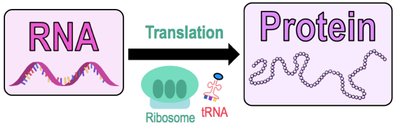
Translation is the process by which proteins are synthesized using the information encoded in RNA.
Gene expression refers to the combined processes of transcription and translation, resulting in the production of proteins from genetic information.
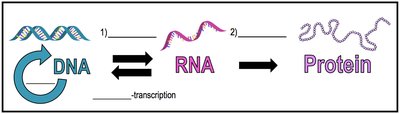
Example: The central dogma is illustrated as DNA → RNA → Protein, with transcription and translation as key steps.
DNA Replication
Introduction to DNA Replication
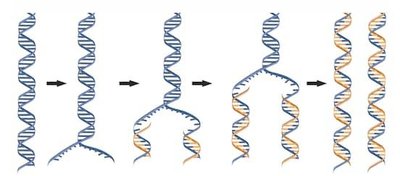
DNA replication is the process by which a cell duplicates its DNA before cell division. This ensures that each daughter cell receives an identical copy of the genetic material.
Most knowledge comes from studies of prokaryotic DNA replication, but the fundamental mechanisms are conserved in both prokaryotes and eukaryotes.
Parental DNA strands separate and serve as templates for the synthesis of new complementary strands.
Key Enzymes and Proteins in DNA Replication
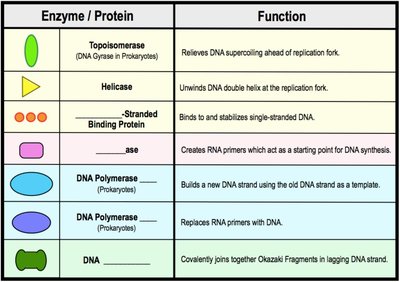
DNA replication requires a coordinated effort of several enzymes and proteins, each with a specific function.
Enzyme / Protein | Function |
|---|---|
Topoisomerase (DNA Gyrase in Prokaryotes) | Relieves DNA supercoiling ahead of replication fork. |
Helicase | Unwinds DNA double helix at the replication fork. |
Single-Stranded Binding Protein | Binds to and stabilizes single-stranded DNA. |
Primase | Creates RNA primers as a starting point for DNA synthesis. |
DNA Polymerase (Prokaryotes) | Builds a new DNA strand using the old DNA strand as a template. |
DNA Polymerase I (Prokaryotes) | Replaces RNA primers with DNA. |
DNA Ligase | Covalently joins Okazaki fragments in lagging DNA strand. |
Origin of Replication
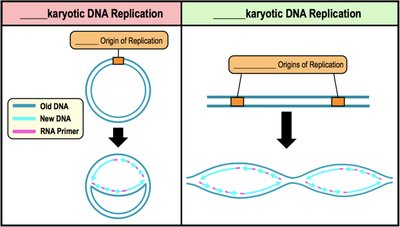
DNA replication begins at specific DNA sequences called the origin of replication (ORI).
Prokaryotes have small, circular chromosomes with a single ORI.
Eukaryotes have large, linear chromosomes with multiple ORIs.
Replication Forks
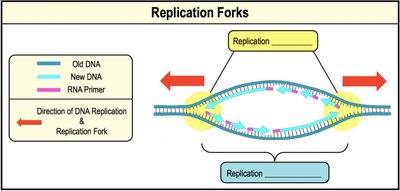
Proteins bind to the ORI and separate the two DNA strands, forming a replication bubble. Replication forks are Y-shaped regions at each end of the bubble where DNA is unwound and replication proceeds bidirectionally.
DNA replication proceeds in both directions from the ORI.
Unwinding the DNA: Topoisomerase, Helicase, and SSBs
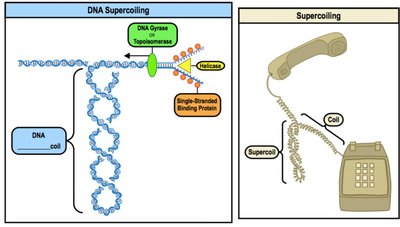
Several proteins participate in the unwinding of DNA during replication:
Topoisomerase relieves strain caused by supercoiling.
Helicase unwinds DNA by breaking hydrogen bonds, creating single-stranded DNA.
Single-Strand Binding Proteins (SSBs) prevent reannealing and degradation of separated DNA strands.
Leading and Lagging DNA Strands
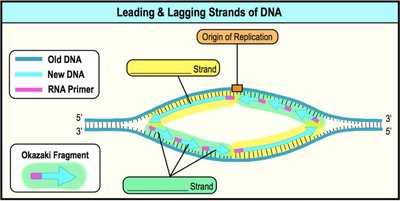
At each replication fork, two single-stranded DNA molecules are formed:
Leading Strand: Synthesized continuously in the same direction as the replication fork movement. Requires only one RNA primer.
Lagging Strand: Synthesized discontinuously in the opposite direction as the replication fork movement. Replicates in small segments called Okazaki fragments, each requiring an RNA primer. Okazaki fragments are joined by DNA ligase.
Replication Fork Directionality
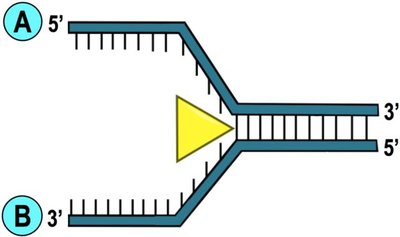
DNA polymerase can only add nucleotides to the 3' end of the growing strand, resulting in antiparallel synthesis of the leading and lagging strands.
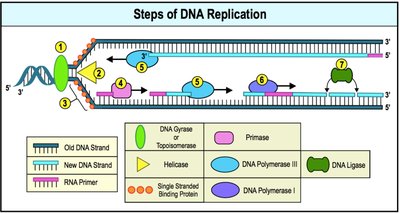
Steps of DNA Replication
DNA replication in prokaryotes can be summarized in several steps:
Topoisomerase binds to the ORI and relieves strain due to supercoiling.
Helicase binds and unwinds the two strands of template DNA.
Single-Stranded Binding Proteins bind to single-stranded DNA.
Primase adds RNA primers to the template DNA.
DNA Polymerase III adds nucleotides to the 3' end of primers and elongates both DNA strands.
DNA Polymerase I removes RNA primers and replaces them with DNA nucleotides.
DNA Ligase joins Okazaki fragments together on the lagging strand.
Transcription: DNA to RNA
Introduction to Transcription
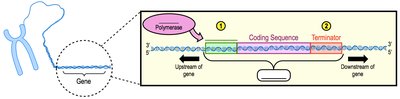
Transcription is the process by which RNA is synthesized from a DNA template within a gene. Genes are units of DNA that encode products such as proteins.
Promoter: DNA sequence where transcription begins; site of RNA polymerase attachment.
Terminator: DNA sequence where transcription ends.
RNA polymerase builds RNA from scratch, without a primer.
Overview of Transcription
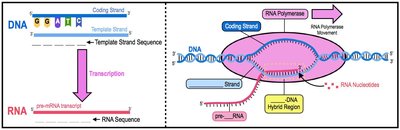
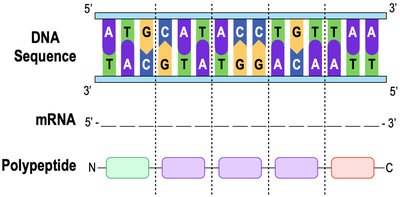
The two strands of DNA in a gene are referred to as the coding strand and the template strand. RNA molecules have the same sequence as the coding strand (except uracil replaces thymine).
RNA is built from 5' to 3' end by pairing free RNA nucleotides on a DNA template.
Base pairing follows Watson & Crick rules: A-U (in RNA), G-C.
Steps of Transcription
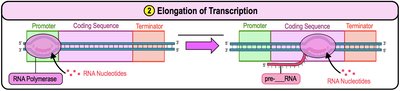
Transcription consists of three main steps: initiation, elongation, and termination.
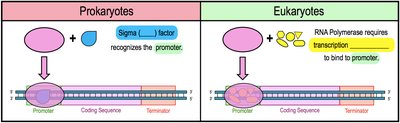
Initiation: RNA polymerase binds to the promoter and unwinds the DNA. In prokaryotes, the sigma factor recognizes the promoter; in eukaryotes, transcription factors are required.
Elongation: RNA polymerase synthesizes RNA by pairing free nucleotides with the DNA template, moving in the 5' to 3' direction.
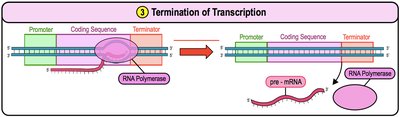
Termination: Transcription ends, producing an RNA molecule. Eukaryotic termination forms a pre-mRNA molecule requiring further modification.
Types of RNA
Major Types of RNA and Their Functions
All life uses several types of RNA, each with distinct functions:
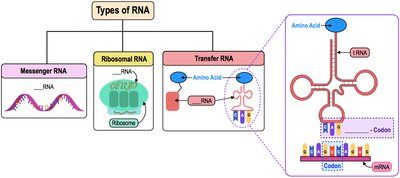
Messenger RNA (mRNA): Carries DNA-encoded information and is translated to protein. Contains codons (three nucleotides coding for a specific amino acid).
Ribosomal RNA (rRNA): Forms part of the structure of ribosomes.
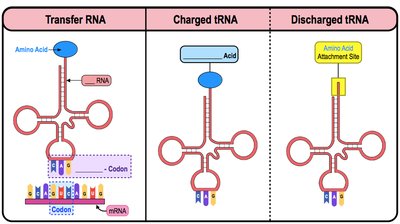
Transfer RNA (tRNA): Carries amino acids to the ribosome during translation. Contains anti-codons (three nucleotides complementary to mRNA codons).

Eukaryotic RNA Processing and Splicing
RNA Processing
Unlike prokaryotic mRNA, eukaryotic mRNA requires further modification upon transcription termination. Pre-mRNA is processed into mature mRNA ready for translation.
Addition of a 5’ cap (modified guanine nucleotide) to the 5’ end.
Addition of a poly-A tail (sequence of adenine nucleotides) to the 3’ end.
Functions: Facilitate export from nucleus, protect mRNA from degradation, help ribosomes bind for translation.

RNA Splicing
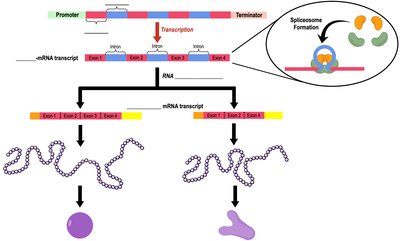
Within eukaryotic genes are regions called introns and exons. RNA splicing removes introns and reconnects exons, creating mature mRNA.
Introns: Noncoding regions that are transcribed but not translated.
Exons: Coding regions that are expressed and translated.
Spliceosome: Large complex responsible for removing introns.
Alternative splicing allows genes to be spliced in different ways, producing multiple products.
The Genetic Code
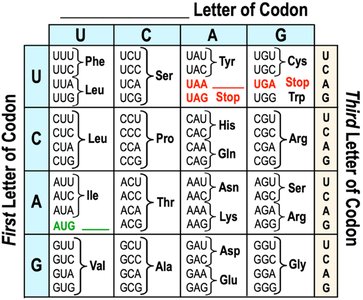
Genetic Code Table
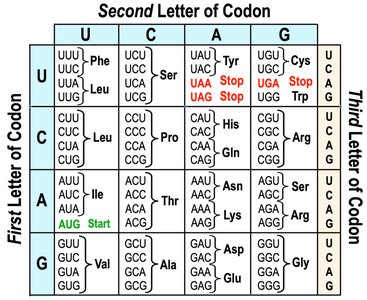
The genetic code reveals how DNA and RNA encode the sequence of amino acids in a protein. It is nearly universal across organisms and analyzes one codon (three nucleotides) at a time.
Redundancy: Multiple codons can code for the same amino acid.
Start codon (AUG) specifies methionine; stop codons signal termination.
First Letter | Second Letter | Third Letter | Amino Acid |
|---|---|---|---|
U | U | U | Phe |
A | U | G | Start (Met) |
U | A | A | Stop |
Translation: RNA to Protein
Introduction to Translation
Translation is the process by which proteins are synthesized using the encoded messages of mRNA. Ribosomes facilitate this process, and tRNA carries amino acids to the ribosome.
tRNA contains anti-codons that pair with mRNA codons.
Charged tRNA is attached to an amino acid; discharged tRNA is not.
Ribosome Structure and tRNA Binding Sites
Ribosomes consist of small and large subunits, each made of proteins and rRNA. Prokaryotes and eukaryotes have different ribosomal subunit sizes.
Three tRNA binding sites: Aminoacyl (A-site), Peptidyl (P-site), Exit (E-site).
A-site holds tRNA with the next amino acid; P-site holds tRNA with the growing polypeptide; E-site releases discharged tRNA.
Steps of Translation
Translation consists of three main steps: initiation, elongation, and termination.
Initiation: Small ribosomal subunit binds mRNA and tRNA; large subunit binds. Start codon (AUG) specifies methionine.
Elongation: Amino acids are added one by one to the C-terminus of the growing chain. Ribosome reads mRNA 5’ → 3’, pairing with tRNA anti-codons.
Termination: A stop codon reaches the ribosome’s A-site, triggering release factors to bind and release the polypeptide.
Summary Table: Central Dogma Processes
Process | Location (Prokaryotes) | Location (Eukaryotes) | Main Enzyme |
|---|---|---|---|
DNA Replication | Cytoplasm | Nucleus | DNA Polymerase |
Transcription | Cytoplasm | Nucleus | RNA Polymerase |
Translation | Cytoplasm | Cytoplasm (Rough ER) | Ribosome |
Additional info: This summary covers the core molecular processes of genetics, including DNA replication, transcription, and translation, as well as the roles of key enzymes and the genetic code. Images included are directly relevant to the described processes and reinforce understanding of molecular mechanisms.
