 Indietro
Ochem Module 8
Guida di studio - Note intelligenti
 Appunti personalizzati basati sui tuoi materiali, ampliati con definizioni chiave, esempi e contesto.
Alkyl Halides: Structure and Classification
Definition and Hybridization
Alkyl halides are organic compounds containing a halogen atom (F, Cl, Br, I) bonded to an sp3 hybridized carbon. The classification of alkyl halides depends on the degree of substitution at the carbon bonded to the halogen.
Primary (1°) alkyl halide: Halogen attached to a carbon bonded to one other carbon.
Secondary (2°) alkyl halide: Halogen attached to a carbon bonded to two other carbons.
Tertiary (3°) alkyl halide: Halogen attached to a carbon bonded to three other carbons.
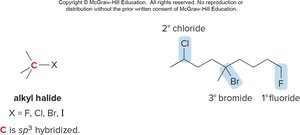
Other Organohalides
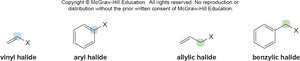
Organohalides include vinyl, aryl, allylic, and benzylic halides, each with unique reactivity due to their structural context.
Vinyl halide: Halogen attached to an alkene carbon.
Aryl halide: Halogen attached to an aromatic ring.
Allylic halide: Halogen attached to a carbon adjacent to a double bond.
Benzylic halide: Halogen attached to a carbon adjacent to a benzene ring.
Nomenclature of Alkyl Halides
IUPAC Rules
Alkyl halides are named by treating halides as substituents, using prefixes such as fluoro-, chloro-, bromo-, and iodo-. The parent chain is chosen to maximize the number of carbons, and substituents are listed alphabetically.
Number the chain to give the halogen the lowest possible number.
Multiple halides are indicated by di-, tri-, etc.
Example: 2,3-difluoro-4-ethylhexane
Physical Properties of Alkyl Halides
Polarity and Intermolecular Forces
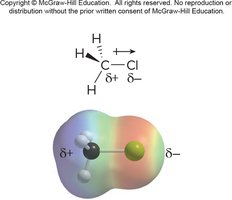
Alkyl halides are weakly polar due to the electronegativity difference between carbon and halogen. They exhibit dipole-dipole and van der Waals interactions, but do not participate in hydrogen bonding.
Boiling and Melting Points
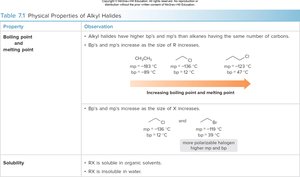
Alkyl halides generally have higher boiling and melting points than alkanes of similar molecular weight. These properties increase with the size and polarizability of the halogen.
Property | Observation |
|---|---|
Boiling point | Increases with size of halogen (F < Cl < Br < I) |
Melting point | Increases with size of halogen |
Solubility | Soluble in organic solvents, insoluble in water |
Examples and Applications
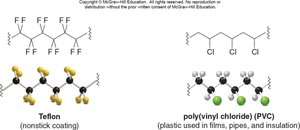
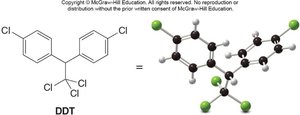
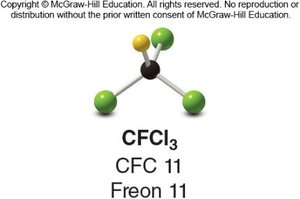
Alkyl halides are used in the synthesis of polymers and pesticides, such as Teflon, PVC, and DDT. They also include environmental compounds like CFCs (Freon).
Substitution Reaction Mechanisms: SN1 and SN2
Mechanistic Extremes
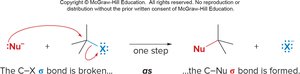
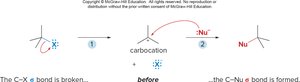
Substitution reactions can proceed via two main mechanisms: SN2 (single step, concerted) and SN1 (two step, not concerted).
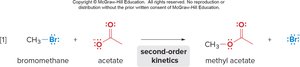
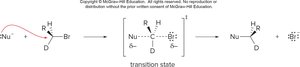
SN2: Nucleophile attacks as leaving group departs; both occur simultaneously.
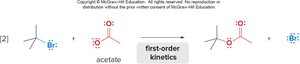
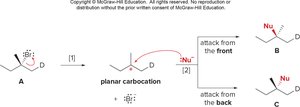
SN1: Leaving group departs first, forming a carbocation intermediate, then nucleophile attacks.
Kinetics
SN2: Second-order kinetics; rate depends on both substrate and nucleophile.
SN1: First-order kinetics; rate depends only on substrate.
Stereochemistry
SN2: Always results in inversion of configuration (Walden inversion).
SN1: Leads to racemization due to planar carbocation intermediate.
Factors Influencing Substitution Mechanisms
Structure of the R-Group
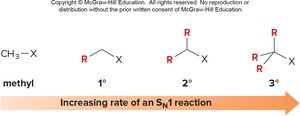
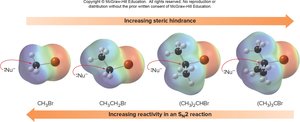
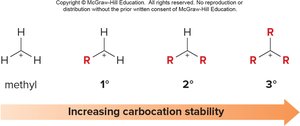
The degree of substitution at the carbon affects the mechanism. SN2 is favored by less hindered (primary) carbons, while SN1 is favored by more substituted (tertiary) carbons due to carbocation stability.
Carbocation Stability
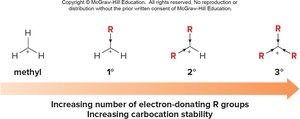
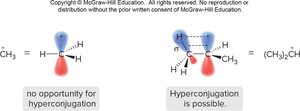
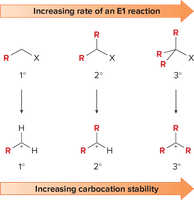
Carbocation stability increases with the number of electron-donating alkyl groups, due to inductive effects and hyperconjugation.
Inductive effect: Alkyl groups donate electron density.
Hyperconjugation: Overlap of σ-bonds with empty p-orbital stabilizes carbocation.
Reaction Energy Diagrams and Hammond Postulate
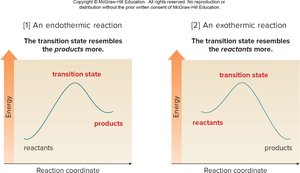
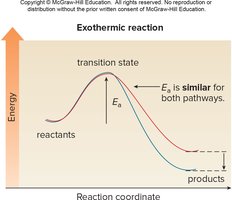
The Hammond postulate states that the transition state resembles the species (reactant or product) closest in energy. Carbocation stability lowers activation energy and increases reaction rate.
Leaving Groups and Nucleophiles
Leaving Group Ability
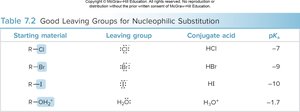
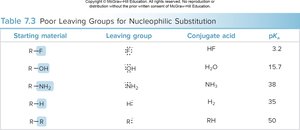
Good leaving groups are conjugate bases of strong acids (low pKa), while poor leaving groups are conjugate bases of weak acids (high pKa).
Starting Material | Leaving Group | Conjugate Acid | pKa |
|---|---|---|---|
R–Cl | Cl– | HCl | -7 |
R–Br | Br– | HBr | -9 |
R–I | I– | HI | -10 |
R–OH2+ | H2O | H3O+ | -1.7 |
Starting Material | Leaving Group | Conjugate Acid | pKa |
|---|---|---|---|
R–F | F– | HF | 3.2 |
R–OH | OH– | H2O | 15.7 |
R–NH2 | NH2– | NH3 | 38 |
R–H | H– | H2 | 35 |
R–R | R– | RH | 50 |
Nucleophile Strength
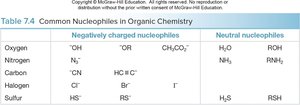
Nucleophilicity parallels basicity for similar atoms. Strong bases are good nucleophiles, and negatively charged nucleophiles are stronger than their neutral counterparts.
Negatively Charged Nucleophiles | Neutral Nucleophiles |
|---|---|
OH–, OR–, CH3CO2– | H2O, ROH |
N–, CN–, HC≡C– | NH3, RNH2 |
Cl–, Br–, I– | |
HS–, RS– | H2S, RSH |
Solvent Effects
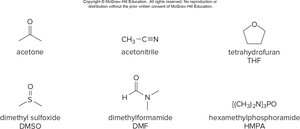
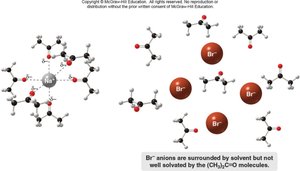
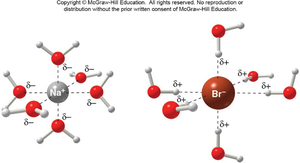
Solvents affect nucleophilicity and mechanism. Polar aprotic solvents favor SN2 by solvating cations but not anions, while polar protic solvents favor SN1 by solvating both.
Alkenes: Structure and Stereoisomerism
Bonding and Rotation
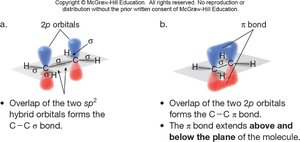
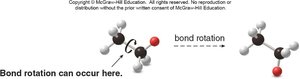
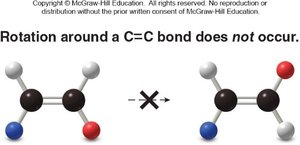
Alkenes contain a carbon-carbon double bond, consisting of one σ and one π bond. The π bond restricts rotation, leading to possible cis/trans (E/Z) stereoisomerism.
Stereoisomers of Alkenes
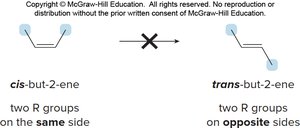
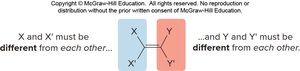
Stereoisomerism arises when each carbon of the double bond has two different substituents. Cis isomers have substituents on the same side; trans isomers have them on opposite sides.
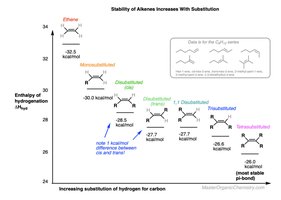
Stability of Alkenes
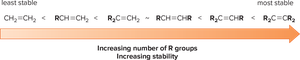
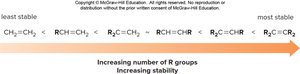
Alkene stability increases with substitution: more alkyl groups attached to the double bond stabilize it via hyperconjugation and inductive effects.
Elimination Mechanisms: E2 and E1
E2 Mechanism
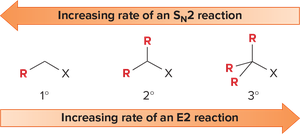
E2 is a concerted, one-step mechanism favored by strong bases and polar aprotic solvents. More substituted halides react faster, and better leaving groups increase the rate.
Characteristic | Result |
|---|---|
Kinetics | Second order |
Mechanism | One step |
Identity of R | More substituted halides react faster |
Base | Favored by strong bases |
Leaving group | Better leaving group = faster reaction |
Solvent | Favored by polar aprotic solvents |
E1 Mechanism
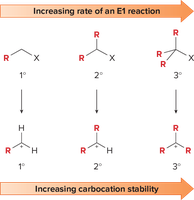
E1 is a two-step mechanism favored by weak bases and polar protic solvents. More substituted halides react faster due to carbocation stability.
Characteristic | Result |
|---|---|
Kinetics | First order |
Mechanism | Two steps |
Identity of R | More substituted halides react faster |
Base | Favored by weak bases |
Leaving group | Better leaving group = faster reaction |
Solvent | Favored by polar protic solvents |
Regioselectivity and Stereoselectivity in Elimination
Zaitsev's Rule
In elimination reactions, the most substituted (and thus most stable) alkene is usually the major product. This is known as Zaitsev's rule.
Hammond Postulate in Elimination
For exothermic E2 reactions, the transition state resembles the product, so the more stable product is formed faster.
Stereoselectivity in E2
E2 reactions require antiperiplanar geometry for optimal orbital overlap. In cyclohexane rings, the leaving group and β-hydrogen must be diaxial.
Competition Between Substitution and Elimination
Factors Determining SN1/SN2/E1/E2
The mechanism depends on the substrate (alkyl halide type), nucleophile/base strength, leaving group quality, and solvent type.
Strong nucleophiles/bases: Favor SN2 or E2.
Weak nucleophiles/bases: Favor SN1 or E1.
Bulky bases: Favor elimination (E2) due to steric hindrance.
Organic Synthesis Using Alkyl Halides
Retrosynthetic Analysis
Organic synthesis involves planning the preparation of compounds from available starting materials. Alkyl halides are versatile intermediates for introducing various functional groups via nucleophilic substitution or elimination.
Alkyne Synthesis
Alkynes can be synthesized by double elimination from dihalide substrates, requiring strong bases for the second elimination step.
*Additional info: Academic context and explanations have been expanded for clarity and completeness, including tables and images directly relevant to the content.*
