 Indietro
Alkynes: Structure, Properties, Nomenclature, and Reactions
Guida di studio - Note intelligenti
 Appunti personalizzati basati sui tuoi materiali, ampliati con definizioni chiave, esempi e contesto.
Alkynes: Structure and Properties
Definition and General Formula
Alkynes are a class of hydrocarbons characterized by the presence of a carbon-carbon triple bond. This triple bond imparts unique chemical and physical properties to alkynes, distinguishing them from alkanes and alkenes. Alkynes are unsaturated molecules, meaning they contain fewer hydrogen atoms than alkanes or alkenes with the same number of carbon atoms.
Acyclic alkynes follow the formula $\mathrm{C_nH_{2n-2}}$.
Cyclic alkynes follow the formula $\mathrm{C_nH_{2n-4}}$.
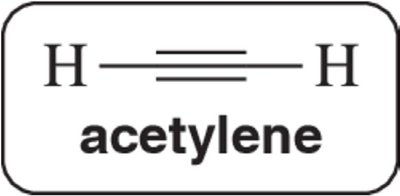
Example: Acetylene (ethyne) is the simplest alkyne, with the formula $\mathrm{C_2H_2}$.
Bonding, Hybridization, and Geometry
The carbon atoms in alkynes are sp-hybridized, resulting in a linear geometry around the triple bond. The triple bond consists of one sigma ($\sigma$) bond and two pi ($\pi$) bonds, making it the shortest and strongest bond among single, double, and triple bonds.
Bond length: Triple bond < Double bond < Single bond
Bond strength: Triple bond > Double bond > Single bond
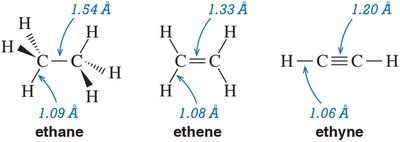
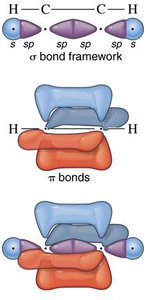
Example: Ethyne (acetylene) has a C≡C bond length of 1.20 Å, compared to 1.33 Å for C=C in ethene and 1.54 Å for C–C in ethane.
Electron Density and Nucleophilicity
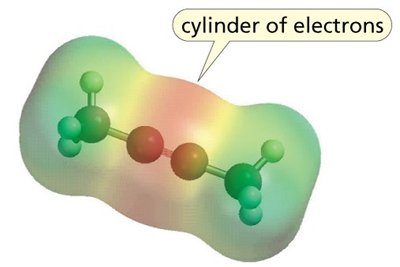
The triple bond in alkynes is surrounded by high electron density, making alkynes good nucleophiles. This electron-rich region is often visualized as a "cylinder of electrons" around the triple bond.
Classification of Alkynes
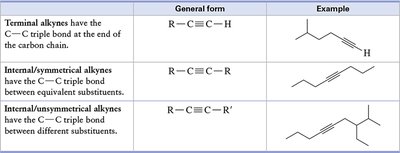
Terminal vs. Internal Alkynes
Alkynes are classified based on the location of the triple bond:
Terminal alkynes: The triple bond is at the end of the carbon chain.
Internal alkynes: The triple bond is within the carbon chain, between two carbon atoms.
Internal alkynes are more stable than terminal alkynes due to the stabilizing effect of alkyl groups.
Physical Properties of Alkynes
Boiling Points and Solubility
Alkynes exhibit distinct physical properties compared to other hydrocarbons:
Boiling points: Increase with molecular weight and are generally higher than alkanes and alkenes of similar size.
Solubility: Alkynes are insoluble in water due to their nonpolar nature.
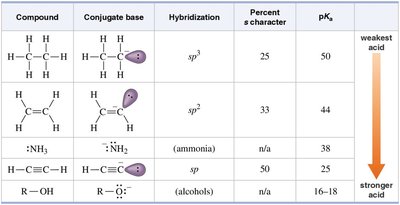
Acidity: Terminal alkynes can be deprotonated easily, forming acetylide ions.
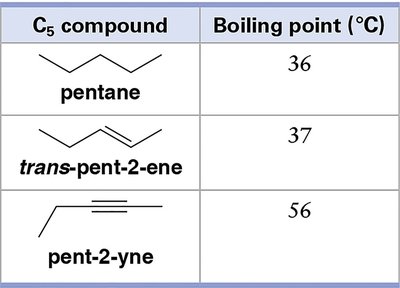
Example: Pent-2-yne has a higher boiling point than pentane and trans-pent-2-ene.
Nomenclature of Alkynes
Rules and Examples
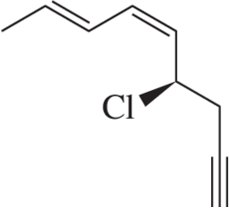
The nomenclature of alkynes follows similar rules to alkanes and alkenes, with specific modifications:
Replace -ane (alkane) or -ene (alkene) with -yne (alkyne).
The triple bond must be part of the longest carbon chain.
Number the chain to give the triple bond the lowest possible number.
Substituents are listed in alphabetical order.
If multiple triple bonds are present, use prefixes like di-, tri-, etc.
If both alkene and alkyne are present, the alkene gets priority in numbering if there is a tie.
Higher priority functional groups (e.g., acids, esters) get the lowest number.

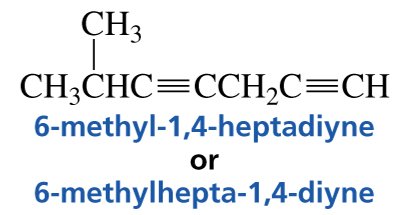

Example: 6-bromo-2-chloro-4-octyne
Reactivity and Reactions of Alkynes
Electrophilic Addition Reactions
Alkynes, being electron-rich, act as nucleophiles and undergo electrophilic addition reactions. The rate-determining step for alkynes is the formation of a vinylic cation, which is less stable than the carbocation formed in alkenes due to the higher electronegativity of the sp-hybridized carbon.


Example: Addition of HCl to an alkyne forms a vinylic cation intermediate.
Formation of Carbon-Carbon Bonds
Terminal alkynes can be deprotonated by strong bases (e.g., sodium amide) to form acetylide ions, which are useful nucleophiles in alkylation reactions. These ions can react with alkyl halides to form new C–C bonds.


Example: Reaction of a terminal alkyne with NaNH2 forms an acetylide ion, which can then react with an alkyl halide.
Catalytic Hydrogenation and Reduction
Alkynes can be reduced to alkanes via catalytic hydrogenation, similar to alkenes. The Lindlar catalyst is used to stop the reaction at the alkene stage, producing a cis-alkene. Dissolving metal reduction (e.g., Na or Li in ammonia) yields trans-alkenes.


Example: Partial hydrogenation of an alkyne with Lindlar catalyst produces a cis-alkene.
Electrophilic Addition of Hydrogen Halides
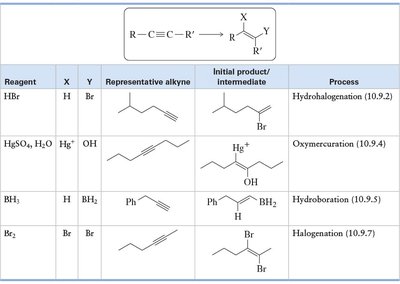
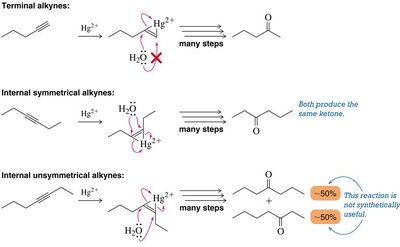
The addition of hydrogen halides (e.g., HBr, HCl) to alkynes results in alkenes and, with excess reagent, dihalides. The regioselectivity of the reaction depends on the stability of the carbocation intermediates and whether the starting alkyne is internal (symmetrical or unsymmetrical).

Hydration and Tautomerization
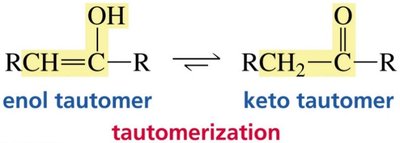
Addition of water to alkynes yields enols, which rapidly tautomerize to ketones. Tautomers are constitutional isomers in equilibrium with each other. Hydration of alkynes is more difficult than alkenes and often requires a catalyst (e.g., HgSO4).


Hydroboration-Oxidation
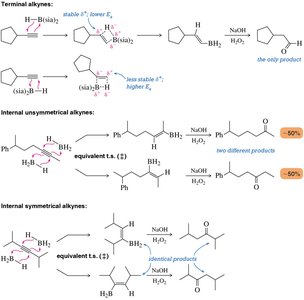
Hydroboration-oxidation of alkynes produces either ketones or aldehydes, depending on the starting alkyne. Tautomerization under basic conditions follows the same mechanism as for alkenes.
Halogenation
Alkynes undergo halogenation reactions via the same mechanism as alkenes. Stoichiometry is important, and the reaction can be used in synthetic schemes, including retrosynthetic analysis.
Applications and Examples
Medicinal Alkynes
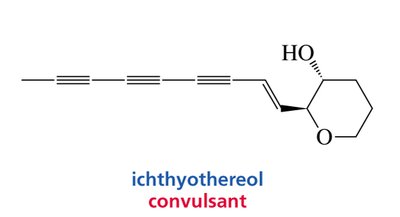
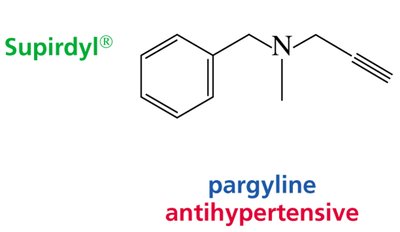
Alkynes are found in various biologically active compounds, including pharmaceuticals.
Ichthyothereol: Convulsant natural product.
Pargyline (Supirdyl): Antihypertensive drug.
Summary Table: Functional Group Priority
Functional group | Priority |
|---|---|
Acids | 1 (highest) |
Esters | 2 |
Acid chlorides | 3 |
Anhydrides | 3 |
Amides | 4 |
Nitriles | 5 |
Aldehydes | 6 |
Ketones | 7 |
Alcohols | 8 |
Amines | 9 |
Alkenes, alkynes | 10 |
Alkanes | Blank |
Ethers | Blank |
Alkyl halides | Lowest |
Practice and Synthesis
Retrosynthetic Analysis
Retrosynthetic analysis is a method used to design synthetic schemes by working backwards from the target molecule to simpler starting materials.
Example Problems
Give the products for reactions such as HCl, NaNH2, CH3CH2CH2CH2Br with alkynes.
How would you prepare specific compounds from ethyne?
Assume you start with the following alkynes; predict the products for each reaction discussed in this chapter.
Additional info: Academic context was added to clarify mechanisms, nomenclature rules, and physical property explanations. Tables and images were selected strictly for direct relevance to the adjacent content.
