 Indietro
Arrows, Resonance, Acid/Base Chemistry, and Substitution/Elimination Mechanisms in Organic Chemistry
Guida di studio - Note intelligenti
 Appunti personalizzati basati sui tuoi materiali, ampliati con definizioni chiave, esempi e contesto.
Arrows in Organic Chemistry
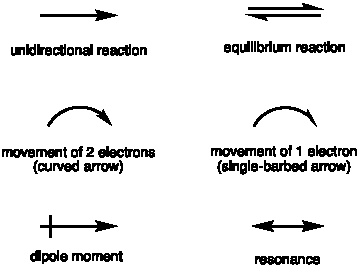
Types of Arrows and Their Meanings
Organic chemistry uses a variety of arrows to represent different processes and electron movements. Understanding these conventions is essential for interpreting reaction mechanisms and molecular behavior.
Unidirectional Reaction Arrow: Indicates a reaction that proceeds in one direction only.
Equilibrium Arrow: Shows that a reaction is reversible and can reach equilibrium.
Curved Arrow (Double-Barbed): Represents the movement of two electrons, typically in bond formation or breaking.
Single-Barbed Arrow: Indicates the movement of a single electron, often seen in radical mechanisms.
Dipole Moment Arrow: Used to show the direction of molecular dipole moments.
Resonance Arrow: Indicates resonance between two or more contributing structures.
Resonance and Aromaticity
Resonance: Delocalization of Electrons
Resonance is a stabilizing force in organic molecules, representing the delocalization of electrons across multiple atoms. It is depicted by drawing multiple resonance structures, which together describe the true electronic structure of the molecule.
Occurs through conjugation: parallel unhybridized p orbitals on three or more consecutive atoms.
Involves π bonds, empty p orbitals (e.g., carbocations), or lone pairs that can be conjugated.
Not all resonance structures contribute equally; the most stable ones minimize charge and maximize octet completion.
Example: Resonance in α,β-unsaturated ketones and allyl carbocations.
Guidelines for Drawing Resonance Structures
Minimize formal charges.
Ensure atoms (especially those to the right of carbon) have complete octets when possible.
Avoid placing opposite charges on adjacent carbons.
Aromaticity and Anti-Aromaticity
Aromatic compounds are cyclic, planar molecules with uninterrupted π systems containing 4n+2 π electrons (Hückel's rule, where n is an integer). These compounds are unusually stable. Anti-aromatic compounds have 4n π electrons and are less stable than expected.
Aromatic: More stable, less reactive.
Anti-aromatic: Less stable, more reactive.
Acid/Base Chemistry in Organic Molecules
Brønsted-Lowry and Lewis Definitions
Acids and bases can be defined in two main ways:
Brønsted-Lowry Acid: Proton (H+) donor.
Brønsted-Lowry Base: Proton (H+) acceptor.
Lewis Acid: Electron pair acceptor.
Lewis Base: Electron pair donor.
General acid/base reactions can be represented with curved arrows to show electron movement.

pKa and Acid Strength
The pKa value is a logarithmic measure of acid strength. It is defined as:
Where is the acid dissociation constant. Lower pKa values indicate stronger acids, while higher pKa values indicate weaker acids.
Stronger acid: More H3O+ produced, higher , lower pKa.
Weaker acid: Less H3O+ produced, lower , higher pKa.
Predicting Equilibrium Using pKa
The equilibrium constant () for an acid/base reaction can be related to the pKa values of the acids involved:
Reactions favor the formation of the weaker acid (higher pKa).

Factors Affecting Acidity and Basicity
Several factors influence the acidity or basicity of a molecule:
Atom bonded to the acidic proton: More electronegative atoms and larger atomic radii increase acidity.
Resonance: Delocalization of negative charge stabilizes the conjugate base, increasing acidity.
Inductive Effects: Electronegative atoms withdraw electron density through σ bonds, stabilizing the conjugate base.
Hybridization: Greater s-character (sp > sp2 > sp3) increases acidity.
Other considerations include hydrogen bonding and solvent effects.
Substitution and Elimination Reactions
Substitution Reactions: SN2 and SN1 Mechanisms
Substitution reactions involve the replacement of one group (leaving group) by another (nucleophile). Two main mechanisms are observed:
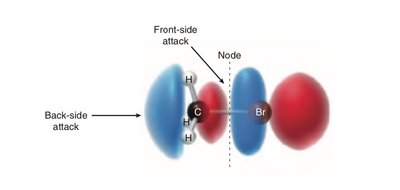
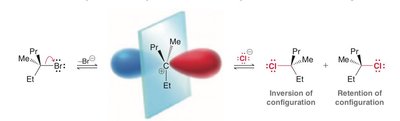
SN2 (Bimolecular Nucleophilic Substitution): Concerted, single-step mechanism with inversion of stereochemistry. Favored by strong nucleophiles, good leaving groups, small/unbranched electrophiles, and polar aprotic solvents.
SN1 (Unimolecular Nucleophilic Substitution): Two-step mechanism via carbocation intermediate, leading to loss of stereochemical information. Favored by good leaving groups, highly substituted electrophiles, and polar protic solvents.
Factors Affecting SN1 and SN2 Mechanisms
Factor | Favors SN2 | Favors SN1 |
|---|---|---|
Leaving Group | Good | Good |
Nucleophile | Strong | Not significant |
Electrophile | Small, unbranched | Substituted |
Solvent | Polar aprotic | Polar protic |
Elimination Reactions: E2 and E1 Mechanisms
Elimination reactions result in the formation of alkenes by removal of atoms or groups from adjacent carbons. Two main mechanisms are:
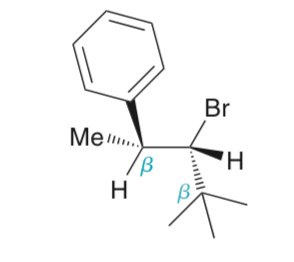
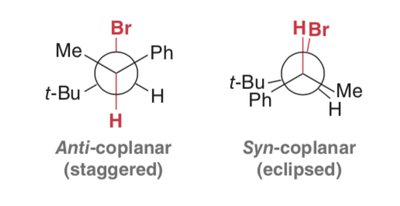
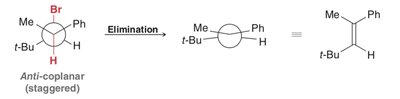
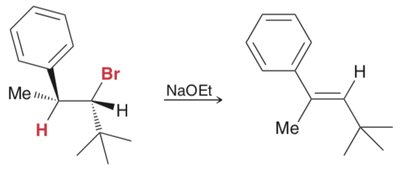
E2 (Bimolecular Elimination): Concerted, single-step process. Requires a strong base and anti-coplanar arrangement of leaving group and hydrogen. Competes with SN2.
E1 (Unimolecular Elimination): Two-step process via carbocation intermediate. Competes with SN1. Prefers more substituted (Zaitsev) alkene.
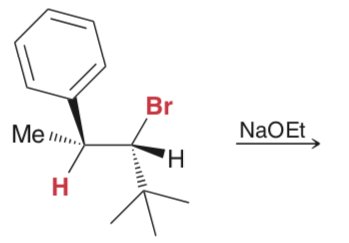
Stereochemistry in Elimination Reactions
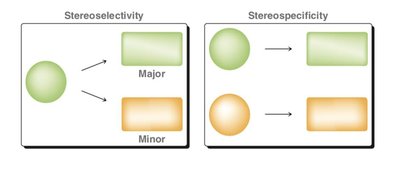
E2: Proceeds via anti-elimination; can be stereoselective (favoring E alkenes) or stereospecific (stereochemistry of starting material dictates product).
E1: Stereoselective for E alkenes; loss of stereochemical information due to planar carbocation intermediate.
Summary Table: Substitution and Elimination Mechanisms
Mechanism | Key Features | Stereochemistry | Favored Conditions |
|---|---|---|---|
SN2 | Backside attack, concerted | Inversion | Strong nucleophile, polar aprotic solvent, primary/secondary carbon |
SN1 | Carbocation intermediate | Racemic mixture | Polar protic solvent, tertiary carbon |
E2 | Concerted, anti-coplanar | Anti-elimination | Strong base, polar aprotic solvent |
E1 | Carbocation intermediate | Loss of stereochemistry | Weak base, polar protic solvent |
Additional Notes
Alcohols can be converted to better leaving groups (e.g., by protonation or conversion to sulfonate esters).
Intramolecular reactions are generally faster than intermolecular ones, especially for forming 3, 5, or 6-membered rings.
Carbocation rearrangements (hydride or carbon shifts) can occur in SN1 and E1 mechanisms.
