 Indietro
E1 Mechanism: Predicting the Product of Alkyl Halide Elimination
Guida di studio - Note intelligenti
 Appunti personalizzati basati sui tuoi materiali, ampliati con definizioni chiave, esempi e contesto.
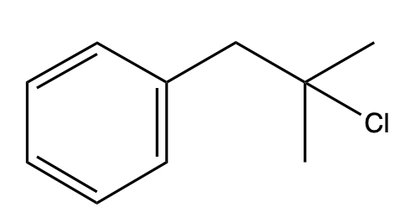
Q1. What is the product obtained from the following alkyl halide when it undergoes an E1 reaction?
Background
Topic: E1 Elimination Mechanism
This question tests your understanding of the E1 (unimolecular elimination) mechanism, which is a two-step process involving the formation of a carbocation intermediate followed by elimination to form an alkene. You need to predict the major product based on the stability of the carbocation and the possible elimination pathways.
Key Terms and Formulas
E1 Mechanism: A two-step elimination process where the leaving group departs first, forming a carbocation, followed by removal of a proton to form a double bond.
Carbocation Stability: More substituted carbocations are more stable (tertiary > secondary > primary).
Zaitsev's Rule: The most substituted (stable) alkene is usually the major product.
Possible Products: Consider all possible β-hydrogens that can be eliminated to form different alkenes.
Step-by-Step Guidance
Identify the leaving group (Cl) and recognize that the reaction proceeds via E1, so the first step is the loss of the leaving group to form a carbocation.
Draw the carbocation intermediate that forms after the chloride leaves. Consider resonance and rearrangement possibilities for increased stability.
Locate all β-hydrogens adjacent to the carbocation. Each β-hydrogen can be eliminated to form a different alkene product.
Apply Zaitsev's rule to determine which alkene will be the major product (the more substituted alkene is favored).
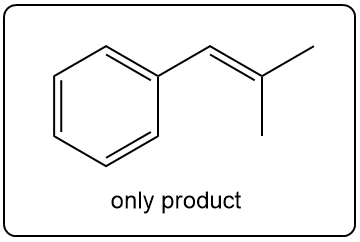
Review the possible product structures and match them to the answer choices provided. Stop here and set up the elimination step for the student to complete.
Try solving on your own before revealing the answer!
Final Answer:
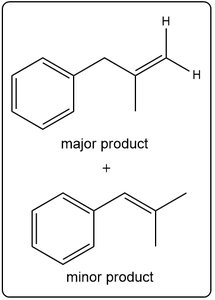
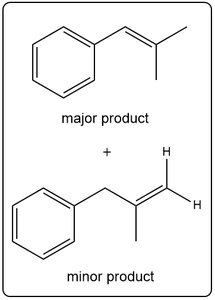
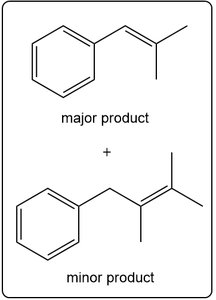
The major product of the E1 elimination is the more substituted alkene, following Zaitsev's rule. The correct answer is shown in image_3: the major product is the alkene with the double bond between the two most substituted carbons, and the minor product is the less substituted alkene.
This occurs because the carbocation intermediate is stabilized by the adjacent phenyl group, and elimination of a β-hydrogen from the more substituted carbon leads to the most stable (major) alkene.
