 Indietro
Organic Chemistry Exam 3 Practice – Step-by-Step Guidance
Guida di studio - Note intelligenti
 Appunti personalizzati basati sui tuoi materiali, ampliati con definizioni chiave, esempi e contesto.
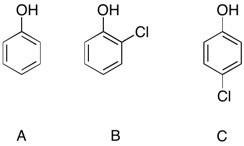
Q3. Rank the following phenols in order of acidity (most acidic = first, least acidic = last):
Background
Topic: Acidity of Phenols and Substituent Effects
This question tests your understanding of how substituents on the aromatic ring affect the acidity of phenols. Specifically, it focuses on the influence of electron-withdrawing groups (like chlorine) and their position relative to the hydroxyl group.
Key Terms and Concepts:
Phenol: An aromatic compound with a hydroxyl group attached to a benzene ring.
Acidity: The tendency of a compound to donate a proton (H+). More acidic compounds have lower pKa values.
Electron-Withdrawing Groups (EWGs): Substituents like Cl that stabilize the negative charge on the conjugate base, increasing acidity.
Resonance and Inductive Effects: The position of the substituent (ortho, para) affects how strongly it influences acidity.
Step-by-Step Guidance
Examine the structures: A is phenol, B is ortho-chlorophenol, and C is para-chlorophenol.
Recall that electron-withdrawing groups (like Cl) increase acidity by stabilizing the phenoxide ion formed after deprotonation.
Consider the position of the chlorine atom: ortho (B) and para (C) relative to the hydroxyl group. The ortho position allows for both inductive and some resonance effects, while para is mainly inductive.
Rank the compounds based on the expected stabilization of the conjugate base. Think about which structure would have the most stabilized phenoxide ion.
Set up your ranking from most acidic to least acidic based on your analysis, but do not write the final order yet.
Try solving on your own before revealing the answer!
Final Answer: C > B > A
Para-chlorophenol (C) is the most acidic due to strong inductive effects, followed by ortho-chlorophenol (B), and then phenol (A) which has no electron-withdrawing substituent. The electron-withdrawing chlorine stabilizes the phenoxide ion, increasing acidity.
