 Indietro
Organic Chemistry Exam III Study Guidance
Guida di studio - Note intelligenti
 Appunti personalizzati basati sui tuoi materiali, ampliati con definizioni chiave, esempi e contesto.
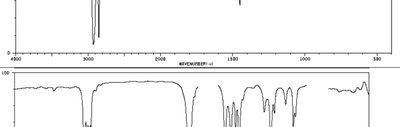
Q7. You perform two unique reactions in a lab, both of which involve cyclopentene as the starting material. You isolate each product and analyze them via IR – the corresponding spectra are given in the table below. Give one example reagent that may have been used to generate each product. There may be multiple correct answers.
Background
Topic: Infrared (IR) Spectroscopy and Organic Reaction Mechanisms
This question tests your ability to interpret IR spectra to deduce functional groups present in the products, and to connect those functional groups to possible reagents used in the reactions starting from cyclopentene.
Key Terms and Concepts:
IR Spectroscopy: Analytical technique used to identify functional groups based on absorption of infrared light at characteristic frequencies.
Cyclopentene: A five-membered ring with one double bond, used as the starting material.
Functional Groups: Common groups include alcohols (O-H stretch), alkenes (C=C stretch), carbonyls (C=O stretch), etc.
Reagents: Chemicals used to transform cyclopentene into products with new functional groups.
Step-by-Step Guidance
Examine the IR spectra for each product. Identify the major peaks and their corresponding wavenumbers (cm-1).
Recall the typical IR absorption ranges for key functional groups: O-H (broad, ~3200-3600 cm-1), C=O (~1700 cm-1), C=C (~1600 cm-1), etc.
Compare the spectra to the starting material (cyclopentene) and note any new functional groups present in the products.
Think about common reactions that can introduce these functional groups to cyclopentene. For example, hydration, oxidation, or addition reactions.
For each product, select a reagent that could reasonably produce the observed functional group from cyclopentene. Consider the mechanism and whether the reaction would be regioselective or stereoselective.
Set up the reaction equation, but stop before writing the final product structure or naming the reagent.
Try solving on your own before revealing the answer!
Final Answer:
For Reaction 1: The IR spectrum shows a broad peak around 3300 cm-1, indicating an O-H stretch (alcohol). A possible reagent is acid-catalyzed hydration (e.g., H2O/H+).
For Reaction 2: The IR spectrum shows a strong peak near 1700 cm-1, indicating a C=O stretch (ketone or aldehyde). A possible reagent is oxidation (e.g., KMnO4 or O3 followed by reductive workup).
These reagents are commonly used to convert cyclopentene into alcohols or carbonyl-containing compounds, as indicated by the IR spectra.
