 Indietro
Predicting Products and Mechanisms for (1-bromoethyl)cyclohexane in Methanol
Guida di studio - Note intelligenti
 Appunti personalizzati basati sui tuoi materiali, ampliati con definizioni chiave, esempi e contesto.
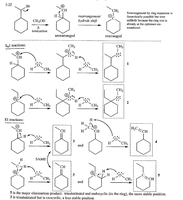
Q1. When (1-bromoethyl)cyclohexane is heated in methanol for an extended period of time, five products result: two ethers and three alkenes. Predict the products of this reaction, and propose mechanisms for their formation. Predict which of the three alkenes is the major elimination product.
Background
Topic: Substitution and Elimination Reactions (SN1, E1) in Organic Chemistry
This question tests your understanding of how a secondary alkyl bromide reacts with methanol under heating, leading to both substitution (ether formation) and elimination (alkene formation) products. You are also asked to propose mechanisms and identify the major alkene product.
Key Terms and Formulas
SN1 Reaction: Substitution nucleophilic unimolecular, typically occurs with secondary/tertiary alkyl halides in polar protic solvents.
E1 Reaction: Elimination unimolecular, also favored by secondary/tertiary alkyl halides in polar protic solvents and heat.
Carbocation Rearrangement: Migration of hydride or alkyl groups to stabilize the carbocation intermediate.
Zaitsev's Rule: The most substituted alkene is usually the major product in elimination reactions.
Mechanism Steps: Formation of carbocation, nucleophilic attack (for SN1), or loss of proton (for E1).
Step-by-Step Guidance
Draw the structure of (1-bromoethyl)cyclohexane and identify the reactive site (the bromine atom attached to the secondary carbon).
Consider the reaction conditions: methanol (a polar protic solvent) and heat. These favor both SN1 and E1 mechanisms.
For SN1: The bromide leaves, forming a carbocation. Methanol can attack this carbocation, leading to ether products. Consider possible carbocation rearrangements (hydride or methyl shifts) that could lead to different ethers.
For E1: After carbocation formation, elimination of a proton from adjacent carbons leads to alkene products. Draw possible alkenes, considering both trans and cis isomers, and ring positions.
Apply Zaitsev's rule to predict which alkene is the major product (the most substituted, thermodynamically stable alkene).
Set up the mechanism for each product, showing the carbocation intermediate, nucleophilic attack (for ethers), and proton loss (for alkenes). Stop here and let the student complete the product structures and identify the major alkene.
Try solving on your own before revealing the answer!
Final Answer:
The five products are:
Two ethers: Formed by SN1 substitution with methanol, including possible rearranged carbocation intermediates.
Three alkenes: Formed by E1 elimination, including trans- and cis- isomers and ring positions.
The major elimination product is the trans-alkene (trans-decalin structure), which is more stable due to less ring strain and greater substitution, following Zaitsev's rule.
Mechanisms involve carbocation formation, possible rearrangement, nucleophilic attack by methanol (for ethers), and proton loss (for alkenes).
