 Indietro
Thermodynamics and Kinetics of Free Radical Halogenation of Alkanes
Guida di studio - Note intelligenti
 Appunti personalizzati basati sui tuoi materiali, ampliati con definizioni chiave, esempi e contesto.
Thermodynamics and Kinetics of Free Radical Halogenation
Introduction to Reaction Mechanisms
Chemical reactions involve the transformation of reactants into products. To fully understand these processes, it is essential to study both the energy changes (thermodynamics) and the rates at which reactions occur (kinetics). The mechanism of a reaction provides a step-by-step description of how reactants are converted into products, including the identification of intermediates and transition states.
Free Radical Halogenation of Alkanes
Chlorination of Methane: Overview
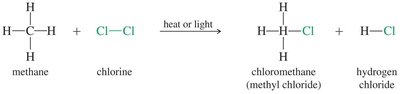
The chlorination of methane is a classic example of a free radical chain reaction. This process requires heat or light to initiate and proceeds via a chain mechanism with three fundamental steps: initiation, propagation, and termination.
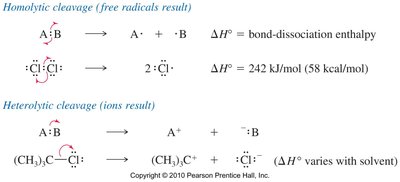
Initiation: Generation of free radicals, typically by homolytic cleavage of a chlorine molecule.
Propagation: Free radicals react with stable molecules to produce new radicals and products.
Termination: Two radicals combine to form a stable, non-radical product, ending the chain reaction.
Initiation Step
In the initiation step, a chlorine molecule absorbs energy (usually from blue light) and splits homolytically to form two chlorine atoms (free radicals):

Lewis Structures of Free Radicals
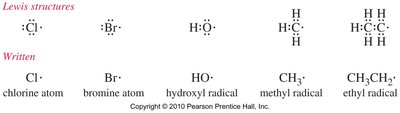
Free radicals are species with an unpaired electron. Common examples include chlorine atom (Cl·), bromine atom (Br·), hydroxyl radical (HO·), methyl radical (CH3·), and ethyl radical (CH3CH2·).
Propagation Steps
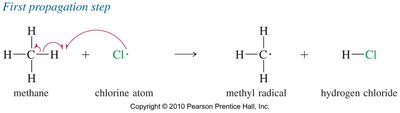
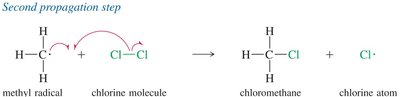
The propagation phase consists of two main steps:
The chlorine radical abstracts a hydrogen atom from methane, forming hydrogen chloride and a methyl radical.
The methyl radical reacts with another chlorine molecule to form chloromethane and regenerate a chlorine radical.
Termination Steps
Termination occurs when two free radicals combine to form a stable molecule, thus removing radicals from the reaction mixture and slowing or stopping the chain process.
Overall Reaction
The net reaction for the chlorination of methane is:
Thermodynamics of Free Radical Halogenation
Equilibrium Constant and Free Energy
The equilibrium constant (Keq) expresses the ratio of product to reactant concentrations at equilibrium. For the chlorination of methane:
A large value indicates the reaction proceeds nearly to completion.
The standard free energy change () is related to by:
where J/K·mol and is temperature in kelvins.
Enthalpy and Entropy
Enthalpy (): The heat evolved or absorbed during a reaction. Exothermic reactions () release heat, while endothermic reactions () absorb heat. Reactions favor products with lower enthalpy (stronger bonds).
Entropy (): A measure of disorder or randomness. Usually, is the dominant factor in determining spontaneity for halogenation reactions.
The relationship between these quantities is:
Bond Dissociation Energies (BDE) and Reaction Enthalpy
Bond dissociation energy is the energy required to break a bond homolytically. The enthalpy change for a reaction can be estimated using BDEs:
For the chlorination of methane:
Bonds Broken | (kJ/mol) | Bonds Formed | (kJ/mol) |
|---|---|---|---|
Cl–Cl | +242 | H–Cl | -431 |
CH3–H | +435 | CH3–Cl | -351 |
Total | +677 | Total | -782 |
kJ/mol
Kinetics of Free Radical Halogenation
Reaction Rate and Rate Law
Kinetics is the study of reaction rates. The rate law expresses the relationship between reactant concentrations and the observed reaction rate:
where and are the reaction orders with respect to A and B, respectively, and is the rate constant. The overall order is .
Activation Energy and Temperature Dependence
The rate constant depends on temperature according to the Arrhenius equation:
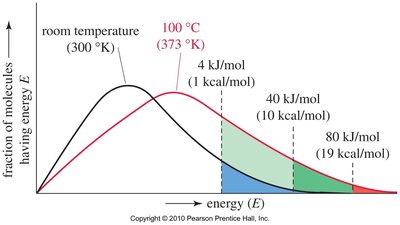
where is the frequency factor, is the activation energy, is the gas constant, and is the temperature in kelvins. Higher temperatures increase the fraction of molecules with sufficient energy to react.
Energy Diagrams and Transition States
Energy diagrams plot the potential energy of the system as the reaction progresses. The highest point corresponds to the transition state, and the energy difference between reactants and the transition state is the activation energy ().

Multistep Reactions and Rate-Limiting Step
In multistep reactions, the step with the highest activation energy is the slowest and determines the overall reaction rate (rate-limiting step). Intermediates are found at energy minima between transition states.

Halogen Reactivity and Selectivity
Relative Reactivity of Halogens
The reactivity of halogens in alkane halogenation decreases in the order: F2 > Cl2 > Br2 > I2. Fluorine reacts explosively, chlorine reacts moderately, bromine requires heating, and iodine does not react detectably under standard conditions.
Product Distribution and Selectivity
For higher alkanes, different types of hydrogens (primary, secondary, tertiary) lead to different products. The selectivity of halogenation depends on the stability of the intermediate radicals formed.

C–H bond | F· (25°C, gas) | Cl· (25°C, gas) | Br· (150°C, gas) |
|---|---|---|---|
CH3–H | 0.5 | 0.004 | 0.002 |
RCH2–H | 1 | 1 | 1 |
R2CH–H | 1.2 | 4.5 | 80 |
R3C–H | 1.4 | 5.5 | 1700 |
Additional info: Bromination is highly selective for tertiary hydrogens, while chlorination is less selective, and fluorination is nearly nonselective.
Stability of Free Radicals and Other Reactive Intermediates
Radical Stability
Free radical stability increases with substitution: methyl < primary < secondary < tertiary. This is due to hyperconjugation and, in some cases, resonance stabilization.
Hyperconjugation: Delocalization of electrons from adjacent σ bonds into the partially filled p orbital of the radical center.
Resonance: Delocalization involving π orbitals, especially in allylic and benzylic radicals.
Other Reactive Intermediates
Carbocations: Positively charged, sp2 hybridized, stabilized by alkyl groups (inductive effect and hyperconjugation) and resonance (allylic and benzylic positions).
Carbanions: Negatively charged, nucleophilic, destabilized by alkyl groups, most stable as methyl carbanion.
Carbenes: Neutral, have both a lone pair and an empty p orbital, can act as nucleophiles or electrophiles.
Summary of Key Concepts
Propose mechanisms for free-radical halogenation, including initiation, propagation, and termination steps.
Predict major products based on radical stability and halogen selectivity.
Draw and interpret reaction energy diagrams, identifying transition states, intermediates, and rate-limiting steps.
Calculate enthalpy changes using bond dissociation energies.
Relate equilibrium constants to free energy changes.
Determine reaction order from rate equations.
Describe the structure and stability of carbocations, carbanions, free radicals, and carbenes.
