Ch. 16 - Reactions of Aldehydes and Ketones • More Reactions of Carboxylic Acid Derivatives
Bruice - Organic Chemistry 8th Edition
Bruice8th EditionOrganic ChemistryISBN: 9780135213711Non è quello che usi tu?Cambia libro di testo
Capitolo 16, Problema 39(1)

Which of the following are a. hemiacetals? b. acetals? c. hydrates?
1. Structural formula of a compound showing a central carbon atom bonded to an OH group, a methyl group, and an ether group.

Guida verificata passo dopo passo
1
Step 1: Identify the functional groups present in the given structure. The molecule contains a hydroxyl group (-OH) and a methoxy group (-OCH3) attached to the same carbon atom.
Step 2: Recall the definitions of hemiacetals, acetals, and hydrates. A hemiacetal contains one hydroxyl group (-OH) and one alkoxy group (-OR) attached to the same carbon atom. An acetal contains two alkoxy groups (-OR) attached to the same carbon atom. A hydrate contains two hydroxyl groups (-OH) attached to the same carbon atom.
Step 3: Compare the structure to the definitions. The presence of one hydroxyl group (-OH) and one alkoxy group (-OCH3) attached to the same carbon atom matches the definition of a hemiacetal.
Step 4: Confirm that the molecule does not fit the definitions of an acetal or a hydrate. The molecule does not have two alkoxy groups (-OR) or two hydroxyl groups (-OH) attached to the same carbon atom, so it is not an acetal or a hydrate.
Step 5: Conclude that the given structure is a hemiacetal based on the functional groups present and the definitions provided.

Risposta video verificata per un problema simile:

Questa soluzione video è stata consigliata dai nostri tutor come utile per risolvere questo problema.
Durata del video:
3m

Concetti chiave

Ecco i concetti essenziali che devi comprendere per rispondere correttamente alla domanda.

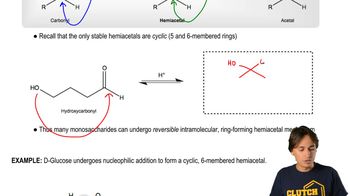
Hemiacetals

Hemiacetals are formed when an aldehyde or ketone reacts with an alcohol, resulting in a compound that contains both a hydroxyl group (-OH) and an ether group (-O-alkyl). They are characterized by having one -OH group and one -O-alkyl group attached to the same carbon atom, which is typically derived from the carbonyl carbon of the aldehyde or ketone.
Video consigliato:
06:23
Monosaccharides - Forming Cyclic Hemiacetals

Acetals

Acetals are derived from hemiacetals through a reaction with an additional alcohol molecule, leading to the replacement of the hydroxyl group with another alkoxy group (-O-alkyl). Acetals are stable compounds that contain two -O-alkyl groups attached to the same carbon atom, which is no longer reactive as a carbonyl carbon, making them less susceptible to hydrolysis compared to hemiacetals.
Video consigliato:
04:29
Acetal Protecting Group

Hydrates

Hydrates are formed when water adds to a carbonyl compound, such as an aldehyde or ketone, resulting in a molecule that contains two hydroxyl groups (-OH) attached to the same carbon atom. This process is a type of hydration reaction and is characterized by the presence of a carbon atom bonded to two -OH groups, distinguishing it from hemiacetals and acetals.
Video consigliato:
09:11
Alkyne Hydration