Ch. 16 - Reactions of Aldehydes and Ketones • More Reactions of Carboxylic Acid Derivatives
Bruice - Organic Chemistry 8th Edition
Bruice8th EditionOrganic ChemistryISBN: 9780135213711Non è quello che usi tu?Cambia libro di testo
Capitolo 16, Problema 16

Can a cyanohydrin be prepared by treating a ketone with sodium cyanide?

Guida verificata passo dopo passo
1
Identify the functional groups involved: A cyanohydrin is formed from a ketone or aldehyde and contains a hydroxyl group (-OH) and a cyano group (-CN) attached to the same carbon.
Understand the reaction mechanism: The reaction involves nucleophilic addition of the cyanide ion (CN⁻) to the carbonyl carbon of the ketone.
Consider the role of sodium cyanide: Sodium cyanide (NaCN) provides the cyanide ion (CN⁻) necessary for the nucleophilic attack on the carbonyl carbon.
Recognize the conditions required: The reaction typically occurs in the presence of an acid, such as HCl, to protonate the oxygen and stabilize the intermediate, leading to the formation of the cyanohydrin.
Conclude the feasibility: Yes, a cyanohydrin can be prepared by treating a ketone with sodium cyanide under the appropriate acidic conditions.

Risposta video verificata per un problema simile:

Questa soluzione video è stata consigliata dai nostri tutor come utile per risolvere questo problema.
Durata del video:
4m

Concetti chiave

Ecco i concetti essenziali che devi comprendere per rispondere correttamente alla domanda.

Cyanohydrin Formation

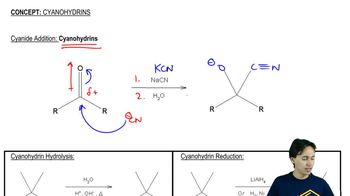
Cyanohydrins are organic compounds formed when a carbonyl compound, such as an aldehyde or ketone, reacts with hydrogen cyanide (HCN) or a cyanide salt. This reaction involves the nucleophilic addition of the cyanide ion to the carbonyl carbon, leading to the formation of a hydroxyl group and a cyano group on the same carbon atom.
Video consigliato:
02:36
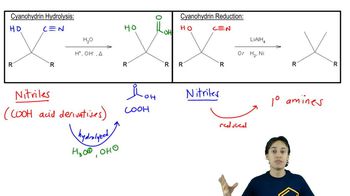
Nitrile Reduction

Nucleophilic Addition

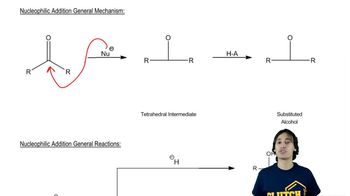
Nucleophilic addition is a fundamental reaction mechanism in organic chemistry where a nucleophile attacks an electrophilic carbon atom, typically found in carbonyl groups. In the case of cyanohydrin formation, the cyanide ion acts as the nucleophile, attacking the electrophilic carbon of the ketone, resulting in the formation of a new carbon-carbon bond.
Video consigliato:
08:27
Nucleophilic Addition

Role of Sodium Cyanide

Sodium cyanide (NaCN) is a source of cyanide ions in organic reactions. When treating a ketone with sodium cyanide, the cyanide ion generated can effectively participate in nucleophilic addition to the carbonyl group of the ketone, facilitating the formation of a cyanohydrin. This reaction is significant in organic synthesis for introducing functional groups into molecules.
Video consigliato:
03:53
Addition of Cyanide