Ch. 16 - Reactions of Aldehydes and Ketones • More Reactions of Carboxylic Acid Derivatives
Bruice - Organic Chemistry 8th Edition
Bruice8th EditionOrganic ChemistryISBN: 9780135213711Non è quello che usi tu?Cambia libro di testo
Capitolo 16, Problema 20c,d

What alcohols are obtained from the reduction of the following compounds with sodium borohydride?
c. 4-tert-butylcyclohexanone
d. acetophenone

Guida verificata passo dopo passo
1
Identify the functional group in each compound. For 4-tert-butylcyclohexanone, the functional group is a ketone (C=O) attached to a cyclohexane ring with a tert-butyl group at the 4-position. For acetophenone, the functional group is also a ketone (C=O) attached to a benzene ring with a methyl group on the carbonyl carbon.
Understand the role of sodium borohydride (NaBH₄). Sodium borohydride is a reducing agent that selectively reduces ketones and aldehydes to their corresponding alcohols. It donates a hydride ion (H⁻) to the carbonyl carbon, converting the C=O bond into a C-OH bond.
For 4-tert-butylcyclohexanone, the reduction will occur at the ketone group. The hydride ion from NaBH₄ will attack the carbonyl carbon, breaking the double bond and forming a secondary alcohol. The tert-butyl group remains unchanged.
For acetophenone, the reduction will also occur at the ketone group. The hydride ion will attack the carbonyl carbon, converting the ketone into a secondary alcohol. The benzene ring and the methyl group remain unchanged.
After the reduction, the products are alcohols. For 4-tert-butylcyclohexanone, the product is 4-tert-butylcyclohexanol. For acetophenone, the product is 1-phenylethanol. These alcohols are formed as a result of the reduction of the ketone groups in the original compounds.

Risposta video verificata per un problema simile:

Questa soluzione video è stata consigliata dai nostri tutor come utile per risolvere questo problema.
Durata del video:
1m

Concetti chiave

Ecco i concetti essenziali che devi comprendere per rispondere correttamente alla domanda.

Reduction Reactions

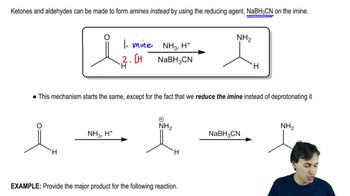
Reduction reactions involve the gain of electrons or hydrogen, or the loss of oxygen in a chemical species. In organic chemistry, this often refers to the conversion of carbonyl compounds (like ketones and aldehydes) into alcohols. Sodium borohydride (NaBH4) is a common reducing agent used for this purpose, as it selectively reduces ketones and aldehydes to their corresponding alcohols.
Video consigliato:
07:12
Reductive Amination

Sodium Borohydride

Sodium borohydride is a powerful and selective reducing agent commonly used in organic synthesis. It is particularly effective for reducing ketones and aldehydes to alcohols without affecting other functional groups. Its mild nature allows for the reduction of sensitive compounds, making it a preferred choice in laboratory settings for producing alcohols from carbonyl precursors.
Video consigliato:
03:19
Sodium Alkynide Alkylation

Structure of Alcohols

Alcohols are organic compounds characterized by the presence of one or more hydroxyl (-OH) groups attached to a carbon atom. The structure of the starting carbonyl compound influences the structure of the resulting alcohol. For example, the reduction of 4-tert-butylcyclohexanone will yield a tertiary alcohol, while the reduction of acetophenone will yield a secondary alcohol, reflecting the different carbon environments in these compounds.
Video consigliato:
01:01
How to name alcohols